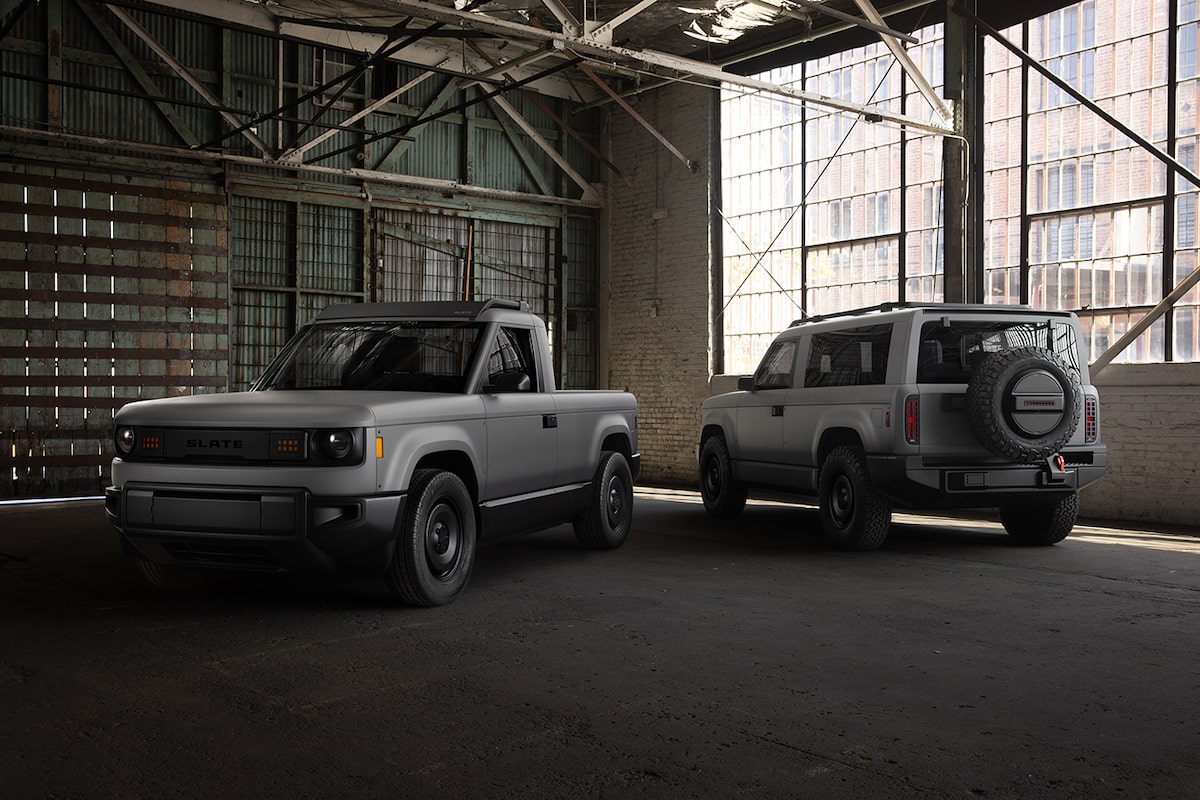
Slate says the pickup will start at US$27,500 and it can be converted to an SUV with an optional package.Courtesy of manufacturer
Cars are too damn expensive. You’ve been saying it. I’ve been saying it. And now a new American startup called Slate Auto is saying it too. That’s the premise behind the company’s pitch to sell a bare-bones US$27,500 electric pickup truck and SUV.
The automotive industry has “abandoned the majority of Americans,” said Slate’s chief commercial officer Jeremy Snyder during the brand’s coming out party in California in late April. The sentiment applies equally here in Canada where the average transaction price of new cars had climbed to more than $65,000, according to AutoTrader.
After U.S. federal incentives – at least as they are now – the price of Slate’s electric pickup would drop to US$20,000 before tax. That’s $27,700 in our money, or $38,000 without those incentives. That makes this truck cheaper than the dinky Fiat 500e, $10,000 less than the Chevrolet Equinox EV and roughly $24,000 less than Ford’s cheapest electric pickup in Canada.
Whether Slate can follow through on its promise of an affordable EV is anybody’s guess.
The company is backed by Jeff Bezos and some other billionaires, but the failures of EV upstarts Fisker, Canoo, Faraday Future, Byton and Lordstown Motors loom in the background. Whether Slate joins them in the graveyard of automotive history is beside the point.
The exciting thing is the idea, proof of concept for a cheap(er) electric car, one that could be made in North America, not in China.
The Slate pickup is much smaller than a Ford F-150, but is roughly the same size as a small pickup truck from the 1980s.Courtesy of manufacturer
Judging by the positive reaction online, the company is onto something. People want cheaper cars but the auto industry seems incapable – or perhaps merely uninterested – in delivering. U.S. President Donald Trump’s trade war is only exacerbating the affordability problem.
Meanwhile, auto executives are too busy trying to turn cars into infinitely monetizable software platforms with pay-to-play automated-driving systems and hundreds of features drivers never use. (Did you want to buy a car with an Invigorating Wellness Mode and 72 colours of ambient lightning or do you want safe, reliable transportation?) Nobody wants more and bigger touchscreens, I swear.
So, perhaps now the big brands will take note. “The industry has been so focused on autonomy and technology in the vehicle, it has driven prices to a place that most Americans simply can’t afford,” Slate’s Snyder said before the brand’s boxy little pickup finally rolled onto the stage.
So, how is Slate planning to pull this off? It’s simple: do less. The company is stripping away everything from the vehicle that’s not a car, reducing the automotive form to the bare necessities. For example, the nameless pickup – a blank Slate – has wind-up windows and no touchscreens or infotainment system. Stereo speakers are optional; owners can bring a portable Bluetooth speaker into the car if they want.
“Instead of spending time developing an [infotainment] operating system that would become quickly out of date, and adding cost and complexity with another screen, we went the other direction,” said Slate’s head of design, Tisha Johnson.
The solution? A phone mount on the dashboard. Perfect. Like the old Ford Model T, the Slate comes in any colour you want as long as you want grey. The body panels are plastic, like old Saturns. There’s no need for a multimillion-dollar paint shop at the factory. A glorified sticker kit lets customers wrap the vehicle in a colour of their choosing, if they so desire and want to pay extra for it.
The Slate pickup or SUV don’t come with a touchscreen or infotainment system. Drivers will just use their phone.Courtesy of manufacturer
A separate bolt-on kit – sold as Ikea-style flatpack – lets owners convert the Slate pickup into a five-seat SUV with a hardtop, or Jeep Wrangler-style SUV with open-air seating. Going against the trend to ever larger vehicles, the Slate is small. It’s dwarfed by the modern Ford F-150, but about the same size as pickups from the 1980s. Reducing the bloat keeps costs down, so does having a single rear-drive motor and a small battery.
Slate estimates the truck’s 52.7-kilowatt-hour battery pack is good for 241 kilometres of estimated range. An optional 84.3-kilowatt-hour battery bumps the range to 386 kilometres. Such modest driving range will scare off some buyers but should be enough for many drivers – especially given the truck’s appealing price.
“Seventy per cent of Americans make $100,000 or less per year,” said Snyder. “The math pencils out that in a responsible budget one should spend $400 or less on their car payment per month. The average new car payment today is $742.”
In Canada, $70,500 was the median after-tax income of families and unattached individuals in 2022. Globe and Mail finance columnist Rob Carrick’s personal rule was to cap monthly car payments at $400.
But, the average new car payment is double that: approximately $850 for new loans and $760 for new leases, according to J.D. Power Canada data.
“The definition of what’s affordable is broken,” said Slate’s chief executive officer Chris Barman at the vehicle’s unveiling.
And, whether Slate is the company to fix the affordability problem, she’s right; it’s past time car companies woke up to that fact and got back into the business of making transportation, not tech.