In 2022, Victoria Oladosu asked students in a secondary school in Nasarawa if they could use a desktop computer. They all said no. The experience, which occurred during her compulsory National Youth Service Corps (NYSC) year, would become a turning point.
“It was then that I knew I had to do something to solve the problem,” she said. Her solution was an initiative to equip the students with digital skills by bringing trained professionals to teach them. Later, she shifted her focus to becoming an advocate for STEM education in secondary schools in the north.
What began as a volunteer-led initiative to teach digital skills has since evolved into Stem-A-School, an education technology startup focused on increasing awareness and access to science, technology, engineering, and mathematics (STEM) education.
According to the World Bank, sub-Saharan Africa needs about 2.5 million more engineers to meet its development goals. The institution stressed that STEM skills are essential for countries navigating the demands of automation, artificial intelligence, and digital transformation.
Yet despite this urgency, STEM education in Nigeria, like in most parts of Africa, remains limited. According to the World Bank, less than 25 percent of higher education students are enrolled in STEM fields across Africa.
In 2018, Nigeria’s Ministry of Education published a new National Policy on Science and Technology Education.
“The role of Science and Technology Education is central to the industrial development of any country. There is therefore the need to re-position the delivery of Science and Technology Education in Nigeria …,” wrote Sonny Echono, the then permanent Secretary of the ministry.
However, implementation has been low. Oladosu believes part of the gap lies in early exposure and engagement, a stance echoed by the World Bank, which noted that enhancing awareness and access is critical to closing the STEM gap.
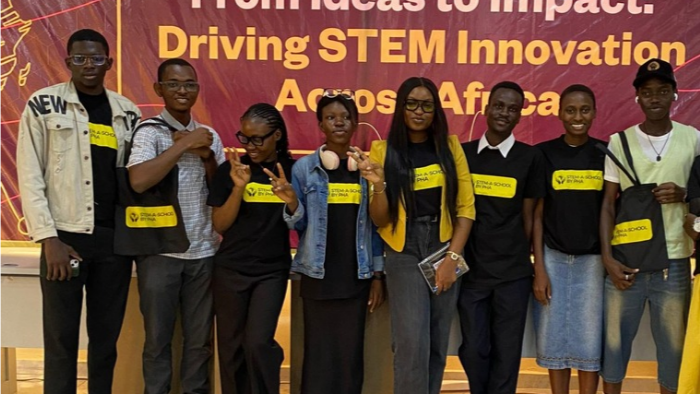
Since launching Stem-A-School, she says the initiative has reached more than 3,000 students across the north. In May 2025, the startup extended its reach with a STEM awareness tour of five universities in Osun State, including Obafemi Awolowo University, Oduduwa University, Osun State University, Bowen University, and Redeemer’s University, drawing in over 2,000 students.
“The goal has always been to expand to more schools, and once we got that opportunity, we took it,” she said.
Read also: FG to empower 10 million women through STEM – Minister
The tour featured talks from policymakers and academics, including Ayofe Olatunji (commissioner for Innovation, Science and Technology, Osun State), Lateef Alani (coordinator, Lagos State Science Research and Innovation Council Secretariat), Olanrewaju Adesina (Dean of Engineering, Redeemers University), and Janet Jooda (Computer Engineering lecturer, Redeemers University).
“We live in an era of unprecedented technological transformation,” said Alani of Lagos State. “AI, Robotics, Blockchain, and renewable energies are reshaping economies. But as we embrace this 4th industrial revolution, we must ask where Nigeria was in the past industrial revolutions and how we can ensure that we don’t miss out this time around.”
Jooda of Redeemers echoed this stance but argued that Nigeria’s young population will give it leverage in the 4th industrial revolution. “We have the population, but we need to harness it well. We can’t do this without STEM,” she said.
According to the state government, it is making efforts to close its STEM gap. Olufunke Jolayemi, permanent secretary at the state’s Ministry of Innovation, Science and Technology, noted that the state is partnering with schools, equipping tech hubs, and hosting hackathons as part of its broader strategy.
Despite the momentum that Stem-A-School has garnered, challenges remain. While the startup’s conferences and workshops have created interest, sustaining that engagement has proven harder. Many students reach out afterwards seeking guidance or further learning opportunities.
“We cannot stop at awareness,” Oladosu said. “To make a real impact, we need to give students consistent access to STEM learning tools.”
In response, Stem-A-School is preparing to launch its first STEM lab, starting with a university pilot. The lab will provide hands-on experience in fields like robotics and programming, moving the initiative beyond one-off events.
“There is a lot of work ahead,” Oladosu said. “But I believe we are making progress, one school and one student at a time.”