
The startup failure rate is nearly 90%. This ratio fluctuates between 20% and 90% depending on the years and the startup’s survival in the market.
Approximately one in five close their doors within the first year of operation. Particularly, in the United States, the overall failure rate is around 80%.
These statistics highlight the challenges that new businesses face, including insufficient funding and a lack of market demand.
Startup Failure Rates 2026 (Top Picks)
- Approximately 90% of the startups fail.
- 1 in 5 startups fail within their first year of operation.
- Over 20% fail in their first year after launching.
- In the United States, 80% of startups fail.
- On average, 65% of startups manage to survive for 15 years.
- First-time entrepreneurs have an 18% success rate when launching a startup.
- Nearly 42% of startups fail because they fail to meet market demand with their product.
- Around 14% of startups fail due to poor marketing.
How Many Startups Fail?
- The latest data reveals that 90% of startups fail.
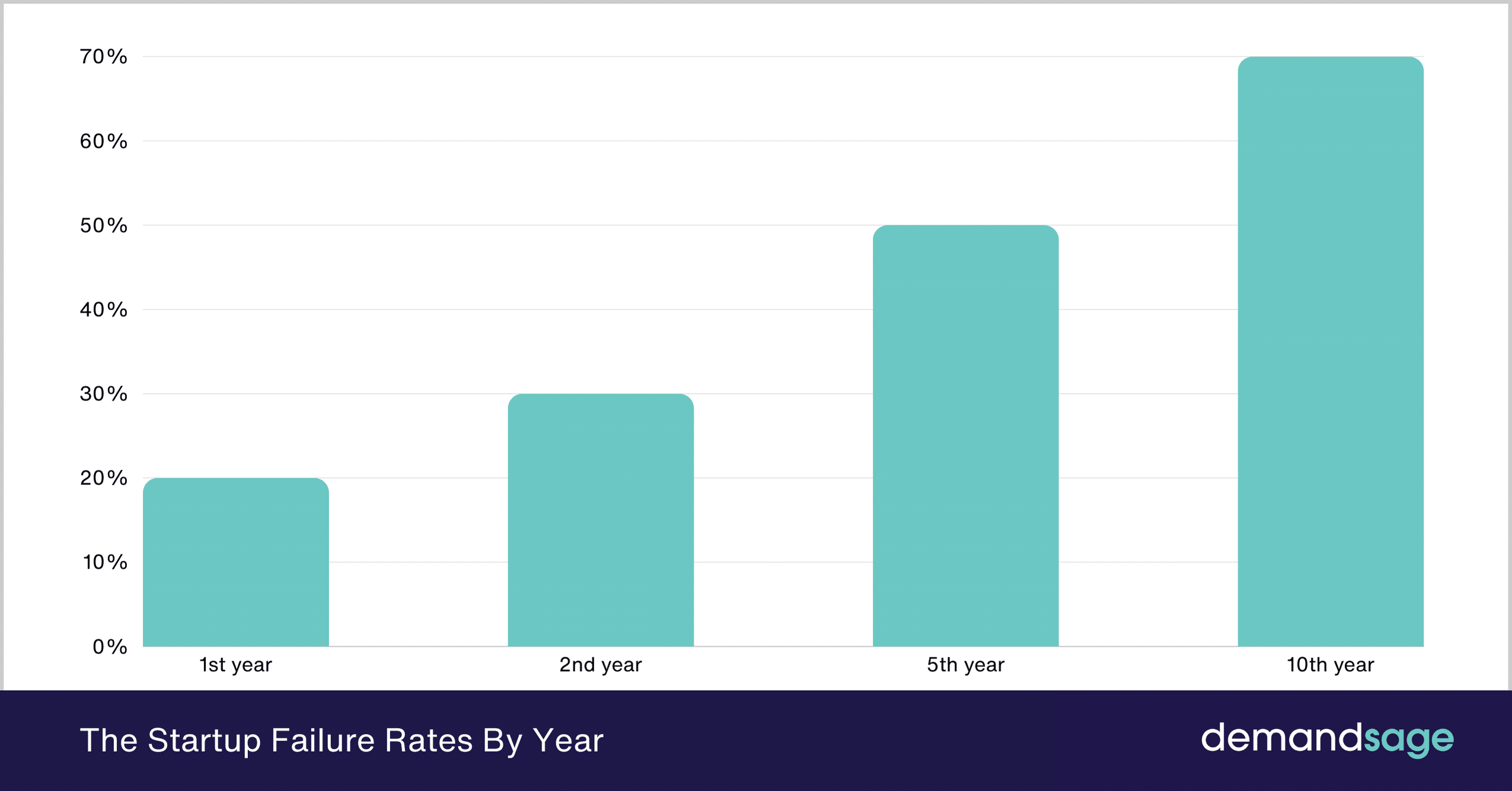
Of these, over 20% fail within the first year of establishment. Companies with 11 to 50 employees face a higher risk of failure. Additionally, 70% of startups fail within five years of establishment.
The following table breaks down the startup failure rates by year of establishment:
| Until The End Of The Year | Failure Rate |
|---|---|
| 1st year | 20.4% |
| 2nd year | 30% |
| 5th year | 50% |
| 10th year | 70% |
- Only 6% of the startups that appeared on Shark Tank have shut down.
- 75% of venture-backed companies never return the cash to the investors.
- In 30 to 40% of cases of startup failure, investors lose their initial investment.
- Only 0.05% of the startups receive VC funding.
- 43% of entrepreneurs are concerned about the failure of their startups.
- Up to 80% of e-commerce startups fail. The remaining 20% succeeded significantly.
- Approximately 80% of startups fail in the United States in the long run.
- However, around 77% of entrepreneurs in the startup mentioned that they failed due to COVID-19.
Sources: HBS Edu Newsroom, CFI, McKinsey, Startups Magazine
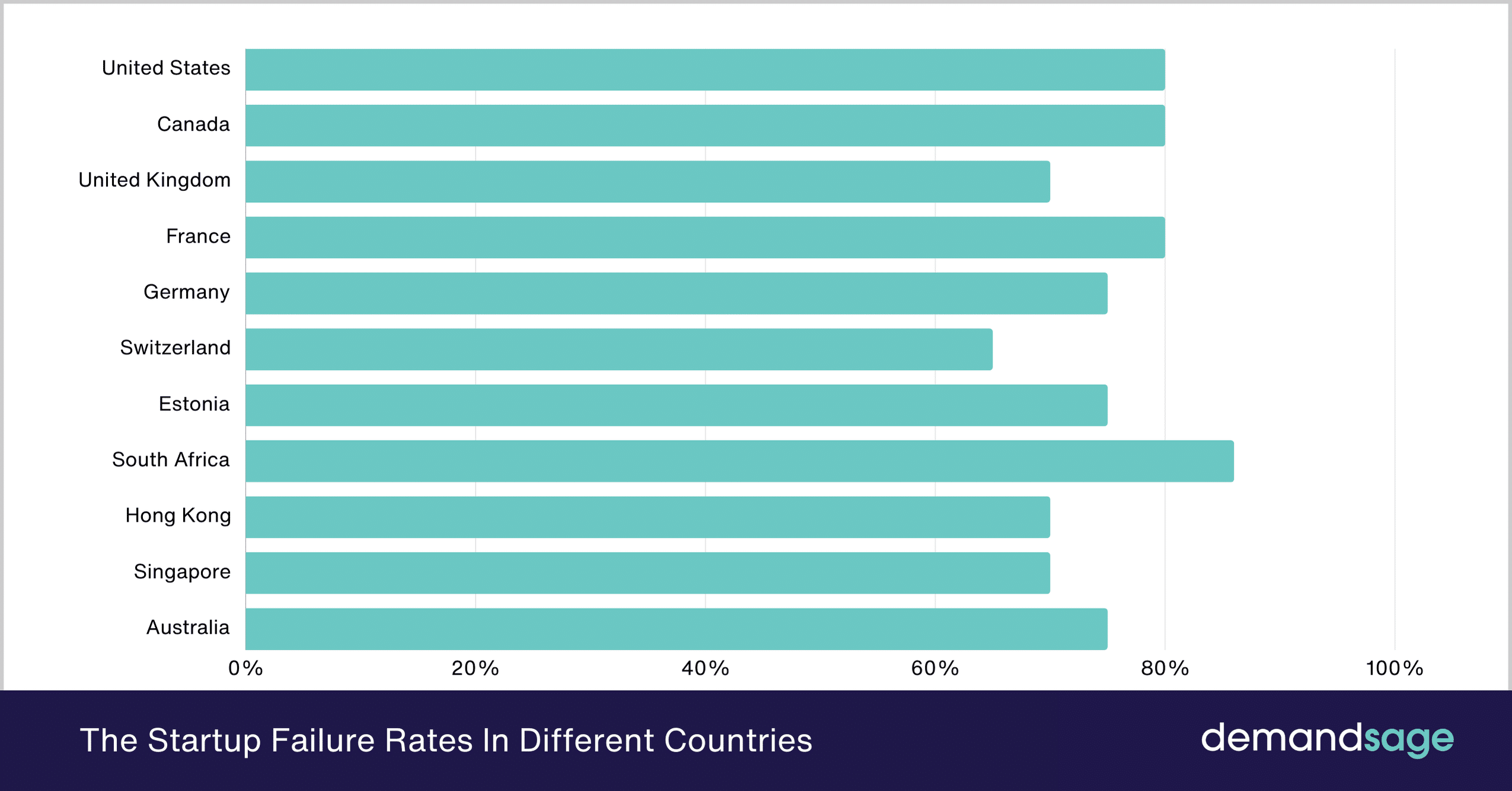
The following table displays the startup failure rates in different countries around the globe.
| Country | Startup Failure Rate |
|---|---|
| United States | 80% |
| Canada | 80% |
| United Kingdom | 70% |
| France | 80% |
| Germany | 75% |
| Switzerland | 65% |
| Estonia | 75% |
| South Africa | 86% |
| Hong Kong | 70% |
| Singapore | 70% |
| Australia | 75% |
We have further highlighted the failure rates of startups at different stages.
| Business Type / Years | Failure Rate (%) |
|---|---|
| Startup (Overall) | ~90% |
| New Business (1 year) | ~20% |
| New Business (2 years) | ~30% |
| New Business (5 years) | ~50% |
| New Business (10 years) | ~70% |
| VC-Backed Startups | ~75% |
(‘~’ symbol indicates the approximate value)
Source: Bureau of Labor, Harvard Business School
- For new businesses, the 1-year survival rate is nearly 80%, the second-year survival rate is almost 67–70%, the 5th-year survival rate is around 48–55%, and the 10th-year survival rate is between 33–37%.
- Less than 1% of startups achieve Unicorn status worldwide.
- A typical startup has a nearly 99% failure rate in achieving the $1 billion valuation benchmark.
What Are The Success Rates Of The Startup?
- Just 10% of the startups become successful in the long run.
- Small business owners starting a company for the first time have a success rate of 18%.
- Approximately 78% of new small businesses survive for at least one year.
- Additionally, nearly 50% of new small businesses survive for 5 years.
- Business owners who have started successful businesses in the past have a success rate of 30% for their new startup venture.
- Two founders increase the chances of a startup being a success by 30% due to more investment and a higher growth rate.
- 40% of the startups are profitable.
- 70% of the startups in the US are launched from home.
- Up to 66% of small businesses outsource tasks to other small businesses.
- Gaming startups have a 50% success rate.
- There are around 1000 unicorn companies around the world.
- Currently, the US has the most unicorns with 755 companies, representing over half of all unicorns worldwide.
- China ranks second with 313 Unicorns, followed by India with 61, the UK with 48, and Israel with 27 Unicorns.
Sources: U.S. Bureau of Labor (BLS), Hostinger, Statista, Pitchbook
How Much Does It Cost To Setup A Startup?
- On average, starting a new business costs the owners approximately $3,000.
- The median total startup cost to open a restaurant is $375,500.
- Lower-quartile restaurants spend around $175,500 to start.
- Upper-quartile restaurants spend approximately $750,500 to start.
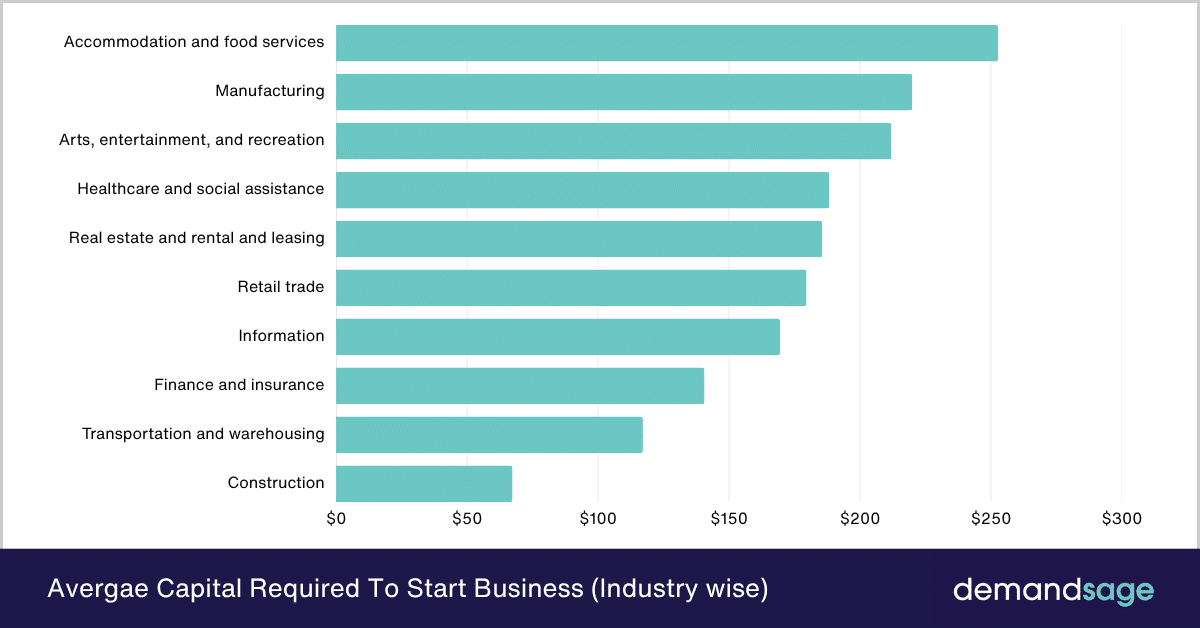
Here, let’s take an overview of the average startup costs by Industry.
| Industry | Average Capital Needed to Start a Business |
|---|---|
| Accommodation and food services | $252,713 |
| Manufacturing | $219,982 |
| Arts, entertainment, and recreation | $211,970 |
| Healthcare and social assistance | $188,336 |
| Real estate and rental and leasing | $185,630 |
| Retail trade | $179,585 |
| Information | $169,457 |
| Finance and insurance | $140,628 |
| Transportation and warehousing | $117,116 |
| Construction | $67,349 |
Source: Lending Tree
Note: These are average startup costs; the price changes depending on the business size, materials required, and the location.
- Payroll is the most crucial startup cost. It may require $300,500 on average per 5 employees.
- 58% of the small businesses in the United States need less than $25,000 to start their venture.
- 77% of the startups used personal funds to finance their businesses.
- Startups in the capital industry, such as Airbnb and Uber, require more than $1 billion.
Source: Small Business Trends, Failory, Restaurant Owner, Bankrate, Pitchbook, Embroker, Empower News
Startup Funding And Investor Statistics
- Approximately 18% of global VC funding went to European startups in Q1 2024.
- A venture capital firm receives more than 1,000 proposals per year on average.
- 44% of new businesses are financed from business loans, credit card debts, and personal cash flow.
- Around 75% of loans, lines of credit, and advance cash are given by small banks.
- Employee capital in 33% of startups is less than $10,000.
- $250,000 is the startup capital for 12% of the employer firms.
- In 2017, venture capital funding reached the amount of $155 billion.
- Only 1% of startups emerge as unicorn startups like Uber, Slack, Airbnb, Stripe, etc.
- In the U.S., all-female founder teams have received venture-capital funding of 2.4%, which is almost similar to the 2.3% VC share in 2018.
Sources: Crunchbase, Gov Info, Federal Reserve Gov, Embroker, Advocacy Sba, NVCA, CB Insights, HKS Harvard
What Are The Top Reasons For Startup Failure?
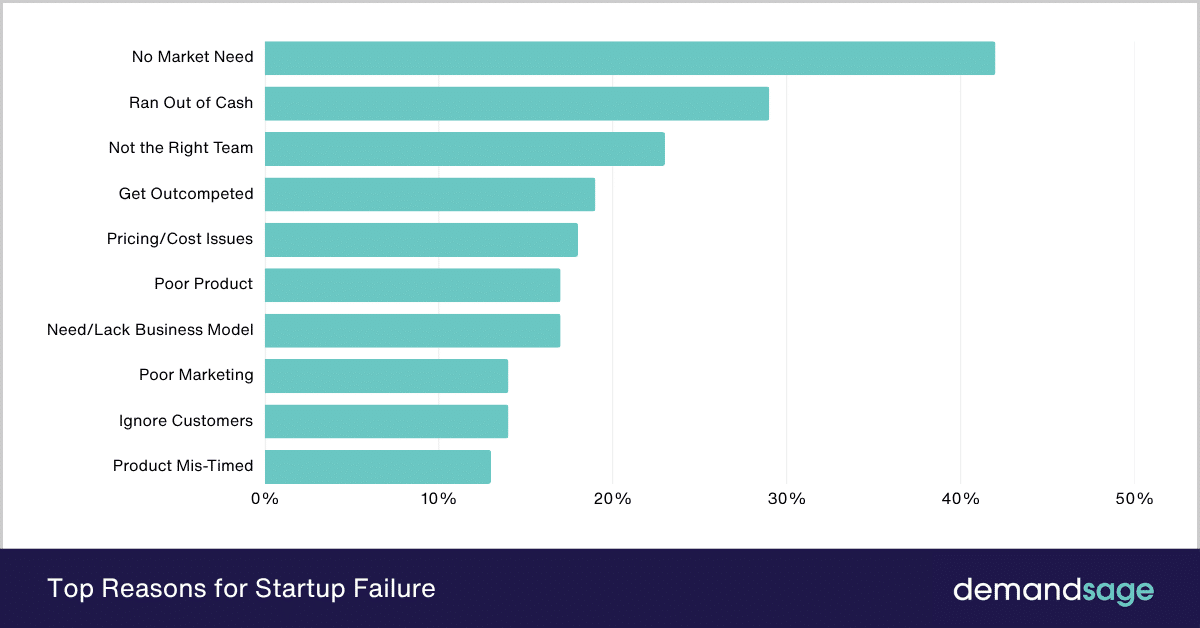
- 42% of startups fail because there is no market need for their product.
- Approximately 23% of startups fail because they don’t have the right team.
The following table breaks down the reasons for the failure of startups.
| Reason for Failure | Percentage |
|---|---|
| No Market Need | 42% |
| Ran Out of Cash | 29% |
| Not the Right Team | 23% |
| Get Outcompeted | 19% |
| Pricing/Cost Issues | 18% |
| Poor Product | 17% |
| Need/Lack Business Model | 17% |
| Poor Marketing | 14% |
| Ignore Customers | 14% |
| Product Mis-Timed | 13% |
Source: CB Insights Report
- 29% of the startups failed due to financial issues, cash flow problems, and improper management of finances.
- Besides this, 13% lose focus in the startups, and around 9% lack passion.
- Approximately 13% fail due to mismanagement and disharmony among team members or investors.
- 8% face issues such as no financing for their startups, not using the network or advisors, or legal challenges.
The Failure Rate Of Startups By Industry
The failure rates of startups vary in different industries. Some industries have lower failure rates, while some have higher. In the following section, you will come across the failure rates of the startups observed across different industries.
The following table highlights the number of startup failure rates in different industries.
| Industry | Startup Failure Rates |
|---|---|
| Finance, insurance, and real estate | 42% |
| Education and health | 44% |
| Agriculture | 44% |
| Services | 45% |
| Wholesale | 46% |
| Mining | 49% |
| Manufacturing | 51% |
| Construction | 53% |
| Retail | 53% |
| Transportation and utilities | 55% |
| Information | 63% |
Fintech Industry
The fintech industry is one of the fastest-growing industries in today’s era. However, most startups fail in the industry due to immense competition and low success rates.
Here are a few stats related to the failure rates of startups in the fintech industry.
- 75% of the fintech startups fail if they are venture capital-backed businesses.
- The investment of venture capital firms in the global fintech businesses went from $1.8 billion in 2011 to $30.8 billion in the year 2018.
- The fintech industry receives $50 billion every year in the form of investments.
- 80% of the financial institutions in the United States are partners with fintech service providers.
- More than 8,775 fintech startups are in the United States.
- The valuation of the largest fintech company in the world is $131 billion.
- The global value of the fintech company was $309.98 billion in 2022.
Sources: McKinsey, Statista, PR Newswire
Real Estate Startups
Starting a real estate business requires a large investment and determination. In total, 42% of the startups fail in the real estate industry.
The primary reason identified was a lack of cash flow. Let us take a look at some other interesting facts related to the failure rates of startups in the real estate industry.
- Real estate businesses have approximately a 34.8% failure rate within the first 5 years, making them one of the more stable industries.
- $1.9 billion was generated by real estate startups in the year 2019.
- In 2023, 392 U.S. real estate firms sold more than $1 billion in real estate, down slightly from 435 firms in 2022.
Sources: U.S. Bureau of Labor Statistics, Housing Wire
IT And Tech Industry
IT and the tech industry are the leading industries in today’s age. They work with other industries to make the world more automated and reduce human labor. But the start-ups in these industries have more chances of failing.
Here are some interesting stats related to startup failure rates in the technology industry.
- 63% of the tech businesses fail within the first 5 years of establishment.
- In 2024, only 28% of software and online services companies survive to reach $100 million in revenue, meaning 72% fail before this milestone.
- 97% of tech startups fail to reach $1 billion in revenue.
- Out of nearly 3,000 companies analyzed, only 17 achieved this as independent companies.
- 85% of high-growth tech companies (supergrowers) are unable to maintain their growth rates, and once lost, less than 25% can recapture them.
- The technology market in the United States is valued at $1.6 trillion.
- On average, tech startup founders are 39 to 45 years old.
Sources: TechCrunch, McKinsey 1, CB Insights
Construction Industry
The construction industry has gained demand in the last decade. The startups in this industry are comparatively low due to the large amount of cash flow required to keep the startups growing.
Here are a few stats related to the failure of startups in the construction industry.
- 25% of construction startups fail within the first year of establishment.
- The construction industry has a 73.4% failure rate over 10 years, rising to 83% over 20 years.
- 83% of construction firms that opened in 2001 had closed within 20 years, with nearly half failing in just three years.
- The fastest-growing sector in the construction industry is the residential housing sector.
- It is expected that the contribution of AI in the construction sector will increase profit by 71%.
Sources: Bureau of Labor Statistics, Embroker, CFMA
Future Of The Startups
OpenAI is now a popular platform in the field of artificial intelligence (AI), widely used and a well-funded startup valued at over $12 billion. As per the last recorded data, its net worth is over $500 billion.
Global startup funding in Q2 2025 reached approximately US$91 billion.
In Q1 2025, global venture funding totaled $113 billion, which is the highest quarter since 2022. Overall, many top companies are funding startups with unique ideas.
Fintech startups have grown by nearly 30,000 globally in 2024, compared to 12,200 in 2019. This shows the growing demand for this sector in the future.
In the future, Technology trends like automation, robotics, and frontier tech will become core to startup offerings.
Suggestion: If you are planning for a startup, check out the best products that you can sell online in 2026 to boost your e-commerce business.
Sources: Crunchbase 1, 2, Statista, McKinsey
Conclusion: Nearly 90% Of The Startups Fail
Approximately 90% of startups fail due to a lack of focus, financial issues, mismanagement, and many other factors. Around 20% of the startups close their business in the first year only.
70% of startups fail between the second and fifth year. The leading cause of failure is a lack of market need for the product, which accounts for nearly 42% of closures, followed by running out of cash and team issues.
However, it is estimated that the future of startups with AI will remain stable in the long term. Trends such as automation, robotics, and tech can become key factors in startups’ success and funding offerings.
Source link