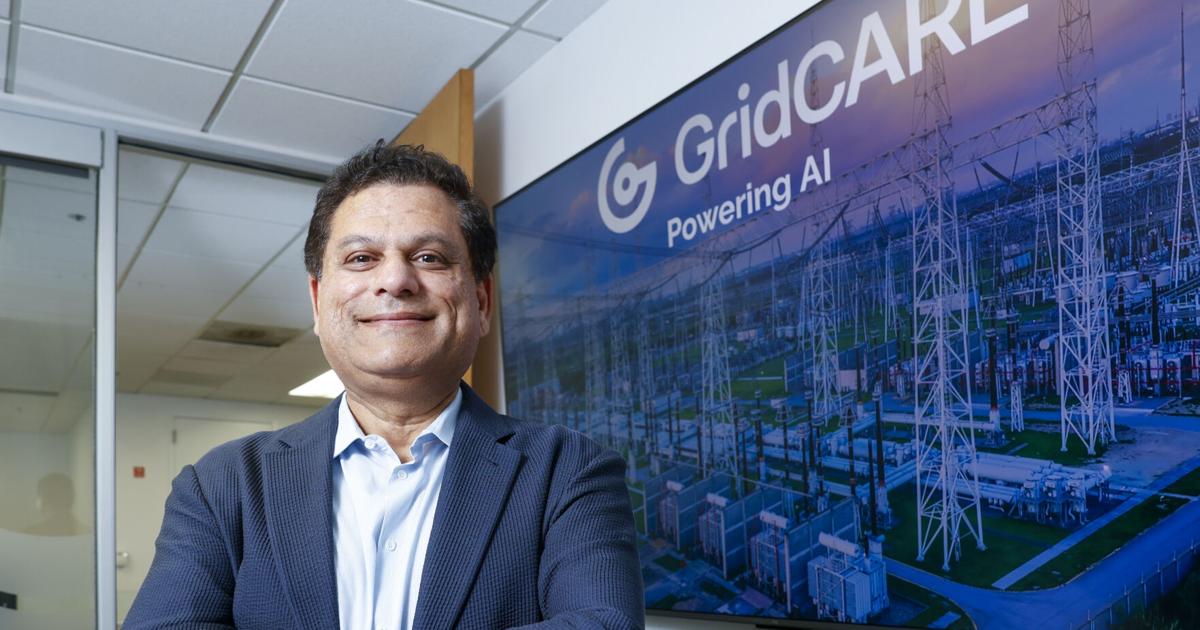



The surging demand for energy driven by the artificial-intelligence boom has created a big challenge for the nation’s electrical grid, utilities and data-center operators.
But the founders of Silicon Valley startup GridCare think they’ve developed a better way to power up data centers — by tapping into the unused electricity that’s already available.
“The cheapest and the cleanest megawatt is something that you don’t have to build, and the fastest megawatt is [one] that already exists in the grid,” Amit Narayan, the Redwood City company’s CEO and co-founder, told The Examiner.
The ability of the grid to accommodate additional data centers and artificial-intelligence-related demand is crucial to San Francisco’s booming AI industry. City-based companies such as OpenAI and Anthropic depend on facilities packed with computers running the latest high-powered chips — typically from Nvidia — to train and run their models.
Those AI companies and others are expecting to need new data centers to field the growing number of queries to Claude or ChatGPT and the rising number of images generated by Sora.
All that adds up to increased electricity demand. Last year, Lawrence Berkeley National Laboratory forecast that the amount of U.S. electricity usage consumed by data centers could more than triple from 2023 to 2028 due to AI, going from 176 terawatt hours — 4.4% of total U.S. electricity usage — to 580 terawatt hours, or 12%.
Utilities plan around peak demand. But they see that kind of demand infrequently, typically during a few hours in the evening on the hottest days of summer when the amount of energy generated by solar panels tails off and people go home and turn on their air conditioners, said Narayan, who has long experience working with utilities to address such demand.
On average across the year, the demand U.S. utilities see is equivalent to only about 31% of their capacity, he said. And for some electricity providers, the average can be as low as 17%, he said.
In recent years, there have been a growing number of what Narayan calls “tools” that theoretically would allow utilities to accommodate surging demand and new loads without overloading the grid.
In California and other states, there are a growing number of industrial-scale battery back-up systems that soak up extra electricity from solar arrays and then provide power when the sun goes down. There are also what are called virtual power plants — coordinated systems that can include everything from residential solar arrays to smart appliances and industrial equipment that can provide supplemental power to the grid or reduce load as needed.
To date, though, utilities have had a tough time modeling how those tools affect their actual capacity at any particular time, Narayan said. As a result, they basically plan for the worst-case scenario.
“Right now, they don’t have the capability to analyze the grid on an hour-by-hour basis,” he said.
That’s where GridCare comes in. It takes data it collects on historical grid usage for particular utilities, as well as their planned upgrades and rate information, to forecast hourly demand and capacity. Narayan, who founded the company last year, and his team have designed the system to help utilities figure out what capacity they already have so they can allocate it to data centers, allowing the latter to get connected quicker.
GridCare’s system uses large-language models to parse some of that data from regulatory documents, check that data for errors and help create documents for its own filings, Narayan said. It then uses a machine-learning model to create trillions of scenarios to figure out the best way to model demand, he said.
“The best use case for AI is for the grid, so that grid can become available for AI,” Narayan said.
This isn’t all just theoretical. Last month, Portland General Electric, an Oregon utility that serves some 950,000 customers, announced it had worked with GridCare to identify 80 megawatts of surplus capacity that could be freed up for data centers in Hillsboro, an existing data-center hub outside Portland, Ore.
Factoring in new transmission lines it’s building, PGE said it now believes that thanks to its work with GridCare, it can add about 400 megawatts of additional load by 2029, according to Larry Bekkedahl, the utility’s senior vice president of advanced energy delivery.
That’s significantly more additional capacity than it previously expected those transmission lines would provide, Bekkedahl said.
“As we bring on new transmission, we’re able to do even more than we thought,” he said.
PGE has already seen a spike in demand. After more than 20 years of electricity usage growing at 1% per year or less, it started to see a surge in residential and commercial demand about four years ago, thanks to customers buying electric vehicles and heat pumps, along with efforts to electrify buildings, Bekkedahl said.

The last week of the month brings exhibition baseball, a chocolate festival and a craft fair with more than 250 vendors to San Francisco
Joby Aviation conducted a series of test flights with its new-style aircraft last week — and if all goes well, local residents could be hailing them by late next year
Board of Supervisors president says he’ll introduce legislation that would allow pot retailers to offer food, drinks and shows in effort to boost sector’s economic health
But within the last two years, industrial electricity demand — which accounts for about a third of all usage on PGE’s grid — started growing by 11% to 15% per year thanks to data centers, he said. That kind of growth is difficult to accommodate, he said.
If PGE were to have to build new transmission lines so it would have more power it could deliver to those data centers, they might be waiting until 2030 or even 2035, Bekkedahl said. Transmission equipment is in high demand and short supply right now, and construction and permitting can take a while, he said. But GridCare’s system looks like it can help get such facilities online much sooner, he said.
And there’s another set of benefits of GridCare’s system, he said — it can help increase utilization, keep peak usage down, and allow utilities to avoid or defer building pricey new upgrades, he said.
“Economically, it keeps the entire system at a much lower cost and making it affordable for everybody,” Bekkedahl said.
But to the extent that there is extra capacity on the grid, that capacity ought to be dedicated to ramping up electrification efforts, said Mark Jacobson, who focuses on energy policies as a professor of civil and environmental engineering at Stanford University.
To complete the transition from fossil fuels, electricity is going to be needed to charge electric cars and to power heat pumps and induction stoves. It could also be converted into heat for use in industrial processes or used to produce hydrogen for fuel.
Replacing fossil fuels will aid the fight against climate change, reduce deadly and costly emissions and enhance the nation’s energy security, Jacobson said. As such, it will benefit lots more people than building new data centers, he said.
Using excess electricity to power AI data centers is waste of energy, Jacobson said, comparing them to bitcoin mining.
“It’s not like you can’t use [surplus capacity] for data centers. Sure you could,” he said. “But there’s all sorts of other competing options as well. The question is: Are data centers … really useful? Is that the best option, or do we try to get rid of emissions?”
Although GridCare works closely with utilities and depends on their data, its actual customers are data-center operators, Narayan said. Such companies are more than willing to pay up to speed the time needed to make their facilities operational, he said. Already, GridCare counts one of the top three cloud-computing companies and several of the second-tier data-center businesses as customers, Narayan said, although he declined to name the companies.
GridCare expects to end the year with about 175 megawatts of power it’s helped contract to data-center operators, he said. That’s above its target of 100 megawatts, he said.
It also expects to record $10 million in revenue for the year, up for $0 last year, he said.
“We are pretty excited about that,” Narayan said.
The company’s backers appear to be excited about its potential. GridCare announced in May it had raised $13.5 million in a seed round co-led by Xora Innovation, a venture-capital firm based in Singapore that focuses in part on early-stage startups in the energy and AI sectors.
Xora had previously invested in Peak Energy, which has developed a sodium-ion battery that’s designed to provide backup power for data centers and other industrial uses, and in Amperesand, which has created a solid-state transformer that can send energy to and receive it from the grid, according to Phil Inagaki, the firm’s managing partner and chief investment officer. Those companies and others promise to provide data centers and utilities extra flexibility to manage power demand, he said.
GridCare’s system is a complement to such tools, Inagaki said. And it’s coming along at a time when data centers in particular are more open to embracing ways to moderate their impact on the grid due to perceived power constraints, he said.
“We felt the timing for GridCare was really perfect,” he said.
What’s next for the company is going beyond proofs of concept and demonstration efforts as it did with PGE to full-bore revenue mode, Inagaki said. He expects GridCare to start seeing significant revenue next year
”We know it works,” he said. “Now [Narayan] needs to really start scaling into larger engagement [with customers], proving out the full business model.”
If you have a tip about tech, startups or the venture industry, contact Troy Wolverton at [email protected] or via text or Signal at 415.515.5594.
Source link