

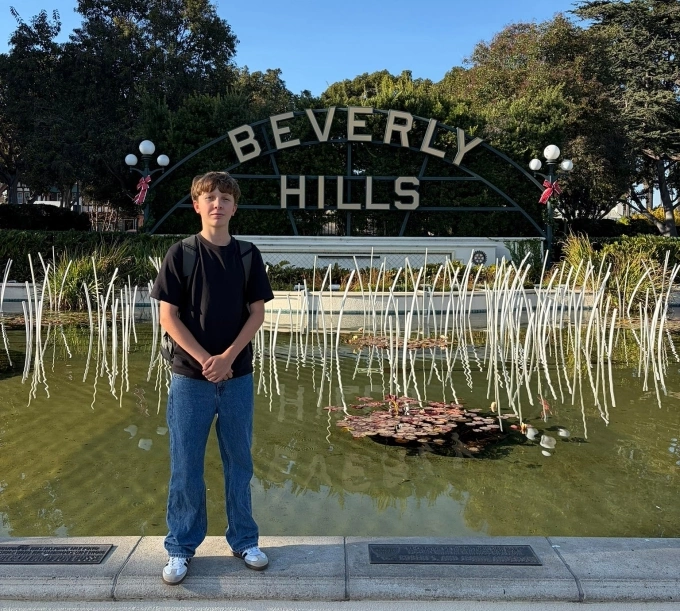
Dobroshinsky, the founder of BeyondSPX, an AI-driven financial research platform, is one of three teenage entrepreneurs featured in a recent Wall Street Journal report on the rise of teen tech founders. Like many startup founders, he spends late nights and early mornings working on his company. What sets him apart is what happens in between. From 8:00 a.m. to 2:55 p.m., Dobroshinsky is still a high school student.
He said the idea for BeyondSPX, which generates financial reports on small- and mid-cap publicly traded companies, took shape toward the end of eighth grade.
“Around the end of eighth grade, I wanted to make some sort of business,” Dobroshinsky told The Wall Street Journal. “I just spent a long time thinking about what problems there are that could be fixed with AI.”
|
|
Nick Dobroshinsky, 15, founder of BeyondSPX, an AI-based financial research platform. Photo courtesy of Dobroshinsky’s LinkedIn |
Encouraged by suggestions from his parents, he began building the platform with minimal traditional coding. Dobroshinsky said he has written only about 10 lines of code himself, instead relying on AI tools such as Anthropic’s Claude, along with models like ChatGPT and Gemini, to design the software architecture.
He has taken a similarly unconventional approach to marketing. Rather than hiring a team, he deploys Reddit bots that promote BeyondSPX in investment-related discussions. “If someone asks for the best investing tools, then my bot will comment, ‘There’s a bunch of investing tools and BeyondSPX is one of them,’” he said.
The platform now attracts more than 50,000 monthly users, and Dobroshinsky plans to introduce monetization features in the future.
This low-code, AI-assisted approach is increasingly seen not as a shortcut, but as a preview of how software development may evolve. Industry leaders have begun to frame it as a new engineering paradigm, often referred to as “vibe-coding.” Alexandr Wang, Meta’s chief AI officer, has urged teenagers interested in tech careers to embrace the approach fully.
“If you are 13 years old, you should spend all of your time vibe-coding. That’s how you should live your life,” Wang recently said on the TBPN podcast, as quoted by Fortune.
In Wang’s view, the mindset behind the trend is akin to the “be there early, go deep” stage that famous tech founders such as Bill Gates and Mark Zuckerberg experienced. Gates himself has recalled sneaking out of his parents’ house as a teenager to spend hours coding, taking advantage of free computer access given to him by a local Seattle company, according to CNBC. For today’s teenagers, that “free access” is the chat interface of a large language model.
For today’s teenagers, that free access no longer requires a physical lab. It exists in the chat interface of a large language model.
A recent Business Insider “Young Geniuses” series, which profiles teenage and twenty-something leaders, innovators, and entrepreneurs, highlights a common pattern: young founders moving quickly, raising serious capital, and stepping away from traditional paths. With AI lowering barriers to entry, urgency has become a defining feature of this new wave of entrepreneurship.
|
|
14-year-old eighth-grader Alby Churven is building AI tool that generates app and website code. Photo courtesy of Churven’s X |
For 14-year-old Australian Alby Churven, that urgency took shape after watching teenage app builders gain traction on social media. He recently submitted a video application to Y Combinator, which has no minimum age requirement, that included a small teenage in-joke and went viral on X, drawing millions of views.
The eighth-grader from Sydney said his initial motivation was “purely a money thing.” “But as I started doing it more and more, I actually like doing it,” he said.
His first startup, Finkle, a gamified education app, later stalled after he concluded it would not scale. He has since partnered with a co-founder to develop an AI tool that generates app and website code. If AI coding tools are enabling a new generation of founders, he wants to be among those building and selling them. “I want to capitalize on it,” he said.
Kulveer Taggar, a San Francisco-based venture capitalist, noted that the average age of founders has decreased alongside the rise of AI tools like ChatGPT. While building software at scale is becoming easier, he pointed out that distribution remains a major challenge. However, these young founders often feel uniquely qualified to succeed, believing that mastering platforms like TikTok or X gives them the blueprint for market dominance.
One of Taggar’s investments includes Raghav Arora, who was accepted into Y Combinator at 16. Arora’s entrepreneurial roots trace back to Singapore, where he sourced hard-to-find U.S. candy to sell to classmates, a venture that earned him both cash and three days of detention.
Arora’s current company, GetASAP, goes beyond candy. The startup uses AI to forecast inventory for grocers, connecting farmers directly with stores across the U.S. and Asia. Now 17 and living in Southern California after dropping out of high school, Arora has raised $3.4 million in pre-seed funding led by General Catalyst and manages a team of 48.
But for every success story, veteran investors urge a measure of caution. Ali Partovi, founder of the accelerator Neo and an early investor in the AI coding tool Cursor, said while he admires the drive of high-schoolers, he remains hesitant to back them so early. To Partovi, college is not just about classes. It is about the network of peers who become future co-founders.
“The only thing I’m focused on is: Is this person going to attract people smarter than them?” he said, adding that young founders are worth watching and he “would love to invest in their second startup.”
Source link