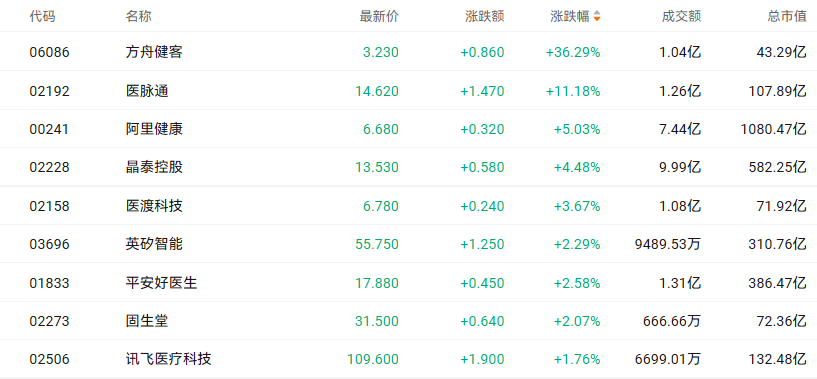

AI healthcare concept stocks in the Hong Kong stock market collectively surged, $FANGZHOU JIANKE (06086.HK)$ with some rising over 36%, $MEDLIVE (02192.HK)$ others gaining more than 11%, $ALI HEALTH (00241.HK)$some increasing by over 5%, $XTALPI (02228.HK)$ rose more than 4%, $YIDU TECH (02158.HK)$ with some rising over 3%, $INSILICO (03696.HK)$ and certain ones exceeding 2%.
NVIDIA and Eli Lilly and Co Invest in AI-Driven Drug Development
At the 44th JPMorgan Global Healthcare Conference, NVIDIA and Eli Lilly and Co announced a joint plan to invest $1 billion over the next five years to establish a collaborative research laboratory in the San Francisco Bay Area. The initiative aims to accelerate the application of artificial intelligence in the pharmaceutical industry.
This collaboration did not come as a surprise. As early as October last year, Eli Lilly and Co announced plans to deploy the world’s largest and most powerful AI pharmaceutical factory, utilizing NVIDIA’s DGX supercluster based on the Blackwell architecture. David Ricks, Chairman of Eli Lilly and Co, stated: ‘By combining our vast data and scientific expertise with NVIDIA’s computational capabilities and model-building proficiency, we could fundamentally revolutionize drug discovery as we know it.’
Going forward, the collaboration will focus on building a continuous learning system that closely integrates Eli Lilly and Co’s intelligent wet labs with computational dry labs, enabling around-the-clock AI-assisted experiments to support biologists and chemists.
As an important branch of AI applications, AI-driven drug discovery is becoming increasingly prevalent. According to a synthesis of views from multiple broker reports, the core value of AI in pharmaceuticals lies in significantly improving the efficiency of early-stage drug research and development. For instance, $INSILICO (03696.HK)$ Pharma.AI has demonstrated the ability to shorten the time required for identifying candidate drugs from target discovery to preclinical candidate confirmation from 4.5 years to just 12 to 18 months, thereby greatly enhancing the return on investment during the early research phase.
According to incomplete statistics by The STAR Market Daily, several multinational pharmaceutical companies have recently engaged in AI-driven drug development technologies:
In January 2026, Sanofi and Earendil Labs, a subsidiary of Huashen Intelligence, announced an increase in their strategic partnership’s total value to $2.56 billion. Earendil Labs will leverage its AI discovery platform to optimize new bispecific antibodies for Sanofi.
On November 20, 2025, Merck announced a $3 billion strategic partnership with biotech company Valo Health to use an AI platform to rapidly generate preclinical compounds.
Guangfa Securities believes that AI-driven drug development is gradually gaining commercial recognition from leading clients but remains in its nascent stages. By the third quarter of 2025, global AI-driven pharmaceutical orders showed signs of gradual growth. Conservatively estimated, breakthrough milestone events validating the effectiveness and efficiency of AI-driven drug development are expected by the second half of 2026, leading to market size validation and corresponding stock valuation increases.
Doubling Down on ‘AI + Healthcare’! OpenAI Acquires Health Tech Startup Torch
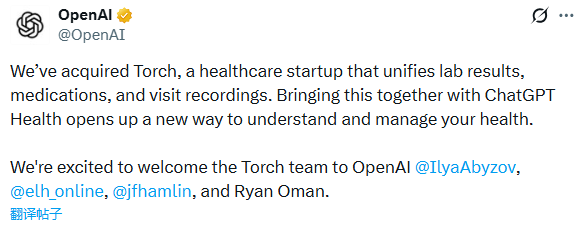
OpenAI announced on the social media platform X on Monday that it has acquired the health technology startup Torch. This acquisition represents a strategic move by OpenAI to enhance its capabilities in the healthcare sector as the company continues to expand the application of its AI technologies across various industries.
OpenAI did not disclose the specific acquisition amount. According to an industry insider speaking to the media, the deal was valued at approximately $60 million. However, there are also rumors suggesting that OpenAI agreed to acquire the company for around $100 million in equity.
Currently, Torch is working on building a ‘unified medical memory system’ for the AI industry, aiming to integrate patient health data stored across different vendors and formats into a single platform. This system can help users view and analyze health data from various sources, including healthcare systems like Kaiser Permanente, medical imaging companies such as Plenovo, and fitness tracking apps like Apple Health.
Torch stated that its product currently leverages some of OpenAI’s AI models to generate personalized medical recommendations based on user data.
Notably, prior to the announcement of the Torch acquisition, OpenAI had just launched a new feature last week called ‘ChatGPT Health.’ This mode, integrated within ChatGPT, serves as a ‘dedicated space for health-related conversations with ChatGPT,’ capable of connecting electronic medical records and various health applications. It generates responses by combining users’ health information with their personal context.
OpenAI also released several enterprise-level products targeting healthcare institutions, with initial partners including large healthcare systems such as HCA Healthcare. These developments signify OpenAI’s growing ambitions in the ‘AI + Healthcare’ domain.
The AI healthcare sector is entering a golden age of development.
In Jensen Huang’s view, artificial intelligence is transforming various industries, with the most profound impact expected to be in the life sciences sector.
In fact, the life sciences domain benefiting from AI extends far beyond pharmaceuticals alone. For instance, NVIDIA and Eli Lilly and Co, apart from drug discovery, are also exploring opportunities to apply artificial intelligence in clinical development, manufacturing, and commercial operations, including the use of physical AI and robotics in factories. Recently, Elon Musk mentioned that within three years, robots will surpass humans in surgical skills.
Additionally, recent developments have seen continuous catalyzation in the AI healthcare sector. Domestically, the new version of Ant Alipay’s app now boasts 30 million monthly active users, doubling its user base compared to a month ago. Overseas, OpenAI officially launched ‘ChatGPT Health,’ aimed at helping users access health information. Just yesterday, the company announced the acquisition of healthcare startup Torch, further enhancing the capabilities of ChatGPT Health.
Caixin Securities believes that the AI healthcare industry is entering a golden period of development. Innovative achievements such as AI-assisted diagnostics in medical imaging, intelligent surgical robots, and AI platforms for drug discovery are being implemented at an accelerated pace. Synergistic efforts across the upstream and downstream of the industry chain are forming a complete ecosystem ranging from algorithm development and data services to product applications. In the future, with the continuous advancement of artificial intelligence technology and the growing demand for healthcare among the population, the AI healthcare sector is expected to expand further.
Regarding investment, Guojin Securities noted that fields like medical devices and innovative drugs still require waiting for optimized procurement policies or significant technological breakthroughs, with overall sustainability potentially weaker than the tech-focused sectors. However, structural opportunities, especially areas combining innovative technologies, remain noteworthy. Huayuan Securities stated that under the wave of major AI-driven technology, the pharmaceutical sector could unlock new growth logic, with rapid advancements in brain-computer interfaces, early cancer screening, and AI healthcare. Looking ahead to 2026, the outlook remains positive for the innovation-driven pharmaceutical technology sector.
Founder Securities pointed out that AI is driving the medical industry to form a new growth pole, and there remains strong optimism about the revolutionary potential of AI + healthcare in areas such as pharmaceuticals, basic research, diagnosis, and health management: 1) Focus on the two essential tracks of data and equipment; 2) AI-driven drug discovery has reached a critical catalytic point, with the preclinical cycle for INS018_055, the world’s first AI-designed drug, compressed by 60%; 3) The implementation of AI health management at the endpoint is accelerating, driven by policies from the National Data Bureau promoting the opening of medical data elements, further unlocking commercial potential.
Editor/Jayden
Source link