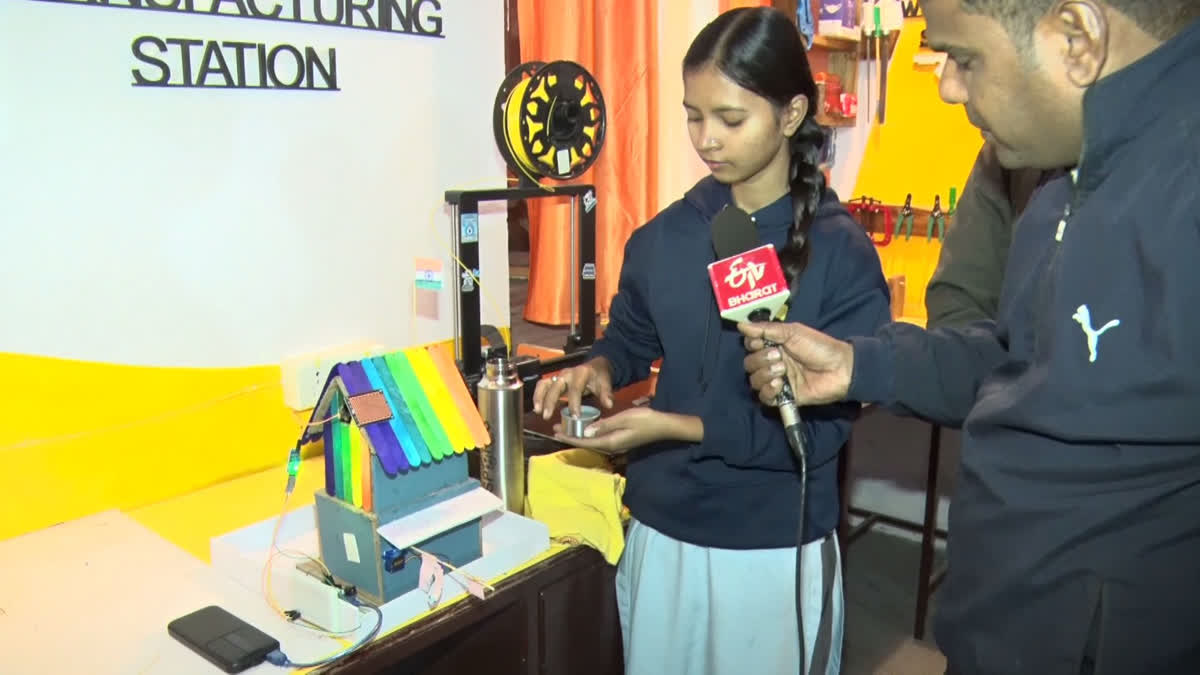
Afsana Parveen displaying her rain sensor instrument (ETV Bharat)
Jaipur: How does a nation progress? How can India become Viksit by 2047? Many of you who are reading this won’t be around then. But today’s young minds will be. That’s why, Prime Minister Narendra Modi had launched Startup India on January 16, 2016.
Today, on the National Startup Day that was launched by PM Modi in 2022, India is marking a decade of the Startup India initiative. It’s time to recognise the contribution of startups to the country’s economic development.
At Jaipur, which is coming up as a hub of startup innovation, ETV Bharat met some promising underprivileged children, who, despite the limited resources in government schools, and amid other hardships, are demonstrating extraordinary talent, simply because of rudimentary STEM education, the benefit of Maker Labs in their schools, and a little help from NGOs Aasra Foundation Jaipur and Vidyalaya Udyam.
Their initial focus is on girl students, because this is a cohort that, for a variety of reasons, receive less push towards STEM education and entrepreneurship. Further down the line, this is reflected in the Labour Force Survey 2023-24 that shows female labour participation rate in India at a disappointing 41.7 per cent, and that too, uneven. It is 47.6 per cent in rural areas, but only 25.4 per cent in urban areas.
How Startup Culture Is Spreading In Rajasthan
Vivek Sharma, founder of the NGO, said both Aasra Foundation, Jaipur, and Vidyalaya Udyam are encouraging boys and girls in government schools to embrace technology and entrepreneurship, with girls their first focus. To this end, innovation and entrepreneurship skills are being taught through Maker Labs and STEM education. The objective of the Maker Lab and STEM education initiative in Rajasthan is to develop entrepreneurial and technical skills in girls.
They want to encourage girls not only to become job seekers, but also to establish their own enterprises and create cutting-edge technology. Currently, two permanent STEM and Maker Labs are successfully operating at government schools in Jaipur. There are more in Udaipur, especially in rural areas. The experience of this first phase demonstrates that with right resources and guidance, even rural girls can excel in science and technology.
Afsana’s Rain Sensor Module
Afsana Parveen, a student at a government school in Jhotwara, has developed a project based on a rain sensor, servo motor, and Arduino, a single-board microcontroller kit built by an Italian open-source hardware and software company. It detects rain and automatically activates a security system to protect essential items. Afsana explains that the purpose of this project is to demonstrate that a structure can be covered or closed without human assistance during rain. It can be used to protect clothes or solar panels, or automatically close windows and shades.
It is a simple yet effective project that provides an effective solution to an everyday problem, displaying the student’s grasp of new technology and a problem-solving mindset.
Bhavika’s Fire Alarm, Chanchal’s Measuring Sensor
Bhavika Jangid and Chanchal Saini, also students at a government school, have put up on display two items with everyday use. While Bhavika’s sensor provides a fire alarm, Chanchal’s instrument accurately measures distance using ultrasonic sensors, and display it on an OLED screen. It can be used in a variety of applications, including car parking systems, robots, water-level measurement, obstacle detection, as well as by those with visual impairment. Because, as the innovator explains, the sensor can be embedded in a walking stick.
Not Just Programming, But Technology Creation
Vivek Sharma of Aasra Foundation explains that this initiative isn’t limited to coding. Girl students are being introduced to various modern technologies, and financially supported with amounts ranging from Rs 10,000 to Rs 40,000, so they can transform their ideas into tangible products.
The process also trains students to understand budgeting, planning, innovation, and entrepreneurship on the way to fostering a startup culture. The Maker Lab initiative demonstrates that when technical and entrepreneurial skills develop simultaneously, even girls from government schools can create high-tech and establish successful enterprises.
From Idea To Startup
Vivek also said, “We’re continuously striving to ensure that more and more girls from rural areas join STEM education and make their future in science, AI, and technology. Hence, we’re also training teachers in government schools as STEM mentors. Work is also underway to establish a project management unit in collaboration with the Education Department to monitor and expand STEM education throughout Rajasthan.”
He added that currently, work is being conducted in some schools as a pilot project. Efforts will be made to identify prominent government schools and bring the wonders of little hands and minds to the attention of the world.
Also Read:
- From Software Job to Goli Soda Startup: Vijayawada Youth’s Business Reaches America
- Bihar Engineer Turns Corn Husk Waste Into Plastic-Free Cups & Saucers, Gets Rs 30 Lakh Worth Orders
- Choco Delight: Engineering Graduate From Jammu Kashmir Builds Chocolate Factory In Remote Dooru Village
- Thermometer For Earth: How This Indian Space-Tech Startup Is Tracking India’s Urban Heat Stress