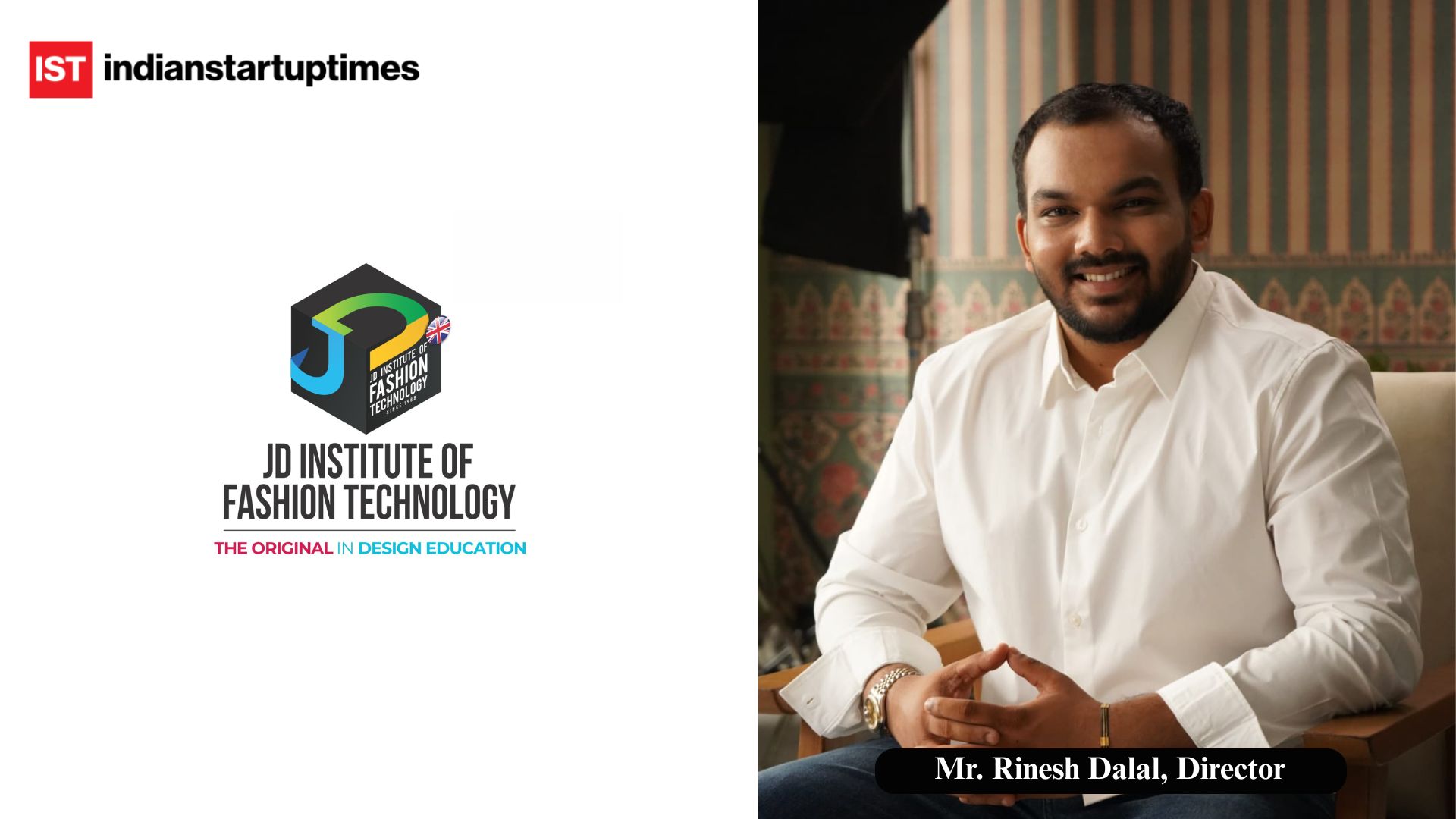
In an era where creativity, technology, and industry relevance intersect more closely than ever, design education is undergoing a profound transformation. At the heart of this evolution in India stands Rinesh Dalal, Director at JD Institute of Fashion Technology, who is steering the legacy institution towards becoming a globally recognised hub for experiential and future-ready design learning.
In this exclusive interaction with Indian Startup Times, Rinesh Dalal opens up about his unconventional journey from filmmaking to education leadership, the challenges of scaling a creative institution across India and abroad, and his long-term vision of positioning JD Institute as a global leader in experiential design education.
A Creative Beginning Rooted in Cinema
Rinesh Dalal’s journey into education leadership was anything but linear. With a Master’s degree in filmmaking and a deep passion for cinema, his early years were shaped by on-ground creative exposure rather than classrooms alone. Filmmaking, he shares, taught him resilience, adaptability, and street-smart decision-making,skills that later became invaluable in managing and scaling an education institution.
Joining JD Institute was not about preserving legacy for the sake of tradition, but about evolving it continuously. “The creative industry changes fast, and education must change even faster,” Rinesh notes, underscoring his philosophy of relevance over rigidity.
Building on a Legacy That Began in 1988
Founded in 1988 by his father Mr. Yogesh Dalal and grandfather Late Shri. Chandraakant Dalal, JD Institute emerged at a time when design education in India lacked structure and recognition. The institute set out to redefine design as a serious academic and professional pursuit, focusing on skill-building, industry relevance, and practical learning.
Rinesh credits his early exposure to entrepreneurship for shaping the institute’s modern outlook. From responding quickly to industry trends to experimenting with new learning formats, JD Institute’s growth has been driven by adaptability and a deep understanding of the creative economy.
Scaling Across 46 Centres While Protecting Quality
Today, JD Institute operates across 46 centres in India,a scale that brings with it unique challenges. Rinesh points out that education brands are far more complex to scale than conventional businesses, as quality, faculty mindset, and student outcomes cannot be standardised mechanically.
To address this, the institute focuses on:
- Strong internal communication across centres
- Standardised quality frameworks with flexibility in teaching styles
- Sensitivity to regional cultures and creative mindsets
Maintaining consistency while allowing creative freedom remains a delicate but intentional balance.
Global Expansion Through Local Execution
JD Institute’s international presence in markets such as Malaysia and Nepal,and plans for regions like Dubai,follows a clear philosophy: global vision, local execution.
Rather than exporting a rigid curriculum, the institute adapts its programs to align with local creative economies, cultural contexts, and market needs. Experiential learning and industry exposure remain the non-negotiable core, while execution models are customised locally.
Rinesh believes India’s growing reputation in education provides a strong foundation for global expansion, provided institutions invest time in understanding local ecosystems deeply.
Creating a Holistic Creative Ecosystem
Beyond classrooms, JD Institute has built multiple platforms to nurture a complete creative ecosystem:
- JD Online for digital learning
- JD Podcast for conversations with industry voices
- JD Creative Community and JD Empower for collaboration and exposure
- JD Design Awards to showcase student talent on a larger stage
“These platforms bridge the gap between education and the real creative world,” Rinesh explains, ensuring students don’t just learn design but live it.
Preparing Students for Real-World Creative Careers
A recurring theme throughout the conversation is experiential learning. From live projects and internships to industry observation and simulations, JD Institute prioritises exposure over theory-heavy education.
The goal, Rinesh says, is simple: by the time students graduate, they should feel confident, industry-aware, and clear about their creative direction,even knowing what they don’t want to pursue.
Redesigning Education for Gen Z
Recognising Gen Z’s need for flexibility, purpose, and tangible outcomes, JD Institute has redesigned its teaching approach. Hybrid learning models, portfolio-driven assessments, real-world problem-solving, and industry interactions form the backbone of this shift.
“Exams matter less than outcomes,” Rinesh notes, emphasising that employability and creative confidence are the real metrics of success.
Industry Experts Over Celebrity Endorsements
In an age dominated by celebrity branding, JD Institute consciously chooses industry experts over celebrity ambassadors. According to Rinesh, practitioners bring credibility, mentorship, and practical insights that visibility alone cannot offer.
This long-term focus ensures students receive grounded guidance rooted in real industry challenges.
AI, Technology, and the Future of Creativity
Rinesh is clear-eyed about the role of AI in design education. While AI can enhance efficiency and imagination, it should never replace human creativity.
JD Institute is actively integrating AI-assisted tools into its curriculum,alongside ethical and responsible usage frameworks. The emphasis remains on conceptual thinking, storytelling, and human intent, with AI acting as an enabler rather than the creator.
Inclusion Beyond Metro Cities
A key pillar of JD Institute’s vision is inclusivity. By expanding into tier-two and tier-three cities, the institute aims to democratise access to quality design education.
Rinesh strongly believes creativity is not limited by geography. With the right mentorship, exposure, and community support, students from non-metro regions can compete,and thrive—on global platforms.
Looking Ahead: A Global Vision for Experiential Design Education
As he reflects on his journey so far, Rinesh Dalal speaks of constant learning, grounded leadership, and long-term impact. His vision is not just to prepare students for jobs, but to empower them to shape the future of design, entrepreneurship, and creative innovation.
Positioning JD Institute as a global leader in experiential design education remains the ultimate goal,one rooted in innovation, inclusivity, and real-world relevance.
Conclusion
Rinesh Dalal’s leadership reflects a rare blend of creative intuition and strategic clarity. By honouring JD Institute’s legacy while relentlessly pushing it forward, he is redefining what modern design education can,and should,look like. As creativity converges with technology and global opportunity, JD Institute’s journey under his direction offers a compelling blueprint for the future of experiential learning.
Interview Conducted By: Arushi Agarwal