
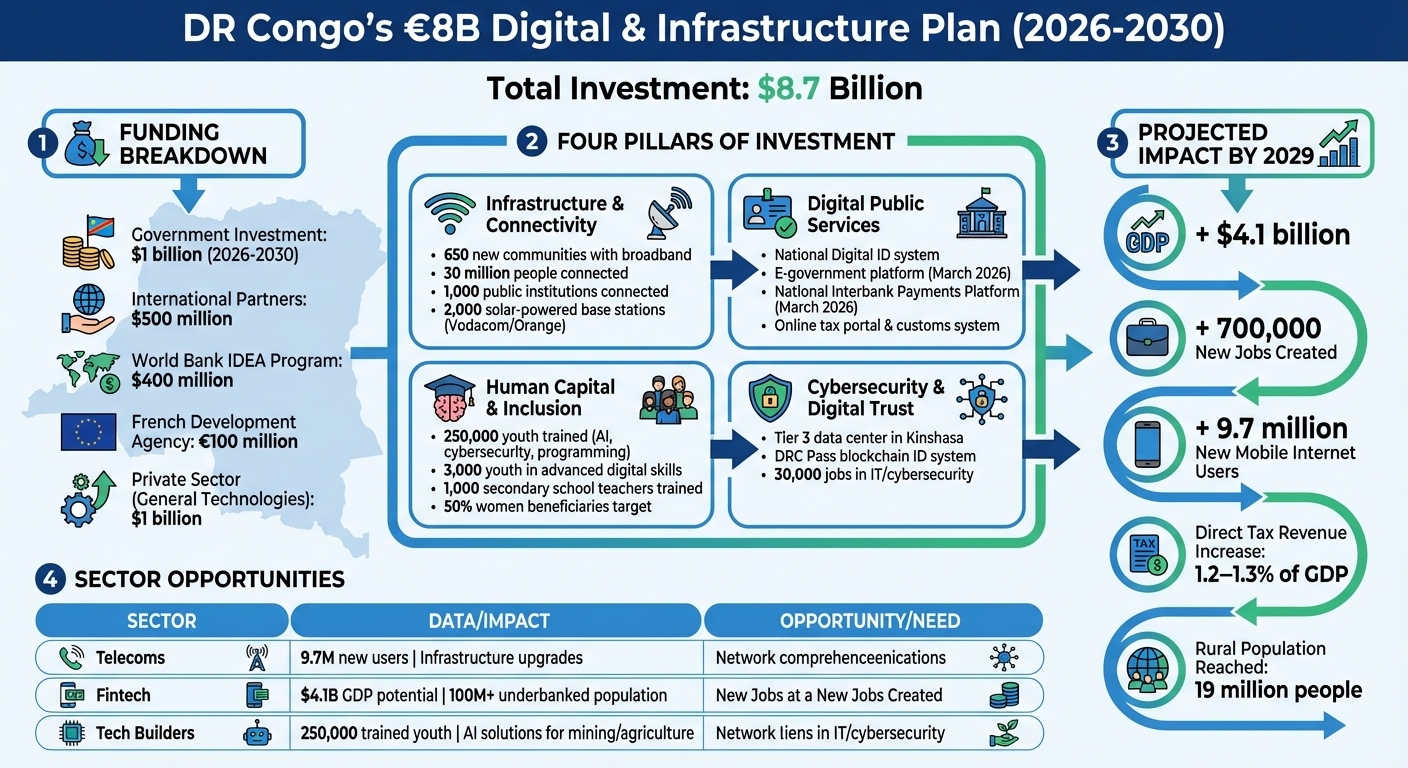


The Democratic Republic of Congo (DRC) is investing $8.7 billion to transform its digital infrastructure, expand connectivity, and boost its economy. This ambitious plan, spanning 2026–2030, focuses on better internet access, modernized public services, and nurturing local tech talent. It’s a bold move to position the DRC as a regional tech hub while leveraging its rich mineral resources for global energy transitions.
Key Highlights:
- Infrastructure Expansion: 650 new communities will gain broadband access, connecting 30 million people and 1,000 public institutions.
- Tech Workforce Growth: Training programs aim to upskill 250,000 youth in AI, programming, and cybersecurity.
- Digital Public Services: A new e-government platform will include digital IDs, tax portals, and interbank payment systems by March 2026.
- Private Sector Investment: Partnerships with global firms like Cisco and General Technologies are driving innovation and funding.
By 2029, these efforts could add $4.1 billion to the DRC’s GDP, create 700,000 jobs, and bring mobile internet to 9.7 million new users. For telecoms, fintech, and tech builders, the DRC offers untapped opportunities in rural broadband, mobile money, and AI-driven solutions for key sectors like mining and agriculture.
DR Congo’s $8.7B Digital Plan: Key Investment Areas and Projected Impact by 2029
Infrastructure Upgrades and Connectivity Expansion
Broadband and Mobile Network Expansion
The Democratic Republic of Congo (DRC) is making strides to bring mobile internet access to the 55% of its population currently without coverage. In January 2025, Vodacom and Orange teamed up to roll out up to 2,000 solar-powered base stations over the next six years. The initial phase targets 1,000 sites equipped with 2G and 4G technology, with the first stations expected to go live in 2025. This rural-focused initiative operates under a 20-year agreement where both companies share infrastructure to lower costs and efficiently expand their networks.
This project aims to deliver essential services – like voice communication, data access, and mobile money – to 19 million people in underserved rural areas. By sharing network resources, the partnership lowers operational costs, making it feasible to cover regions with limited financial returns. Funding support includes $400 million from the World Bank‘s IDEA program, along with an additional €100 million from the French Development Agency, to attract private investment for broadband expansion in unserved areas.
“The Digital Transformation Project will be critical to enhance access and use of the internet… These improvements will contribute to economic and human development… and help meet climate goals and address key drivers of fragility.” – Albert Zeufack, World Bank Country Director for DRC
Regulatory reforms are also in motion to extend connectivity further. Efforts to modernize fiscal policies and streamline sector taxes are expected to reduce consumer costs and entice more private sector involvement. These changes could connect an additional 9.7 million unique mobile internet users by 2029.
As the DRC expands its connectivity, the integration of sustainable energy solutions becomes increasingly vital.
Renewable Energy Integration in Infrastructure
To ensure the long-term sustainability of its digital infrastructure, the DRC is incorporating renewable energy into its expansion plans. Solar power plays a central role, especially in rural areas where the national electricity grid is either unreliable or nonexistent. This approach tackles one of the biggest challenges to digital adoption in the country. Globally, over 90% of new energy capacity added in 2024 came from clean energy sources, a trend expected to continue through 2026 as the DRC builds out its connectivity infrastructure.
“The Democratic Republic of Congo has the opportunity to leapfrog into a digital-led economy. But to fully realize this potential, reforms in fiscal policy, spectrum management, and energy infrastructure must be prioritized.” – Angela Wamola, Head of Africa, GSMA
The use of renewable energy not only ensures the viability of telecom operations in rural areas but also supports the DRC’s climate objectives. By aligning digital transformation with environmental goals, the country is positioning itself to attract investment in both technology and sustainable energy sectors. With an abundance of critical minerals needed for global energy transitions, the DRC has a unique advantage. Policymakers are working to align energy and telecom strategies, ensuring that new towers have the necessary power infrastructure for long-term success. This opens doors for collaborations between tech companies and energy providers to create integrated solutions.
Digital Platforms, Fintech Growth, and Financial Inclusion
Government-Led Digital Programs
The Democratic Republic of Congo (DRC) has laid out an ambitious plan for digital transformation through its National Digital Plan 2026–2030. With a total investment of US$1 billion and annual funding of US$250 million, the plan focuses on key areas like infrastructure development, digital public services, cybersecurity, and promoting human inclusion. President Félix Tshisekedi has committed these resources to drive the country’s digital evolution over the next several years.
A major aspect of this initiative is the integration of platforms such as the national digital ID and the “DRC Pass” with e-government services. These services include an online tax portal, a customs single window, and a digitized civil registration system. By March 2026, the government aims to roll out a National Interbank Payments Platform, which will enable seamless financial transactions between banks and mobile money providers. This interconnected system is designed to foster a unified digital and fintech ecosystem, creating opportunities for businesses to develop solutions that bridge traditional banking and mobile wallets.
The Digital Transformation Project is another cornerstone of this strategy, targeting 30 million users. With an allocation of US$385 million for digital access and US$55 million for e-government infrastructure, the project aims to enhance inclusion, with a focus on ensuring that 50% of beneficiaries are women.
Fintech Ecosystem Opportunities
The government’s digital initiatives are laying a strong foundation for fintech growth, opening doors for innovation in financial services. For instance, in March 2025, Rawbank and Equity BCDC began using mobile banking apps to pay teacher salaries in Goma and Bukavu. These payments are transferred to electronic wallets like Airtel Money, M-Pesa, and Orange Money, showcasing how mobile-first solutions can sustain financial access even during disruptions.
However, challenges like high withdrawal fees – sometimes reaching up to 10% – highlight the need for more affordable digital payment options. With mobile internet penetration still at just 17% as of 2024, there’s a vast untapped market for accessible fintech solutions.
The planned interbank payments platform is set to enhance compatibility across various fintech services, paving the way for broader adoption. Digital reforms are expected to inject US$4.1 billion into the DRC’s economy by 2029. Additionally, the digitalization of citizen-government interactions could boost direct tax revenues by 1.2 to 1.3 percentage points of GDP.
For investors and tech innovators, the combination of strong government backing, expanding infrastructure, and a large underserved population offers a promising opportunity to reshape digital payments and banking in the DRC.
Building Human Capital and Strengthening Tech Ecosystems
National AI Strategy and Training Programs
The Democratic Republic of Congo (DRC) has placed “enhancing human capital and inclusion” at the core of its National Digital Plan for 2026–2030. A key initiative is the Congolese Academy of Artificial Intelligence, which aims to nurture local talent, advance applied research, and create AI solutions tailored to critical sectors like agriculture, mining, education, and healthcare.
To back these ambitions, the government plans to allocate $1 billion over five years, with an additional $500 million coming through international partnerships. At the “DRC Digital Nation 2030” event in September 2025, a memorandum was signed with Cisco and Cybastion to train 250,000 young people in fields such as cybersecurity, data science, programming, and digital entrepreneurship. The program also includes technical English training, recognizing its importance for global digital participation.
Further support comes from the World Bank’s IDEA program, approved in June 2024. This initiative provides $400 million in credit, supplemented by €100 million from the French Development Agency, to drive the DRC’s digital transformation. The program is set to train 3,000 youth in advanced digital skills and 1,000 secondary school teachers.
“This project will… prepare thousands of youths with employable digital skills, stimulate digital innovation, and help meet climate goals and address key drivers of fragility.” – Albert Zeufack, World Bank Country Director for DRC
These investments are laying the foundation for a workforce equipped to tackle local challenges and develop innovative, homegrown solutions.
Opportunities for Tech Builders
With these human capital initiatives underway, tech innovators in the DRC have a wealth of opportunities to tap into. Sectors like AI, cybersecurity, and data science are ripe for startups looking to make their mark. The government is actively encouraging public-private partnerships to fund digital projects and enhance local expertise. Startups that align their solutions with the country’s priorities – digital entrepreneurship, innovation, and sovereign technology – are well-positioned to succeed.
“Our goal is to harness the benefits of the digital economy and position our country… as a catalyst for investment and a contributor to the key challenges of our time.” – Augustin Kibassa Maliba, Minister of Digital Economy
The growing pool of skilled professionals complements the broader digital reforms, creating fertile ground for startups to thrive. Entrepreneurs focusing on AI applications in mining and agriculture, or those aiming to fortify cybersecurity infrastructure, will likely benefit from both government backing and a rising demand for digital solutions. These efforts are expected to drive economic growth and open up new employment opportunities across the nation.
sbb-itb-dd089af
Cybersecurity, Digital Trust, and Cross-Sector Impacts
Building Digital Trust and Sovereignty
The Democratic Republic of Congo (DRC) has made “Cybersecurity and Digital Trust” one of the core pillars of its National Digital Plan 2026–2030 (PNN2), recognizing that safeguarding data privacy and creating resilient systems is essential for economic growth. To achieve this, the DRC has established the National Digital Agency (ADN) and the National Digital Council (CNN) to oversee a secure digital framework. One significant step is the development of a Tier 3 data center in Kinshasa, which reduces dependence on foreign servers.
A major focus of the plan is technological sovereignty. In June 2025, the government partnered with Singapore-based Trident Digital Tech Holdings to launch the “DRC Pass” digital ID system. Built on blockchain technology, this system creates tamper-proof records, bolstering institutional trust while keeping sensitive citizen data within the country. This initiative is also expected to create 30,000 jobs in IT, cybersecurity, and public service.
To support these efforts, the DRC has integrated cybersecurity training for 250,000 young people into its national strategy. Additionally, the World Bank’s $400 million IDEA program, approved in June 2024, allocates $55 million specifically for developing trust services.
How Digital Infrastructure Benefits Key Sectors
Strengthening digital infrastructure not only enhances trust but also delivers measurable benefits across critical sectors. By 2029, digital transformation is projected to contribute $4.1 billion to the DRC’s economy, with mobile technologies alone unlocking CDF 8.6 trillion in value across industries like mining, agriculture, and public services. The Congolese Academy of Artificial Intelligence is playing a key role, developing tailored solutions that improve productivity while maintaining robust data security.
In agriculture, precision farming tools, powered by better connectivity, could increase crop yields by 10.5% to 20% and boost profits by 23% across sub-Saharan Africa. For the mining sector, AI-driven research is expected to enhance transparency and competitiveness through improved mineral tracking and operational efficiency. In healthcare, secure data management and mobile platform integration are set to modernize services while protecting patient information. Furthermore, the digitalization of government-citizen interactions is anticipated to raise direct tax revenues as a share of GDP by 1.2 to 1.3 percentage points, providing additional funding for infrastructure projects.
“This project will support investments in cross-cutting digital building blocks and trust services needed to expand digital service provision across DRC in a cost-effectively and secure manner.” – World Bank Factsheet
Practical Steps for Telecoms, Fintech, and Tech Builders
The Democratic Republic of Congo (DRC) is taking significant steps to advance its digital agenda, paving the way for private sector involvement across telecoms, fintech, and technology development.
Investment and Partnership Opportunities
The DRC government has committed $1 billion (2026–2030) to its National Digital Plan, complemented by an additional $500 million from international partners. This funding creates ample opportunities for Public-Private Partnerships (PPPs), particularly in underserved rural areas where infrastructure gaps are most evident.
In February 2025, the Indian firm General Technologies signed a $1 billion memorandum of understanding with the DRC government to execute various digital initiatives. Similarly, the Unity Development Fund, based in the U.S., announced plans to invest in infrastructure, innovation, and tech programs for youth during the “DRC Digital Nation 2030” forum in September 2025. These collaborations highlight the DRC’s commitment to fostering international partnerships.
For businesses looking for structured entry points, the Project Implementation Unit under the Ministry of Posts, Telecommunications, and Digital is a key contact. This unit manages the $510 million Digital Transformation Project, which is supported by the World Bank and the French Development Agency. It works closely with private investors to align efforts with the four pillars of the National Digital Plan (PNN2): infrastructure and connectivity, digital public services, human capital and inclusion, and cybersecurity and digital trust.
“This project will mobilize significant private capital investment and bridge digital connectivity gaps.” – Albert Zeufack, World Bank Country Director for DRC
This coordinated framework ensures a unified approach to digital development while offering clear opportunities for sector-specific initiatives.
Sector-Specific Entry Points
Each sector offers targeted opportunities with defined goals and timelines:
- Telecoms: There’s a strong focus on expanding rural broadband to connect an additional 9.7 million mobile users by 2029. This includes upgrading fiber-optic networks, rural towers, and 4G/5G spectrum.
- Fintech: The upcoming National Interbank Payments Platform presents a chance to expand digital financial services to over 100 million people with limited banking access. Fintech companies can also develop tools for digitized customs systems and online tax portals.
- Tech Builders: Opportunities include collaborating on training programs to improve local digital skills and partnering with the Congolese Academy of Artificial Intelligence. These partnerships can focus on localized AI solutions for sectors like mining, agriculture, and healthcare. Digital skills training initiatives further enhance collaboration with the government.
Here’s a snapshot of key opportunities and their projected impacts:
| Sector | Key Entry Points | Investment Needs | Projected Impact |
|---|---|---|---|
| Telecoms | Fiber-optic, rural tower upgrades, 4G/5G spectrum | Infrastructure upgrades, renewable energy integration | 9.7M new internet users by 2029 |
| Fintech | Interbank payment systems, mobile money, digital ID integration | Interoperability solutions, cybersecurity frameworks | $4.1B potential GDP addition by 2029 |
| Tech Builders | AI for mining/agriculture, cybersecurity services, e-government platforms | Localized AI research, digital skills training programs | 250,000 youth to be trained |
The DRC’s structured approach and targeted investments provide a strong foundation for businesses to engage with and contribute to the country’s digital transformation.
Conclusion: DR Congo’s Digital Transformation Opportunities
The Democratic Republic of the Congo has unveiled an ambitious $8.7 billion digital transformation plan, offering substantial opportunities for telecom providers, fintech innovators, and tech developers to explore. Backed by $1 billion in government funding and an additional $500 million from international partners, the National Digital Plan 2026–2030 outlines a clear path for private sector involvement across four main areas: expanding infrastructure, improving digital public services, developing human capital, and bolstering cybersecurity.
Projections highlight the potential for significant economic growth, with digital reforms expected to contribute $4.1 billion to the DRC’s GDP and bring mobile internet access to 9.7 million new users by 2029. For telecom companies, this opens doors to rural broadband projects and renewable energy–driven infrastructure development. Fintech firms can seize the chance to grow mobile money services through the national interbank payments platform, slated for a March 2026 launch, addressing the needs of an underbanked population. Meanwhile, tech developers can engage through initiatives like the Congolese Academy of Artificial Intelligence and government programs aimed at training 250,000 young people.
“Our goal is to harness the benefits of the digital economy and position our country – rich in critical minerals vital to digital and energy transitions – as a catalyst for investment.”
– Augustin Kibassa Maliba, Minister of Digital Economy
To thrive in this evolving market, businesses must align with the government’s strategic goals: extending connectivity to underserved regions, advancing local AI capabilities for industries like mining and agriculture, and building trust through improved cybersecurity. By tailoring their solutions to these priorities, companies can position themselves to benefit from the DRC’s digital transformation.
FAQs
What opportunities does the DRC’s €8 billion digital plan offer for fintech companies?
The Democratic Republic of Congo’s €8 billion digital and infrastructure initiative presents major opportunities for fintech companies to make a real impact, especially in promoting financial inclusion and expanding access to digital financial services. With traditional banking reaching only about 14% of the population, there’s a pressing need for solutions like mobile money, digital payment systems, and microloans to support underserved and rural communities.
Fintech companies can tap into this demand by developing digital lending platforms that address the credit gap, offering financing options to individuals and small businesses that often lack access to traditional loans. On top of that, technologies like blockchain could play a key role in ensuring secure and transparent transactions, particularly in the informal sector, which is a cornerstone of the DRC’s economy.
This ambitious plan sets the stage for fintech innovation, opening doors to improve everyday lives, empower local businesses, and contribute to the country’s economic growth.
How will renewable energy boost the DRC’s digital infrastructure development?
Renewable energy is set to play a crucial role in powering the Democratic Republic of the Congo’s (DRC) ambitious €8 billion digital and infrastructure plan. By tapping into sustainable energy sources like solar, hydro, and wind, the country can tackle persistent energy shortages, particularly in rural and underserved regions where electricity access is unreliable. A steady and reliable power supply will be vital to supporting key digital infrastructure, including internet networks, data centers, and satellite systems.
Beyond improving energy access, renewable energy offers additional advantages. It reduces dependence on fossil fuels, cuts operational costs, and aligns with global efforts to protect the environment. These benefits not only support climate goals but also position the DRC to enhance connectivity, improve digital services, and stimulate economic development. Incorporating renewable energy into the nation’s infrastructure plans will be a cornerstone for advancing technology and fostering innovation in the years to come.
What role does the Congolese Academy of Artificial Intelligence play in DRC’s €8 billion digital transformation plan?
The Congolese Academy of Artificial Intelligence (AI) plays a central role in the Democratic Republic of Congo’s (DRC) ambitious €8 billion digital transformation initiative. Its mission revolves around integrating AI technologies into key sectors such as telecommunications, finance, and infrastructure, while building local expertise and encouraging innovation.
The Academy is likely dedicated to training skilled AI professionals, advancing research, and working closely with both government bodies and private organizations to deploy AI-driven solutions. These efforts align with the DRC’s broader objectives, which include expanding digital connectivity, improving financial access, and leveraging technology to fuel economic growth. By spearheading these initiatives, the Academy is helping to establish the DRC as an emerging digital hub in the region.
Related Blog Posts
Source link