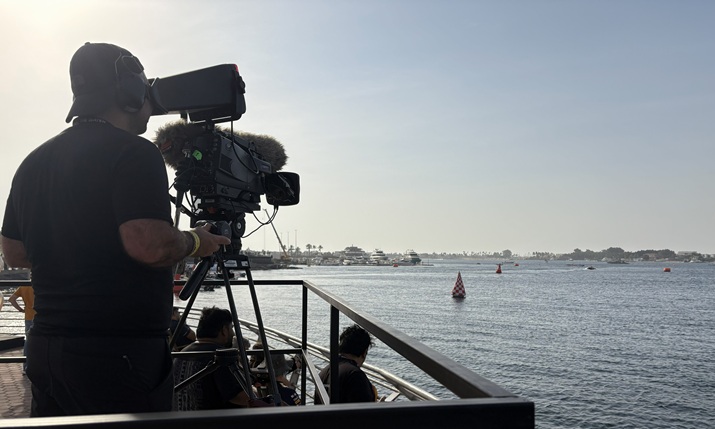
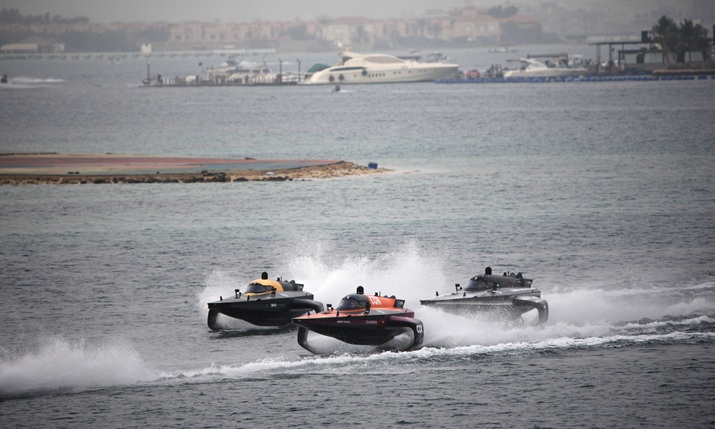
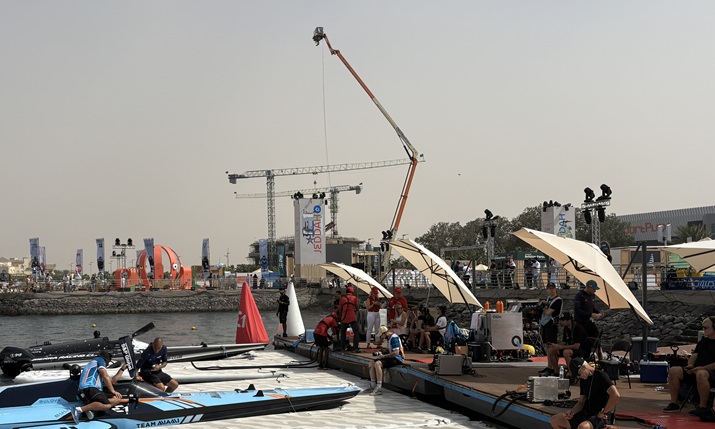
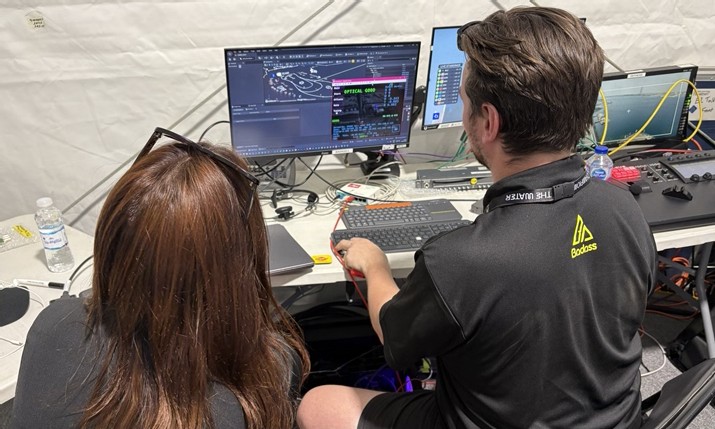
SVG Europe was in Jeddah for the opening race of E1 Series’ third season to find out how the championship’s production and broadcast operation is evolving as the sport scales up.
As the third season of E1 Series gets underway, the electric powerboat championship is shifting from being a startup to a scale up sport.
The number of teams taking part now stands at 10, with two new teams joining for the third season with the aim of reaching a total of 12 teams. And the number of races in 2026 will be eight – up from five during the inaugural season – with the long term goal of 15 per season.
As the series evolves, so too has the broadcast and production operation, which is overseen by E1 chief content and product officer Laurence Boyd.
“When we first started, we produced seven hours of content each race weekend, but the core E1 audience is focused on the 90-minute final show,” he explains.
“We initially tried to tell the story of the entire weekend in those 90 minutes, but after the first season we realised the racing was strong enough to speak for itself.
We shifted to getting more live racing into the show, still featuring all teams, but making the live final more about characters, stories, and the build-up to the finals, rather than summarising the whole weekend.”
That weekend of racing includes qualifying on day 1 with teams attempting to set the fastest lap, and then a second day of stage races, a place race and – because each team has two pilots – two finals.
One thing that hasn’t changed is Aurora Media’s role as production partner, and Boyd is full of praise for their contribution. “We love partnering with them. They’re class-leading in startup and new sports, and they’re as ambitious as we are. With the calibre of E1 team owners, many from sport and entertainment, you have to deliver very high production values.”
Those team owners include the likes of Tom Brady (whose Team Brady outfit won the first and second seasons), Rafa Nadal, Virat Kohli, LeBron James and Didier Drogba, plus Steve Aoki, Marc Anthony and Will Smith.
“Aurora share our ambitions, but they also understand that while we’re scaling up, we’re still working to a startup budget,” adds Boyd. “We solve problems with creativity rather than money, and Aurora are a key part of that.”
With experience working on other startup, purpose-driven sports like Formula E, SailGP and Extreme H, it’s an environment Aurora is used to operating in.
“Startup and scale-up sports like E1 are very much in our comfort zone and something we enjoy,” says Aurora technical producer Emily Merron. “We have a strong technology team who can join the dots and find innovative ways of working and getting the most out of every piece of kit.”
Editorially, the focus is on giving viewers an “access all-areas ticket”, explains Boyd. “We want them as close as possible to the action on the water, using all of our amazing onboard cameras.”
The onboard cameras include one on the deck, one on the dash looking at the pilot, a ‘parrot’ camera over the pilot’s shoulder to provide their perspective of the action, plus the round, ‘Agile’ stabilised camera provided by Cross Shore Media. The Agile cameras – carried by five of the ten boats – provide race coverage and help to convey speed and the skill of the pilots.
There is also an Agile camera on the chase boat. Following concerns about the wake created by a chase boat it wasn’t used during the first season, but has since been added to the camera plan.
“The chase-boat camera gives us flexibility,” explains Merron. “If we’re somewhere with limited land-based camera positions, having a deployable camera on the course gives us a reliable angle to cut to.” Longer term, the plan is to use an electric jet ski for even closer shots of the action.
And tests of a miniature Agile camera placed inside one of the race marks are scheduled to take place during the next E1 race in Lake Como, Italy, towards the end of April. “One of the reasons we love Cross Shore is their creativity,” says Boyd. “Andrew Chandler (Cross Shore Media founder) is constantly pushing technology and is probably among the world’s experts in acquiring content in extreme conditions.”
In addition to the waterborne cameras, wide shots that help to explain the course are provided by a DJI drone (one was used in Jeddah, while for some courses – such as Miami – two are deployed); a hoist camera and one long-lens camera. Plus three handheld RF cameras to capture shots of areas like the Launch Zone and the Ocean Club. There are also two cabled PTZ cameras at Mission Control where teams crunch data and strategise and the international powerboating union UIM and SeaBird teams are based, plus the Launch Zone.
That “access all areas” aim also includes team radio – and, new for the 2026 season and launched in Jeddah – messages from the team owners WhatsApp group displayed on screen.
“Behind the scenes, we want to reveal the pilots’ characters,” says Boyd. “My ultimate aim is to transfer some of the equity from the famous team owners to the pilots themselves. And they are a brilliant cast of characters, so we want to get as close to them as possible.
“One thing we do that I don’t think any other sport does is interview pilots on the water, in their boats, immediately after they cross the finish line. It’s extraordinary access…there’s no delay – it just requires very smart, editorially sensitive producers.”
Remote production
The broadcast is supported remotely by three of E1’s key production partners in the UK and Spain, including facilities firm Timeline Television in Ealing, London. That is the main production hub, where the director, producer and commentators are based and where replays are managed and live programme output is produced. Also, Cross Shore Media, in Portland, Dorset, supply and control the RaceBird-mounted Agile cameras. Plus, Al Kamel Systems in Barcelona, Spain, which operates a centralised graphics operation and real-time race and telemetry data handling.
Read more: Live from E1 Series: Inside the remote production operation
Read more: Live from E1 Series: Managing director John Williams on evolving formats and growing star power
Understanding the action also depends on data being captured and shared with viewers, much of which is essential to revealing the intricacies of how the RaceBird boats operate. Using hydrofoil technology, the boats lift above the water to reduce resistance, making precise telemetry critical to both performance and storytelling.
As Merron explains: “Boat orientation data is crucial. There’s a fine balance in prop angle to keep the boat flying, so displaying those metrics is really important.”
Merron highlights how augmented reality became a key part of that process: “BadAss approached AR in a very different way. They built a full virtual world and then removed elements to create AR graphics. The flexibility is impressive, and the fact they went from zero AR experience to delivering a fully live AR event in two months was phenomenal.”
That innovation is underpinned by a constant flow of live information from the racecourse. Boyd explains: “We produce an enormous volume of real-time data. Al Kamel deliver that to their graphics operators in Barcelona, and also to the BadAss team, who can show real-time positions, boost usage, speed, lap times and more.”
The result is a comprehensive data, graphics and AR ecosystem, built on extensive real-time telemetry covering speed, lap times, boost usage, boat orientation, prop angle and live positioning. This data is delivered by Al Kamel to their graphics operators in Barcelona and to the BadAss team to power AR overlays.
The BadAss augmented reality output includes overhead racecourse views, digital advertising boards, and smart marks that define the course in real time.
Boyd says that the production design always anticipated a strong digital layer.
“Because we can’t place physical advertising around the course in a sustainable way, digital boards and AR overlays were always part of the production design. When combined with real-time data, that opens up lots of creative opportunities using augmented reality.”
Source link