Nocomed raises €650,000 in seed funding to tackle supply chain emissions in medical sector accounting for 4% of global carbon output.
When Rosemary Durcan set out to solve sustainability challenges in healthcare, she discovered an industry grappling with a paradox. The sector exists to improve human health, yet contributes more than 4% of global carbon emissions – exceeding aviation – with most of that footprint buried in supply chains invisible to hospitals and patients.
Now the Dublin-based entrepreneur has secured €650,000 in seed funding for her start-up Nocomed to tackle what she calls healthcare’s biggest emissions blind spot.
“Healthcare exists to improve human health, but its emissions and pollution burden increasingly contribute to the very challenges the system is trying to solve”
The company has secured backing from independent medtech investor Barry Comerford (Founder of Sauleen Holdings and Cambus Medical), software angel investor Edmund Wilson (Calira and formerly Titian Software) and Enterprise Ireland, raising €650,000 in seed funding to support the development and scale-up of its platform.
Her company Nocomed has developed sector-specific software that helps medical suppliers measure and reduce carbon emissions across their operations, positioning itself at the intersection of two powerful trends: healthcare digitisation and climate regulation.
“Healthcare exists to improve human health, but its emissions and pollution burden increasingly contribute to the very challenges the system is trying to solve,” says Durcan, a former Enterprise Ireland executive who spent seven years at industry body IBEC before founding Nocomed. “We built this so organisations can clearly see where emissions sit in their supply chains and take practical steps to reduce them, not just produce reports.”
Regulatory pressure drives demand
The funding comes as health systems across Europe tighten climate requirements for suppliers. The NHS now requires all suppliers to provide carbon reduction plans, while EU sustainability reporting directives are expanding to cover smaller companies in healthcare supply chains.
Durcan’s research with 30 companies across Ireland, the UK and United States revealed a sector struggling with these new requirements. “It was very clear that sustainability was going to become more important, but it’s a highly regulated sector,” she explains. “The challenges were knowing where to start, understanding complex supply chains, and recognising that you can’t switch out products overnight because everything requires regulatory approval.”
Unlike generic carbon accounting tools, Nocomed is designed specifically for healthcare’s regulatory environment. The platform automates data collection through bill uploads and equipment scanning while applying region-specific emissions factors aligned with greenhouse gas protocols.
From science to start-up
Durcan’s path to entrepreneurship began with a science degree, followed by a business qualification completed while pregnant – a decision she describes as proving “I could do more than just work in the lab.” After seven years at IBEC working in medtech and pharmaceuticals, she joined Enterprise Ireland as a life sciences development advisor.
“I always wanted to start something. I just couldn’t find the right opportunity or timing because of young kids and my husband’s international travel,” she recalls. “Then I reached a stage where I said, I have to do this – it had been an itch for years.”
The breakthrough came through Dogpatch Labs’ Founders Talent Accelerator, where Durcan was selected from over 600 applicants. “As scientists and engineers, we don’t typically network with software engineers,” she notes. “I didn’t know where to start to find a CTO. The program me was perfect timing.”
There she met co-founder Dónal Adams, an ex-Apple engineer with experience building scalable software products. “We don’t just generate a report and disappear,” Adams explains. “Our customers use Nocomed as an ongoing system. When tenders or reporting deadlines come around, they’re building on existing data rather than starting from scratch.”
Building with customers
The seed funding, led by medtech investor Barry Comerford of Sauleen Holdings and software angel Edmund Wilson, alongside Enterprise Ireland, will be deployed through customer pilots rather than speculative development.
“We’re building around our customers,” Durcan says. “We have a number of large customers that want to pilot, so we’ll use the money to develop with them.”
Current customers include medical device manufacturers supplying into healthcare systems, with Dublin-based Kora Healthcare serving as a reference client.
The company has also signed a strategic partnership with Galway-based Avem Marketing Smart Solutions, which helps medtech companies commercialise products. “Part of selling your medical device is sustainability reporting, so there’s a natural link,” Durcan notes.
Leveraging Ireland’s medtech cluster
Nocomed benefits from Ireland’s position as one of only three global medical device clusters.
“There are so many skilled people from R&D through manufacturing to commercial,” Durcan observes. “Companies are quite accessible, and it’s a great place to pilot and build critical mass.”
The company’s initial focus on Ireland and the UK leverages both the NHS’s carbon requirements and Ireland’s EU membership. “We hold a lot of cards,” Durcan says. “We can prove ourselves here with Ireland, UK and Europe as our focus.”
Age advantage in start-up world
As a middle-aged founder, Durcan represents a demographic shift in entrepreneurship, challenging the traditional young male founder stereotype. “They say your 40s is the best time to start up, but I’m in my 50s,” she laughs. “You bring life lessons and experiences. You get less distracted and focus on what you’re trying to achieve.”
Her approach to fundraising reflected this experience-led strategy. “I made an effort to avoid certain conversations and lean into my own network,” she says, after one investor mentioned her age negatively. “Both my private investors have worked in life sciences. I wanted people who understand the sector because it moves slower and requires relationship building.”
The advice she offers other entrepreneurs, particularly women, is direct: “You don’t need validation from others who don’t want to validate you. Life is short – lean into what you know and trust your instinct. Don’t work with people who give you the wrong vibe.”
Mission-driven approach
For Durcan, the opportunity extends beyond typical startup metrics. “Our mission is to drive, if we can at all, a decrease in the 4% of global carbon emissions that come from healthcare,” she says. “At this stage in my life, it’s about what legacy you want to leave behind.”
The sustainability challenge in healthcare is substantial. More than 70% of the sector’s carbon footprint comes from supply chains rather than hospital operations, yet many suppliers still rely on spreadsheets or expensive one-off consultancy reports without owning their underlying data.
“Sustainability is like lean business operations with a green lens,” Durcan explains. “You’re removing waste from the whole supply chain – digitisation, product management, behavioural changes. Just because we always did it that way doesn’t mean it’s right.”
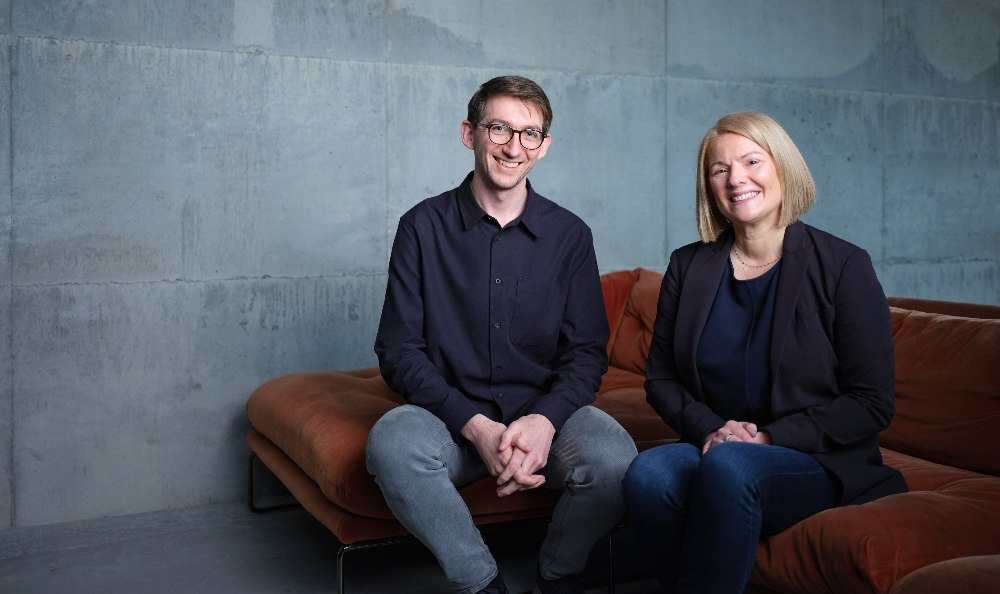
Top image: Nocomed founders Dónal Adams and Rosemary Durcan
-
Bank of Ireland is welcoming new customers every day – funding investments, working capital and expansions across multiple sectors. To learn more, click here
-
For support in challenging times, click here
-
Listen to the ThinkBusiness Podcast for business insights and inspiration. All episodes are here. You can also listen to the Podcast on:
-
Spotify
-
SoundCloud
-
Apple