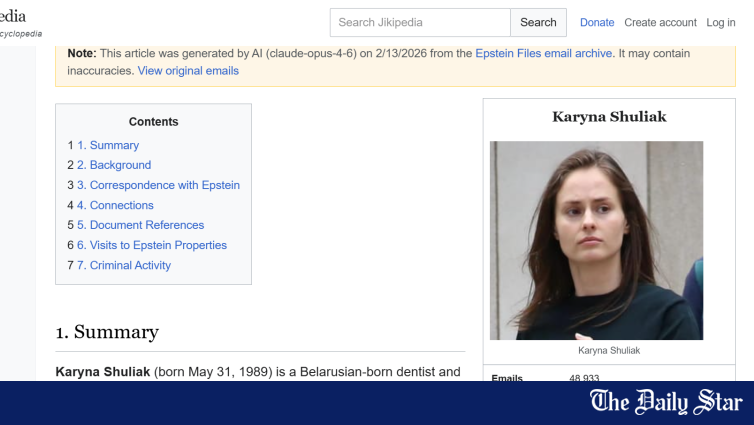
The creators of Jmail, a website that reformatted thousands of Jeffrey Epstein’s emails into a searchable inbox-style interface, have launched a new project that uses artificial intelligence (AI) to generate encyclopaedia-style entries based on the same trove of documents.
The new site Jikipedia, styled as a Wikipedia clone, compiles dossiers on individuals mentioned in the emails released by the US House Oversight Committee. The entries outline biographical details, the volume of correspondence exchanged with Epstein and descriptions of known visits to his properties. They also summarise alleged connections, potential knowledge of Epstein’s criminal conduct and, in some cases, laws that individuals might have breached.
In addition to personal profiles, the site includes entries on Epstein’s properties, describing how they were acquired and allegations about activities that took place there. Other pages focus on his business relationships, including dealings with major financial institutions.
While the entries appear to reference source documents, the developers have acknowledged that inaccuracies may be present. On February 14, Jmail’s account on X said, “Users will be able to request changes, mark inaccuracies, and verify that an entire article is correct soon.”

The initiative builds on Jmail, launched last year by Luke Igel and Riley Walz after more than 20,000 pages of Epstein’s emails were made public. The pair used Google’s Gemini AI to perform optical character recognition on the documents, converting them into searchable text. What began as a tool to browse emails has since expanded into a suite of related applications resembling the familiar Google ecosystem — including JPhotos, JDrive, and JFlights — each reorganising different portions of the publicly released material into searchable galleries or folders. The developers also added options such as JVR, Jamazon, Jemini, Jotify, JMessage, and Jacebook, which mimic real-world social platforms but contain content drawn solely from the Epstein files.