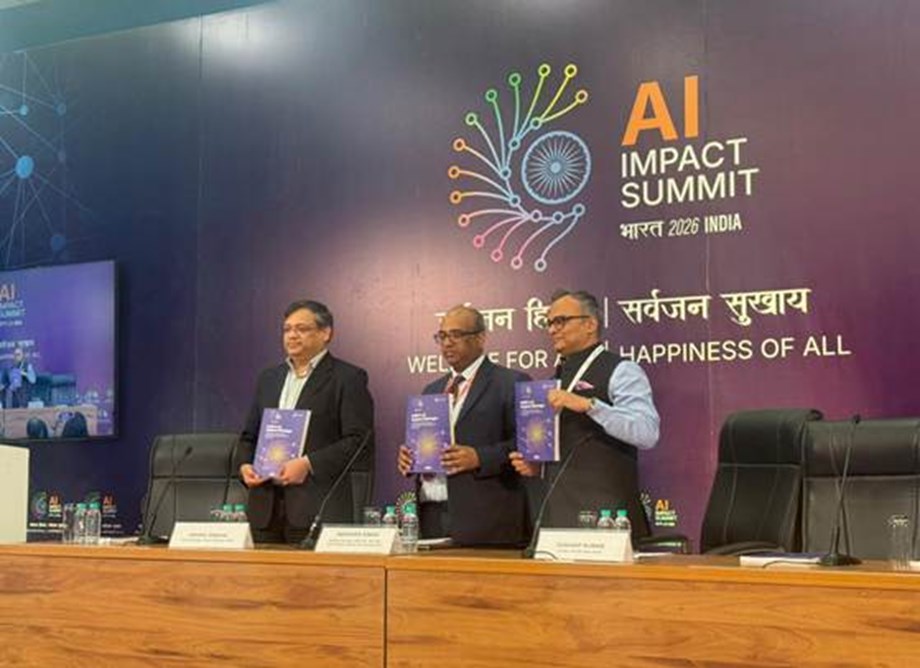
The third day of the India AI Impact Summit 2026 marked the launch of the AI Impact Startup Book, a first-of-its-kind compendium capturing the scale, diversity and global momentum of India’s artificial intelligence and deep-tech startup ecosystem.
The publication analyses a large sample of AI-driven ventures and presents 100 high-impact solutions spanning sectors, technologies and geographies — reflecting the growing maturity of India’s AI landscape.
AI Expands Beyond Metro Hubs and Core Sectors
The study highlights strong AI innovation in traditional domains such as healthcare, while documenting rapid expansion into emerging areas including:
-
Foundation models and large-scale databases
-
Indigenous AI infrastructure development
-
Waste-tech and sustainability solutions
-
Voice- and vision-based applications tailored for Indian users
-
Edge AI integrated with hardware systems
It also underscores the rise of startups beyond major metropolitan centres, signalling the decentralisation of India’s AI innovation ecosystem.
From Early Impact to Global Growth
According to insights presented at the launch, nearly 47% of early-stage ventures have a strong local presence, while at the growth stage, around 68% operate internationally, demonstrating increasing global competitiveness.
The report notes that several Indian startups are transitioning from pilot-stage innovation to international expansion, backed by government partnerships, digital public infrastructure and maturing venture ecosystems.
Scaling Impact Beyond Infrastructure
Shri Abhishek Singh, Director General of NIC, Additional Secretary at MeitY and CEO of IndiaAI, emphasised that while AI infrastructure — including data centres, datasets and foundation models — is critical, the true test lies in citizen impact.
“The true measure of success lies in AI’s ability to improve access to services and deliver tangible benefits for citizens, particularly in healthcare, agriculture, education and employment,” he said.
He highlighted the need for a structured national mechanism to identify, evaluate and scale impactful AI solutions across ministries and state governments.
A Repository for Government Adoption
Singh described the publication as a consolidated repository enabling ministries, states and institutions to assess solution maturity, evaluate performance and adopt technologies at population scale.
He cited language-enabled agricultural advisory services as an example of how AI can expand last-mile access across India’s diverse linguistic landscape, provided richer datasets and coordinated implementation are ensured.
“If India has to become the use-case capital, it will need to scale up impactful solutions. One hundred solutions are listed here, and if in the next 12 to 18 months we can scale up even 10 of them, it will be a significant step forward,” he said.
Eight Key Insights from the Ecosystem
Mr. Sushant Kumar, Founder and CEO of Kalpa Impact, shared eight major insights derived from the study.
Among the most significant findings:
-
AI innovation is expanding beyond healthcare into foundation models and database-driven solutions
-
Nearly half of early-stage ventures are locally rooted, with strong domestic relevance
-
A majority of growth-stage startups are operating internationally
-
India is building its own foundation models and AI infrastructure
-
Edge innovation is emerging as a major frontier
“India is building foundation models. India is building infrastructure. And last, but not least, is edge innovation,” Kumar said.
From Experimentation to Global Competitiveness
The launch of the AI Impact Startup Book signals a turning point for India’s AI ecosystem — moving from early experimentation to globally competitive, infrastructure-backed innovation.
With enabling policies, expanding digital public infrastructure and increasing international market linkages, India’s AI startups are positioning themselves not just as solution providers, but as global technology leaders.
The summit’s third day underscored a clear message: the next phase of India’s AI journey will depend not only on building world-class models and infrastructure, but on scaling high-impact use cases that deliver measurable benefits at national and global levels.