
Agreements between the two tech economies will help founders access research, capital, and global markets.
Canadian entrepreneurship and innovation hub YSpace now works with over 1,400 companies. Increasingly, many of them are asking how they can expand beyond North America in a structured way.
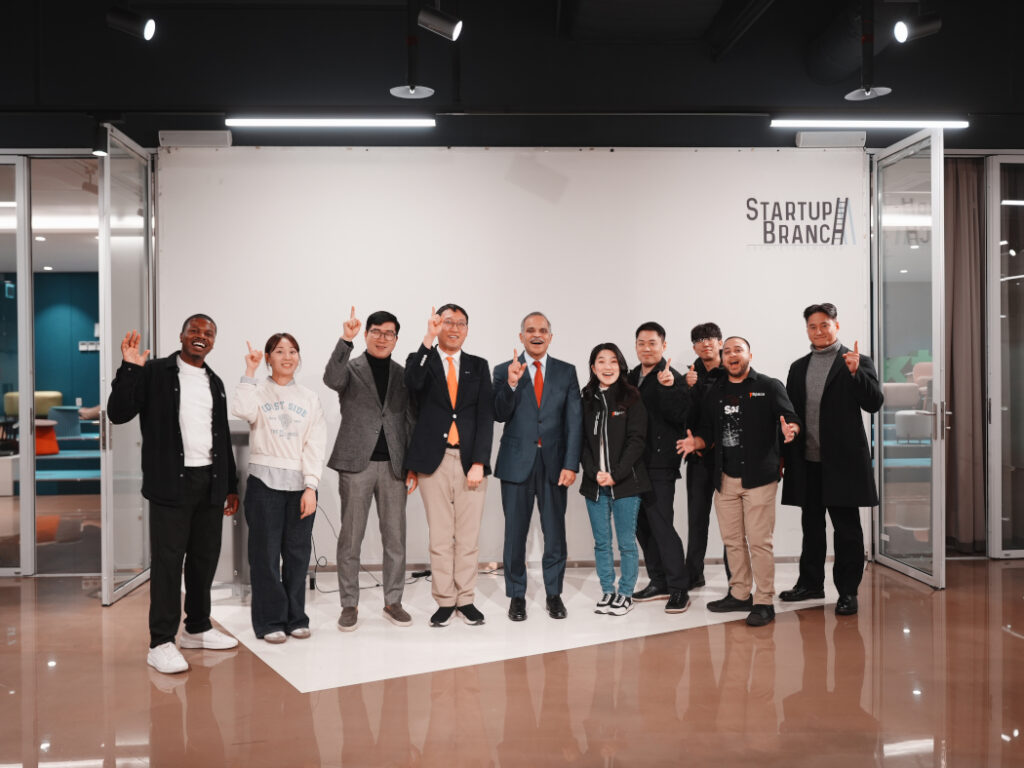
In December, leaders from YSpace and York University travelled to South Korea to formalize an answer.
Nafis Ahmed,
“There are a lot of synergies between Canada and Korea’s industries, academic institutions, and the cultures around innovation.”
YSpace
Two new memorandums of understanding signed in Seoul with the Korea Business Angels Association and the Seoul AI Hub give YSpace the mandate to support Korean startups entering Canada, while opening outbound pathways for Canadian founders into one of Asia’s most industrially advanced markets.
Among the delegation was Nafis Ahmed, Associate Director of Entrepreneurship at YSpace. Across meetings and forums with investors and research institutions over the course of a week, Ahmed observed an ecosystem organized around many of the same foundations he sees at home.
“There are a lot of synergies between Canada and Korea’s industries, academic institutions, and the cultures around innovation,” Ahmed said. “The quality of education is also very similar. Canada creates really incredible talent. We have really high-performing post-secondary institutions, and Korea has the same.”
Canada and Korea sit near the top in the Organisation for Economic Co-operation and Development rankings for nations with the highest share of young adults with college or university education, with deep university-led talent pipelines that feed applied research and commercialization.
Both countries also share priorities in advanced manufacturing and AI. Korea’s strength lies in industrial depth and large-scale deployment, including global leadership in automation and robotics, while Canada brings world-recognized AI research, a flourishing startup ecosystem, and commercialization pathways anchored by a long-running national AI strategy.
Taken together, the two ecosystems are complementary, but that only matters if local institutions can turn their countries’ shared strengths into practical support for founders.
The Korea Business Angels Association is Korea’s oldest angel network and is backed by the national government. Companies supported through the association also gain access to public funding for research and development, international expansion, and exports.
“They have a really interesting model to not only support the development of innovation technologies but also creating global partnerships and collaborations,” said David Kwok, YSpace’s Director of Entrepreneurship and Innovation. “Some of the most trusted companies are backed by that organization.”
The Seoul AI Hub, funded by the municipal government, focuses on applied AI development, research, and commercialization. It works closely with academic institutions, including Seoul National University, to support growing companies that specialize in AI.
“They’re really keen on exploring research commercialization pathways,” said Ahmed. “They liked the idea of not just having access to a thriving startup ecosystem, but collaboration on research and development opportunities through York University.”
Since 2018, YSpace has supported startups and scaleups through entrepreneurship programming, industry partnerships, and applied research initiatives, working across York University to help founders grow in Canada and internationally. According to Kwok, these new agreements give YSpace the ability to turn months of conversations with these organizations into something tangible for founders.
“Without the MOUs, we could talk, but we didn’t have the buy-in of leadership,” Kwok added. “The MOUs secure the leadership buy-in, so now, as operators and boots on the ground, we can actually execute on the stuff that we talked about.”
“Now is the time when AI is being applied across industries and delivering tangible, real-world value. The driving force behind this shift will be AI startups—moving fast, testing in the field, and scaling what works. Through our MOU with YSpace, Seoul AI Hub will help create opportunities for cross-city joint research and industry collaboration, strengthening the foundation for founders to grow globally and turn innovation into impact,” said Chanjin Park, the Managing Director of Seoul AI Hub.
Execution under the agreements includes joint workshops, mentoring sessions, soft-landing support for Korean and Canadian startups exploring the regional markets, and collaboration on projects tied to research commercialization.
YSpace already has some experience here. Until last year, Korean marketing startup Referral Kloser had been testing the Canadian market through informal channels, making repeated trips and building early relationships. The company previously raised funding in Silicon Valley and now established a base in Calgary to sell across Canada.
In October 2023, Kloser joined YSpace’s Startup Visa program, one of the 13 companies selected that year. The program provided international startups with training, mentorship, and coaching as they assessed the feasibility of building in Canada, ultimately leading to setup of its Canadian operations in May of 2025.
According to Referral Kloser’s CEO and Founder, Youngjin (Tony) Byun, the startup hit its initial revenue targets ahead of schedule thanks to YSpace’s operational guidance.
Sun Jin Lee, Hype AI
“The systematic support from YSpace allowed us to significantly shorten the timeline from incorporation to generating actual revenue in Canada.”
“For a Korean startup, navigating Canada’s complex legal, tax, and government incentive landscapes is often the steepest hurdle,” said Byun. “The specialized sessions hosted by YSpace effectively eliminated these uncertainties, replacing regulatory anxiety with strategic confidence. This allowed us to bypass common administrative pitfalls and focus entirely on driving sales from day one.”
Hype AI, an AI startup also originating from South Korea, also recently launched its North American expansion after successfully completing the Startup Visa (SUV) program at YSpace.
“The systematic support from YSpace allowed us to significantly shorten the timeline from incorporation to generating actual revenue in Canada,” said Sun Jin Lee, Founder and CEO of Hype AI. “Moving forward, we plan to build an even stronger network within the Canadian tech ecosystem.”
“Our soft-landing program ranges from helping them do market assessments to understanding cultural nuances,” Kwok added. “Later-stage programming looks at first hires, taxation, IP, and funding programs. We also have physical office spaces that become their initial home base before they scale up. We do the end-to-end work providing support every step of the way to ensure a successful expansion for our companies.”
Kwok also believes deeper ties with Korean institutions will give Canadian tech startups a clearer path to commercialize their products internationally.
“We have over 1,400 companies now, and many of them are later stage,” Kwok said. “They’re not just looking at North American markets. They’re looking globally, and they’re asking us for support.”
YSpace expects programming tied to the agreements to begin later this year, marking another application of a model the organization plans to reuse as it builds relationships in other markets and on other continents.
“We have companies with global aspirations,” Ahmed said. “So for us, this work is really about building those bridges for them, allowing our founders to dream big, and showcasing Canadian innovation to the world.”
PRESENTED BY
YSpace is building a stronger Canadian tech ecosystem by fostering a community of innovators, entrepreneurs, and change makers with dedicated programs for women (ELLA) and Black (BEA) entrepreneurs, and sector-specific initiatives like SmartTO for automotive & mobility related ventures. Learn more.
Feature image courtesy YSpace.
Source link