
Reflo, a London-based sustainable sportswear brand backed by England international striker Harry Kane, has launched a £2.5 million (approximately €3 million) equity crowdfunding campaign on Crowdcube, the UK equity investment platform, giving retail investors the opportunity to buy into the company for the first time. According to an interview co-founder Rory MacFadyen gave to City AM, the raise values Reflo at £25 million (approximately €30 million). The campaign opened on March 5, 2026.
The decision to raise publicly rather than through traditional venture capital is deliberate. MacFadyen said institutional funding “was an option” but that the founders chose a different path, arguing that the brand’s customers deserve a share in the company’s growth. The round follows a Series A completed in 2025 and an initial £1 million seed round in 2024.
Reflo reported £5 million in revenue for 2025 and operates at a gross margin of approximately 60 percent. MacFadyen acknowledged the £25 million valuation is “punchy” relative to current revenues but said it reflects the company’s asset base and growth rate.
Kane’s equity stake adds athlete economy dimension
Kane joined the brand in 2024 as both lead ambassador and equity investor — one of the more direct expressions of the athlete-as-investor model that has become increasingly common in the sporting goods space. Former Manchester United and England defender Phil Jones is also among the brand’s existing backers, according to City AM. The Crowdcube campaign now extends that investor base to the general public.
“I was really impressed with Rory and Pete’s vision for the brand and wanted to get involved,” Kane said. “It’s growing quickly, and it’s exciting for me to be a part of it.”
MacFadyen framed the crowdfund as consistent with the brand’s founding logic. “We’re challenging an industry responsible for up to 10% of global carbon emissions,” he said, “and we believe the people who wear the product should have the chance to own part of the mission. Harry Kane believed in what we’re building and chose to invest. Now others can too.”
Three revenue streams underpin the growth case
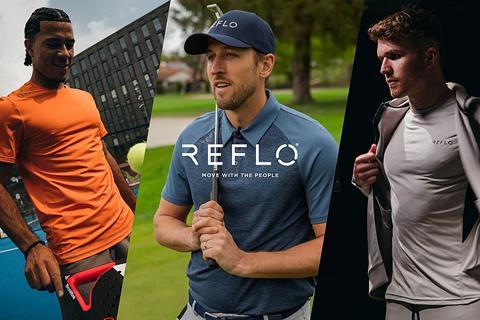
Reflo operates across three commercial divisions. Its core direct-to-consumer (DTC) sportswear line covers golf, running, training and padel. A second division, TeamLabs, provides sustainable kit to professional sports teams and event organizers. A third, SupplyLabs, handles branded corporate apparel for business clients. The diversification across these revenue streams distinguishes Reflo from single-channel challenger brands and is central to the investment case being presented to Crowdcube’s subscriber base.
Co-Founder Peter Philippou said the model demands a more rigorous approach to product development. “We make our lives harder by doing things properly,” he said. “Cleaner materials, responsible manufacturing, better design. It proves sustainability and profitability can co-exist. This raise is about scaling that model globally.”
Elite sport partnerships establish performance credentials
Since its founding in 2021, Reflo has built an apparel portfolio spanning multiple professional sports categories. Kit partnerships include Atlassian Williams Racing in Formula 1, Jaguar TCS Racing and Nissan in Formula E, and the FIA World Rally Championship. In golf, the brand has collaborated with The Open Championship and the DP World Tour. Football partnerships include Luton Town and Forest Green Rovers. The company says it has incorporated the equivalent of five million recycled plastic bottles into its products and planted more than 200,000 trees.
Market context
The global sportswear market was valued at $335 billion (approximately €307 billion) in 2023 and is projected to reach $646 billion (approximately €592 billion) by 2030, according to analyst forecasts cited by the company, driven by demand for performance apparel and athleisure. Reflo’s founders position the brand as a sustainability-first challenger capable of competing against established manufacturers as that market expands and regulatory scrutiny of fashion-sector emissions intensifies.