When Dot Ai went public in June, the Las Vegas-based startup’s stock quickly soared from $10 per share to $75, momentarily making the company worth $2.25 billion.
The stock closed at $38 that day of its debut on the Nasdaq and has since plummeted to a penny stock, closing Friday at 25 cents a share. But Dot Ai (DAIC) co-founder and CEO Ed Nabrotzky still has a snapshot of the moment when the asset tracking technology firm was worth 10 figures.
“That’s on my wall, because for a very brief moment, we were billionaires,” he said. “As a founder, when you start an enterprise, it’s great to take a snapshot of that high point to show at one point you were valued as a $2 billion company.
“Now, we have to get back to that.”
Nabrotzky started the company (formerly SEE ID) — which has corporate headquarters at 5661 South Cameron St. — in 2021 with two partners who lived in Las Vegas.
“So we looked at Las Vegas as a great place to make the headquarters,” he said. “We also looked at different business climates and where the right place was to go. We’re really happy with the tax structure in Nevada, generally, and the ability to do some of our go-to-market pieces in Las Vegas, in particular.
“What cemented the deal was getting to know Jeff Saling and the StartUpNV guys. It’s great when you’re in an area where a group of people are trying to stimulate business in the region and StartupNV really does a great job reaching out to startups like us, trying to nurture them, give them advice, and some of the competitions and funding they can line up is very attractive, so that was definitely a factor too.”
StartUpNV, a nonprofit business incubator and accelerator in Nevada, launched AngelNV, a 12-week program to train new angel investors and fund Nevada-based startups, in 2020. The competition culminates with a mid-six figure investment prize to the winning company.
Dot Ai was the standout winner of the “Shark Tank”-style grand finale of AngelNV2.
“It was really big because they bring together a lot of angel investors and private equity holders that want to invest in interesting startups,” Nabrotzky said. “So you get a chance to make your pitch and work your way through it. It also helps you refine your message.
“We were in there with 400-ish other companies, all startups with different concepts. We went through a series of presentations and knockout eliminations and we went to the finals and won. … Winning was a big deal. It allowed us to get a lot of seed money in and to make relationships with investors that were important to us in the early days and still are important to us.”
Going public
Nabrotzky said the company raised a little more than $8 million in seed capital from many investors, including friends and family and the state of Nevada, before going public via a special purpose acquisition company, which is a blank check shell corporation that raises capital through an inital public offering.
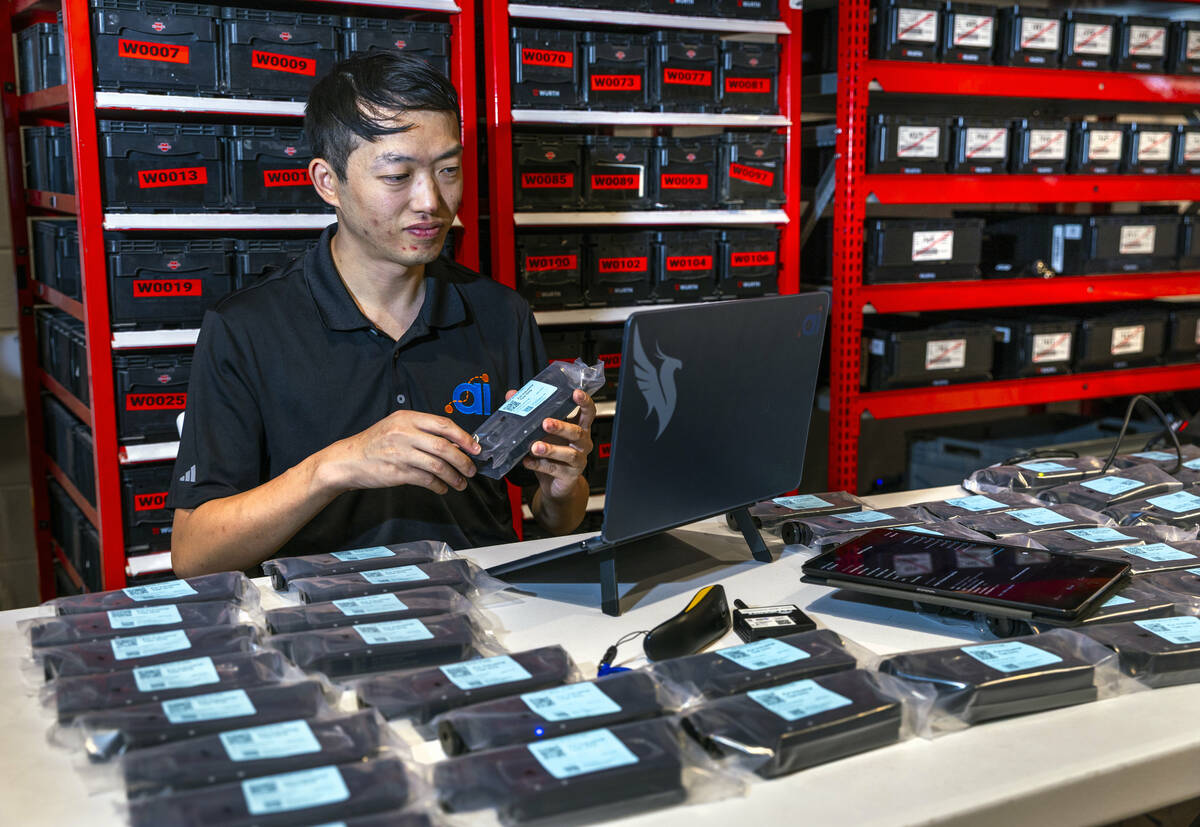
“We were looking for the next step. You have a couple options to do that but we had an opportunity to go with the SPAC route and try to take it public,” he said. “At the time we had a really large customer in Wurth, which we’ve announced publicly we’re signing up to a five-year deal with us. We had a couple others in the pipeline that were of that size, and we knew we needed significant capital to scale and create the organizational capability to service those large multi-national accounts. The question is where to get that capital.
“We decided that the SPAC route and going public was the best way to go. Our investors were also really interested in the liquidity option of being public. … The reality is that some of our adoption became a little bit slower than we wanted it to, so we were probably a little bit early to do the public push. But at the time it certainly was the best path for us.”
Nabrotzky couldn’t definitively say why Dot Ai’s stock price surged so high after going public.
“But I would say historically when you look at companies that go public via SPAC, microcaps like we are, the low trading volume allows people to manipulate the stock price relatively easily,” he said. “I’m not sure that was the case but it’s one thing you can look at. That’s just how the public market works.”
On the flip side, the stock dipped under $1 in December, six months after the company went public.
“There’s always a magic demarcation line at six months,” he said. “You often see a lot of selling after six months with any initial microcap that goes public. We had an inflection point at that six-month point that drove us under a dollar.
“We haven’t generated the revenue we need to. … That’s probably what’s hurt us the most.”
Earnings call
Dot Ai reported on an earnings call Wednesday fourth quarter revenue of $4.5 million, marking its first significant commercial revenue, and full-year revenue of $5.8 million for 2025.
“For us, it was a big close to the year,” Nabrotzky said. “We ended up with just under $6 million in revenue. That doesn’t sound like a lot, but going from pre-revenue where you have no revenue and you’re building technology to getting your first $6 million in the books is a big milestone for us.
“I think that will reflect in the valuation going forward. … These last six months between going public in June and the end of the year, I would call them foundational. … We’re still in growth mode. We’re not profitable yet. We have to move our subscription base a lot higher to make a profit but we’re moving in that direction for sure.”
Dot Ai’s revenue guidance for 2026 is $6 million to $7.5 million.
“It’s small growth over last year, but the difference is a shift,” Nabrotzky said. “Last year, we sold a lot of hardware. This year, we’re selling, on top of hardware, software subscriptions.
“Even though it doesn’t look like big revenue growth for the year, it’s a significantly higher margin and it’s recurring revenue that will happen the next four or five years.”
Tech
To describe Dot Ai’s technology simply, Nabrotzky likened it to Apple Air Tags.
“An Apple Air Tag needs a piece of hardware to be beaconing and it needs a phone to be in proximity to hear the beacon,” he said. “It’s very similar to what we do in the industrial sense. We can put tags on different things, whether physical tags or virtual tags, and we read them with special readers we call bridges.
“Bridges are just like an iPhone, expect we don’t have iPhones wandering around factories or warehouses.”
Contact reporter Todd Dewey at [email protected]. Follow @tdewey33 on X.