“Entrepreneurs can create solutions that are both impactful and commercially successful”
March 13, 2026 | Friday | Views
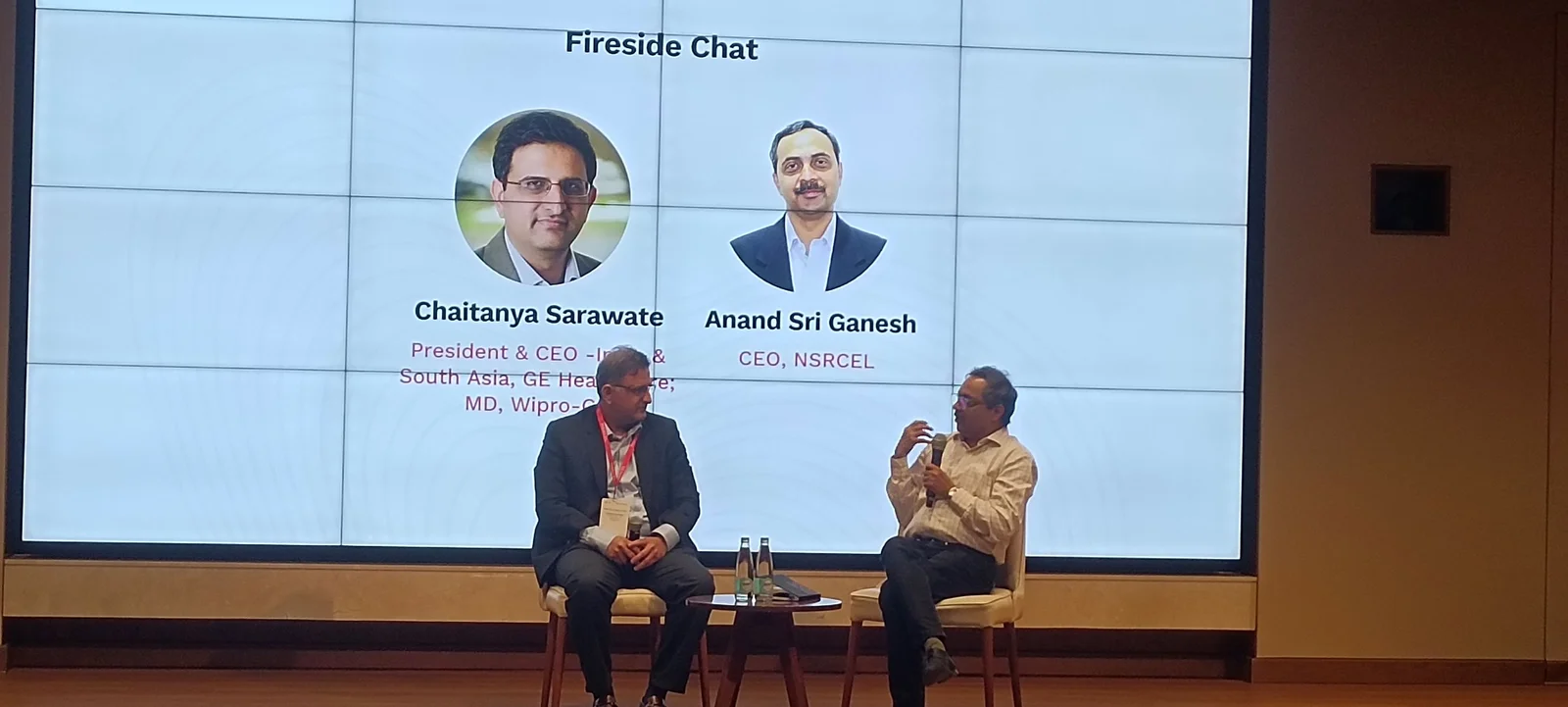
The Nadathur S Raghavan Centre for Entrepreneurial Learning (NSRCEL) at Indian Institute of Management Bangalore (IIMB) in association with DailyRounds/Marrow has organised a day long MedTech Day 2026 in Bangalore by bringing together clinicians, innovators and startup founders to discuss the next wave of healthcare entrepreneurship in India. In a Fireside Chat with Anand Sri Ganesh, CEO, NSRCEL, Chaitanya Sarawate, President & CEO – India and South Asia, GE Healthcare discussed how innovation plays a crucial role both for startups and large organisations like GE Healthcare.
What role does innovation play in large companies like GE Healthcare?
Innovation is essential for maintaining competitiveness in a rapidly evolving healthcare industry. Large organisations like GE Healthcare possess strong resources such as capital, distribution channels, and regulatory knowledge. However, these advantages sometimes lead companies to focus on incremental improvements rather than disruptive innovations. Therefore, companies must continuously re-evaluate their innovation processes to remain relevant and competitive.
What lesson did GE Healthcare learn during the COVID-19 pandemic?
The pandemic highlighted the speed and adaptability of startups and smaller companies. While large corporations were discussing long-term production plans, several smaller firms quickly designed and delivered functional ventilators. This experience showed GE Healthcare that it had become somewhat risk-averse and needed to rediscover its entrepreneurial mindset. The company realised that innovation requires agility, experimentation, and openness to external ideas.
What is the innovation framework GE Healthcare follows?
The innovation framework followed at GE Healthcare consists of three key stages: insight, invention, and industrialisation. The first stage, insight, focuses on deeply understanding the real problems faced by customers, clinicians, or healthcare providers rather than simply responding to surface-level requests. Once the core problem is clearly identified, the second stage, invention, involves developing a technological or process-based solution that effectively addresses that need. The final stage, industrialisation, is about scaling the solution by manufacturing it efficiently and distributing it widely so that it can reach global markets and benefit a larger population.
While GE Healthcare has long been strong in the industrialisation phase—because of its established manufacturing capabilities and global distribution networks—the company realised it needed to strengthen its ability to generate deeper insights and transform them into meaningful innovations.
How does understanding customer insight improve innovation?
Customer insight helps companies design solutions that address the real problem instead of merely responding to surface-level requests. In the anaesthesia machine example, doctors initially asked for neonatal capability, which seemed to require complex engineering changes. However, deeper research showed that their primary concern was reliability and precision in gas delivery. By understanding the underlying need, engineers could design a more practical solution while avoiding unnecessary complexity.
Why is open innovation important for large companies?
Large organisations cannot address every technological challenge internally. By collaborating with startups, universities, and research institutions, companies gain access to diverse ideas, new technologies, and entrepreneurial thinking. Open innovation allows corporations to extend their research ecosystem and accelerate the development of new healthcare solutions.
What initiatives has GE Healthcare taken to support startups?
GE Healthcare launched programmes such as the 5.8 Accelerator, which focuses on developing healthcare solutions for the billions of people worldwide who lack access to quality medical services. Through such initiatives, startups receive mentorship, technical guidance, and access to GE’s manufacturing and distribution capabilities.
At what stage should startups collaborate with large companies?
Collaboration works best when startups have developed a working prototype and a clear understanding of their target market. At this stage, large companies can provide support in areas such as regulatory approvals, product validation, manufacturing, and global distribution. Engaging too early may slow down startups due to the complex processes and risk-management practices of large organizations.
What advice was given to founders and innovators?
Founders should focus on solving real problems rather than striving for unnecessary technological perfection. Products must meet safety standards, but innovators should also consider what customers actually need and are willing to pay for. By balancing innovation with practicality and market demand, entrepreneurs can create solutions that are both impactful and commercially successful.
Narayan Kulkarni
([email protected])