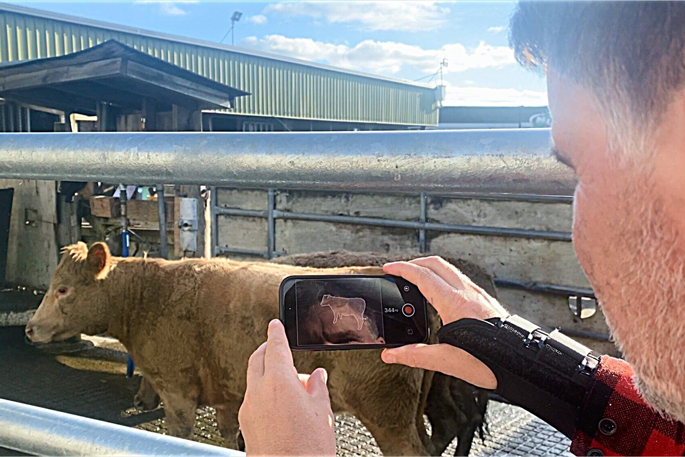
A Waikato-founded agri‑tech startup is aiming to transform how farmers measure and manage livestock, using 3D imaging and artificial intelligence to predict animal weights without traditional scales.
Scanabull chief executive Dan Bull grew up on his family’s sheep and beef farm at Te Akau, across the Whaingaroa Harbour from Raglan.
After completing a Master of Science in Machine Learning degree at the University of Waikato, he built a career as a data scientist specialising in computer vision systems.
But his early years farming, particularly raising Friesian bull calves into 18- to 20‑month-old beef animals, kept him connected to the day‑to‑day challenges on the farm.
“Even when hand‑reared and relatively friendly, bulls are not the easiest to manage and are prone to breaking stuff and each other,” he says.
“Getting them into the yards from the back of long farms can be a mission, especially if all they need is to be weighed.”
Bringing farming and imagery together
Dan has long theorised that 3D measurements could accurately predict an animal’s weight, but the technology wasn’t accessible when the idea first came to him around 2012.
“Now, in 2025, there is cheap, accurate Light Detection and Ranging (LiDAR) hardware available. We wrote our own algorithms to process these images.”
LiDAR uses pulses of laser light to measure distance. The data can be used to create 3D representations of objects and environments, in this case animals.
The company was created in April 2024, and Dan’s 14-year-old son George came up with the very apt name Scanabull.
Software developer and chief technical officer Daniel Stuart-Jones (Daniel SJ) came on board with his experience in imaging solutions for an international company. He moved his family to Raglan in 2019, where he met Dan and started work in 2024 on the development of interfacing Scanabull using existing iPhone technology.
“The new iPhones have a 3D camera, and Apple have done a great job,” Daniel SJ says. “If farmers have an iPhone, they already have the hardware on them while out in the yards and paddocks.”
Dan says using the iPhone 3D images makes it quick and easy to weigh the animals and provide a visual match.
“This data can be used by stock agents by sending a link, and will be useful during stock yard sales.”
Partnering with meat companies
Silver Fern Farms has expressed interest in being an initial customer and sharing data.
“For meat companies, it can be hard to predict the supply chain, and hard to run a consistent business,” says Dan. “If the app is out there, creating valuable information earlier in the supply chain, it can eliminate animals that would be too small or large before they are sent for processing.”
He sees this as a win for farmers, meat processors and the environment as it gets stock off the farm promptly, and less methane is produced.
“If more trading happened on-farm, there would be less journey time. With both an image and an accurate live weight, our system adds trust to on-farm sales. It demonstrates better animal welfare, less yard time for large animals, less travelling and better farm efficiencies.”
Building custom hardware
Traditional scales can be only 95% accurate to the true weight of an animal because of calibration inconsistencies and animal gut fill.
Next year, in addition to using a handheld iPhone, a custom hardware weigh box will be available. This shoebox-sized, waterproof weigh box will allow automatic weighing of animals in the paddock.
“The box can be positioned in a gateway and, as each animal passes through, it automatically takes a 3D scan which predicts the weight plus an image for identification purposes,” says Dan.
The weigh box will assist with automated farming and sharing data with the vets, stock agents, supply chain and meat processors.
Weight is important for dairy industry grazers, as well as beef farmers, and Dan is already talking to the big dairy companies about using Scanabull.
“Using extensive data supplied by Silver Fern Farms, we are also training our AI algorithms to predict carcass weight and grading score.
“It’s useful information for the farmer to predict what the payout might be, and gives the meat processors better supply-chain knowledge.”
Dan has been testing the systems on Pamu farms, and they have been very helpful. Live weight, carcass weight and grading scores will be available for every animal in future.
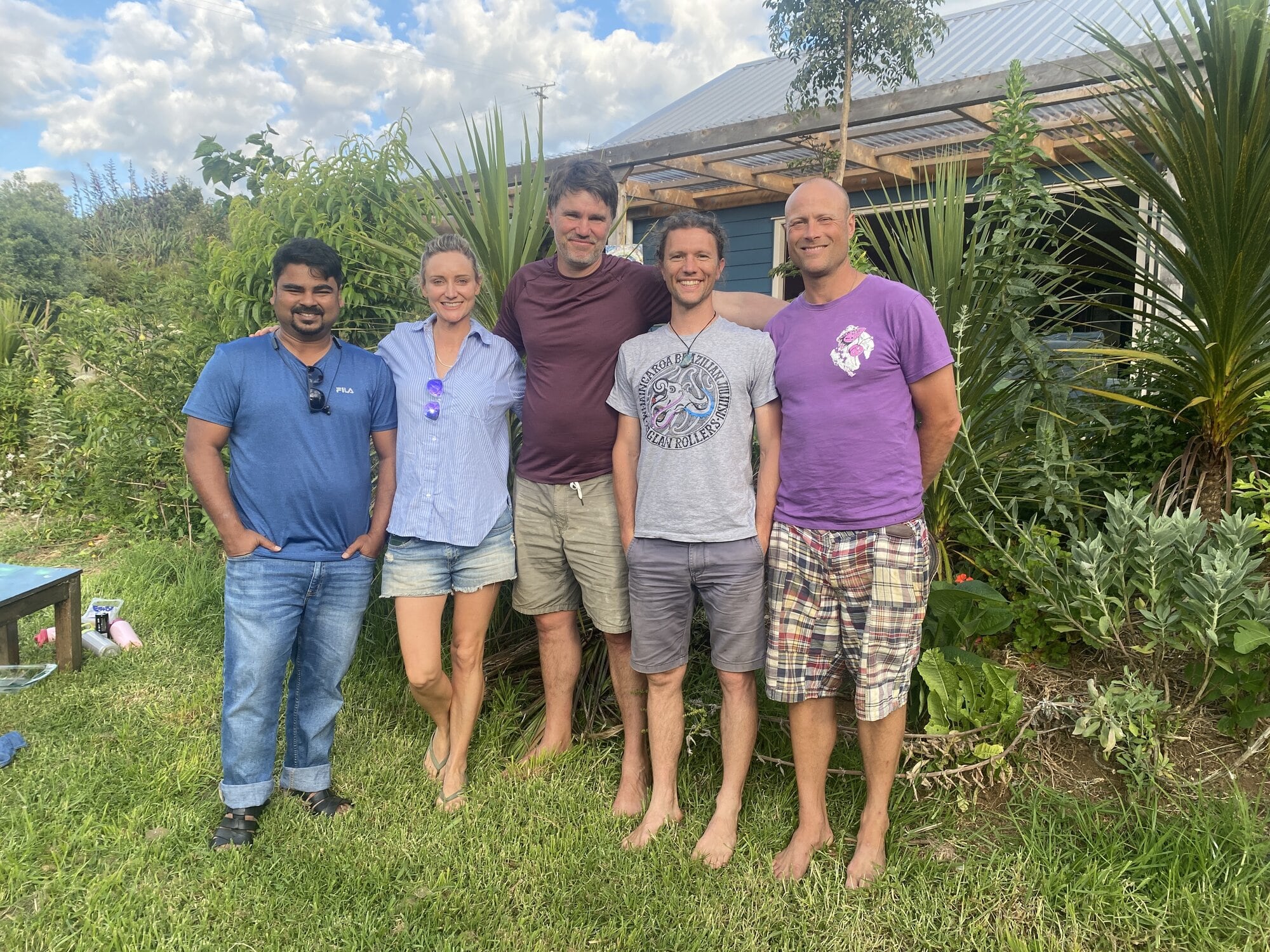
The Scanabull team (from left): Munaz Jahan, Ursula Haywood, Dan Bull, Daniel Stuart-Jones and Paul Sealock.
The four shareholders, Dan and Daniel SJ, head of operations Paul Sealock and chief commercial officer Ursula Haywood, were thrilled to be finalists in the 2025 Fieldays Innovations Awards.
This self-funded venture has been a leap of faith for them all. They intend to use New Zealand as a test bed and then introduce their product to Australia, the United States, Canada and Europe.
Scanabull will soft-launch early this year. Its big commercial launch, alongside its business partners, will be at Fieldays in June.