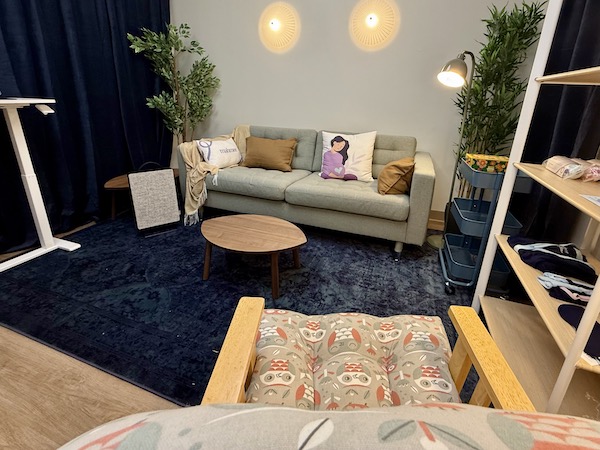
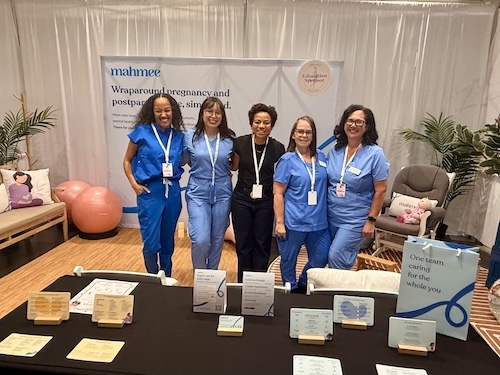
Melissa Hannah speaks at a maternity industry trade show. Mahmee photo
Written by Ben Hensley
A Los Angeles-based health technology company backed by high-profile investors including Mark Cuban and Serena Williams is expanding its maternal and infant health services into the Central Valley, aiming to close gaps in care between doctor visits and hospital stays.
Mahmee (pronounced “Mommy”) was created by entrepreneur Melissa Hanna and her mother Linda Hanna, a maternal health nurse and lactation consultant with more than 40 years of experience. The company’s early technology platform attracted investors including Cuban, Williams and AOL founder Steve Case, and in 2022 Mahmee raised a $9.2 million Series A funding round led by Goldman Sachs.
The mother-daughter duo launched the company with a goal of incorporating technology and coordinated care teams to help improve outcomes for mothers and babies. Mahmee initially launched in Southern California and opened its first Central Valley location in 2025 at the Target-anchored Clovis Commons shopping center at 625 W. Herndon Ave., Ste. 14. The company hopes to continue expanding throughout the state in the coming years.
“The roots of the company are that my own mom has worked in maternal and infant health her whole career, over 40 years as a registered nurse certified in obstetric care and a board certified lactation consultant,” Hanna said.
Dinner table to startup
Hanna began her career in education technology, developing software designed to connect students with resources and support services. While she pursued a joint law degree and business degree at home in Los Angeles, she found herself discussing those systems over dinner with her mother.
“She said, ‘you know, I wish we had something like that to take better care of moms and babies,’” Hanna said.
The comment sparked a realization that despite large investments in health care, maternal outcomes in the United States lag behind those of many other advanced countries.
company providing coordinated maternal and
infant care services, is expanding into the Central Valley to improve care between doctor visits. Mahmee photo
“It didn’t seem possible that we could be No. 1 in cost across all developed wealthy nations — we spend more than anyone else — and we’re last in quality,” Hanna said. “So we spend the most, we get the least in return.”
Mahmee launched its first software-based program in 2016. The platform was designed to connect community-based providers — including doulas, home-visiting nurses and lactation consultants — with hospitals and physicians.
The system allowed providers working directly with families to share information and coordinate care with larger medical systems, helping bridge gaps between patients’ needs and hospital services.
The idea stemmed from Hanna’s observation of a disconnect between frontline caregivers and large medical systems.
“The systems didn’t talk to each other,” Hanna said. “A lot of the people who had a pretty good sense of what was going on for mom and baby were the community-based providers.”
Those providers often have more insight into a family’s day-to-day challenges. However, community-based providers have often been left out of formal health care systems or insurance coverage.
Mahmee’s early software allowed those professionals to track patient data and communicate with hospitals, doctors and insurance providers.
Software platform to full-service network
Hanna eventually realized the technology alone would not solve the problem she and her mother set out to fix.
“We learned that there’s actually not enough care providers in these communities to take care of all of the families that need help,” she said.
Mahmee then shifted into its second iteration — a vertically integrated model employing its own team of doulas, nurses, lactation consultants, mental health providers and nutritionists. Hanna described these five disciplines as areas often missing from standard obstetric and pediatric care.
“We went back to the insurance companies and said, we will do this, we’ll employ the staff and build the workforce if you will pay for these five key services,” Hanna said.
Through a bundled care model available on the Mahmee platform, services became available connecting providers and families through messaging, video calls and in-person clinic visits, while also incorporating tools such as remote blood pressure monitoring.
Users can receive coaching from nutritionists, participate in mental health support groups, book appointments and communicate with care teams throughout all stages of pregnancy and early parenthood.
“We call it a value-based bundle,” Hanna said. “It’s a package like a gym membership where no one says you can’t use the elliptical today — everything is there for you.”
Families can access Mahmee’s services through insurance partnerships or by paying directly for individual services and care packages.
Virtual lactation consultations start at around $100, with postpartum doula support ranging from about $350 to $750.
More comprehensive packages are also available, including birth attendance and ongoing support. Packages range in price, peaking at around $2,800 depending on the level of care. The platform also offers a membership option allowing families to message providers directly and join support groups for around $30 a month.
Expansion targets maternal care gaps
The company now serves thousands of families and operates 11 clinics across California, along with partnerships in the Washington, D.C., region.
Mahmee’s services expanded rapidly in recent years; Hanna noted the company nearly doubled between 2024 and 2025.
The COVID-19 pandemic accelerated the adoption of digital health care tools but also exposed new risks for maternal care.
“We actually saw worse outcomes for moms and babies during the pandemic and shortly after because of that extreme isolation,” Hanna said.
She said the experience reinforced the need for hybrid models combining in-person care with digital interaction between visits.
“Most of pregnancy and new parenthood is happening in the outpatient setting,” Hanna said. “There’s a lot of life happening in between those doctor’s office appointments.”
Mahmee’s expansion into regions such as Fresno and Madera reflects its focus on communities where maternal care disparities are pronounced. Hanna said the goal is to make Mahmee’s services accessible to families ranging from urban neighborhoods to rural communities.
“California is a weird mix,” Hanna said. “We’re doing really well in some areas and not very well in other areas because we’ve got such a diverse population and such a diverse landscape.”
Hanna said reaching those communities is one of the core goals in the company’s broader mission.
“The mission of the company is to make the U.S. the best place in the world to give birth,” she said. “You cannot accomplish that mission unless you actually target the areas and the communities and the families who need the most help.”
Source link

![[Selected Company for Sunchon National University Early-Stage Startup Package 2025 - Deep Tech Selection] Health-Tech Startup ‘BSENS’, Developing Functional Clothing Based on Scientific Evidence](https://newsx.io/wp-content/uploads/2026/01/1768758130_Selected-Company-for-Sunchon-National-University-Early-Stage-Startup-Package-2025.jpg)