
Korea’s push to become global AI powerhouse has been accelerating in a massive speed, backed by capital, policy, and infrastructure at scale. Yet across conversations with founders and investors, a quieter recalibration is taking shape. The question is shifting away from technical capability toward something more fundamental: which AI startups can convert rapid innovation into durable, revenue-generating businesses in an increasingly cost-sensitive environment.
For Korean AI Startups, Growth Is Not the Question Anymore
South Korea’s AI ecosystem is still expanding at pace. Government-backed financing, deep-tech startup programs, and infrastructure investment continue to push the market forward.
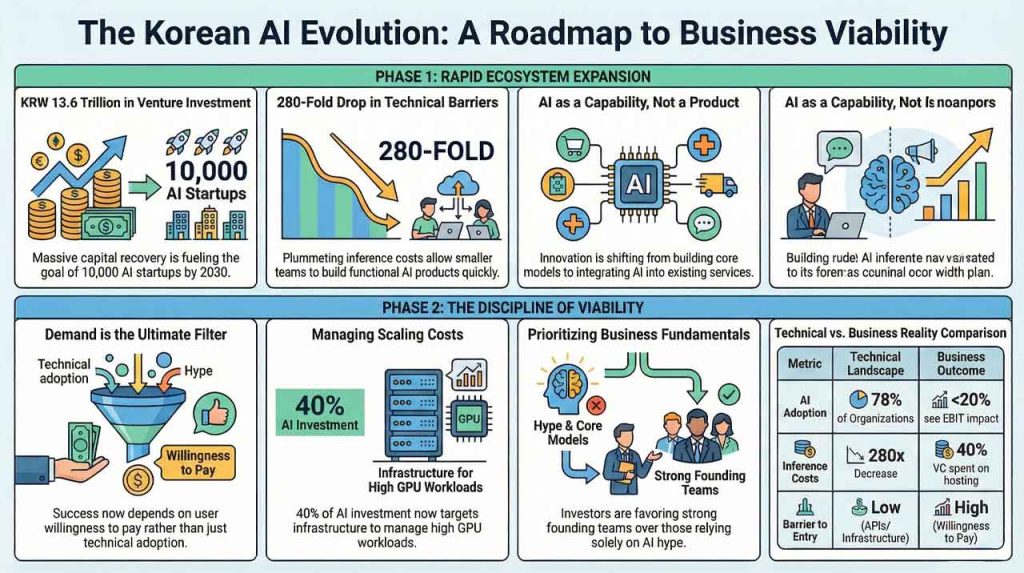
The Ministry of SMEs and Startups has outlined a long-term plan to foster 10,000 AI and deep-tech startups by 2030, alongside expanding venture funding and infrastructure access. At the same time, venture investment in Korea reached KRW 13.6 trillion in 2025, marking a recovery and signaling continued capital availability.
These show clear direction that South Korea is not slowing down its AI push.
Still, beneath this expansion, a different constraint is emerging. The question is no longer whether AI can be built. It is whether AI startups can sustain viable businesses.
Building AI Is Getting Easier, and That Changes Competition
The global shift in AI development is reshaping how startups are formed.
According to Stanford’s AI Index 2025, AI adoption reached 78% of organizations in 2024, while inference costs for models at the level of GPT-3.5 dropped more than 280-fold between 2022 and 2024.
This matters for startups. Lower technical barriers mean that smaller teams can now assemble functional AI products quickly by combining existing models, APIs, and infrastructure.
The result is visible across ecosystems, including Korea. More startups can build, iterate, and launch AI products without developing core models from scratch.
But this accessibility comes with a trade-off. When building becomes easier, differentiation becomes harder.
Demand Becomes the First Filter in AI Startup Viability
As barriers to entry fall, the constraint shifts toward demand.
Hojoung Lee, CEO of Undermilli, frames the issue in operational terms based on his experience building AI products:
“If users have no willingness to pay, the business can’t be viable… it seems that users’ willingness to pay is more important.”
This reflects a broader transition taking place across AI startups.
The early phase of experimentation is giving way to a more disciplined stage, where startups are expected to demonstrate real user demand before scaling.
Global data supports this gap. McKinsey’s 2025 AI report found that while adoption is increasing, more than 80% of organizations have yet to see tangible enterprise-level EBIT impact from generative AI.
The implication is direct. AI capability alone does not guarantee business outcomes.
Rising Infrastructure Costs Are Redefining the Economics of Scale
At the same time, cost structures are becoming more visible as startups move beyond prototypes.
South Korea’s policy direction highlights how central this issue has become. The government is actively expanding AI compute capacity, targeting tens of thousands of advanced GPUs to support large-scale workloads.
This reflects a structural reality. AI systems require significant infrastructure to scale, even if initial development costs are falling.
Global capital flows reinforce this trend. OECD data shows that in 2025, over 40% of AI venture investment went into infrastructure and hosting layers, rather than application-level startups.
For founders, the challenge becomes twofold:
- acquiring users who are willing to pay
- managing the cost of serving those users at scale
This aligns with Lee’s observation that cost sustainability becomes a critical issue after initial traction is achieved.
Investors Are Looking Beyond the AI Label
Investor behavior is also evolving in response to these dynamics.
Urska Vracun, an angel investor active in early-stage ecosystems, highlights that traditional evaluation criteria remain central:
“For early-stage startups, the founding team is very important… if there is cohesion, similar vision and adequate experience, it makes the startup much more attractive.”
At the same time, she points to a more recent shift:
“I also give a higher evaluation to those startups which don’t base their whole product on AI.”
This reflects growing caution toward startups that rely primarily on AI positioning without clear business fundamentals.
External signals support this shift. Investors have raised concerns about inflated valuations among early-stage AI startups, where companies with limited revenue can still attract significant funding based on AI narratives.
The direction is not a rejection of AI. It is a refinement of how AI is evaluated.
AI is increasingly treated as a capability layer rather than a standalone business model.
Korea’s Unique Position: Expansion Meets Discipline
South Korea’s AI ecosystem is entering this transition while still in an expansion phase. Policy support remains strong. Venture funding is recovering. Infrastructure investment is accelerating.
This creates a unique overlap.
Unlike markets that are already showing signs of slowdown, Korea is experiencing growth and discipline at the same time.
For global founders and investors, this has two implications.
First, Korea remains an attractive entry point for AI and deep-tech startups, supported by capital and policy alignment.
Second, the bar for viability is rising faster than the expansion narrative might suggest.
What This Means for Global Startup Operators
The shift toward viability is not unique to Korea, but the speed at which it is happening offers a useful signal for global ecosystems.
Three practical implications stand out:
Real Demand Is Now a Baseline Requirement
Startups are expected to demonstrate user willingness to pay earlier in the lifecycle. Product adoption alone is no longer sufficient.
Cost Discipline Determines Survivability
Even with improving infrastructure access, inefficient cost structures can quickly erode margins as usage scales.
AI Is Becoming an Enabler, not a Business on Its Own
Startups that rely solely on AI positioning face increasing scrutiny. Execution, market fit, and team quality remain decisive factors.
Conclusion: From Capability to Business Discipline
In the end, South Korea’s AI ecosystem is not slowing down. It is evolving instead.
The combination of falling development barriers, rising infrastructure demands, and shifting investor expectations is redefining what success looks like.
The next phase will not be determined by who can build AI products the fastest.
It will be determined by who can turn those products into sustainable businesses.
Key Takeaway on Korean AI Startup Viability
- South Korea continues to expand AI through policy funding, venture capital growth, and GPU infrastructure investment
- AI development barriers are falling globally, with adoption reaching 78% and costs dropping significantly
- Korean founders highlight a shift toward user willingness to pay as the primary viability factor
- Infrastructure costs remain a critical constraint as AI products scale
- Investors are placing greater emphasis on team quality and business fundamentals, not just AI positioning
- Korea’s ecosystem is entering a phase where growth and discipline coexist, raising the bar for startup success
- For global founders and investors, Korea signals a broader transition toward AI startup monetization and sustainable business models
🤝 Looking to connect with verified Korean companies building globally?
Explore curated company profiles and request direct introductions through beSUCCESS Connect.
– Stay Ahead in Korea’s Startup Scene –
Get real-time insights, funding updates, and policy shifts shaping Korea’s innovation ecosystem.
➡️ Follow KoreaTechDesk on LinkedIn, X (Twitter), Threads, Bluesky, Telegram, Facebook, and WhatsApp Channel.