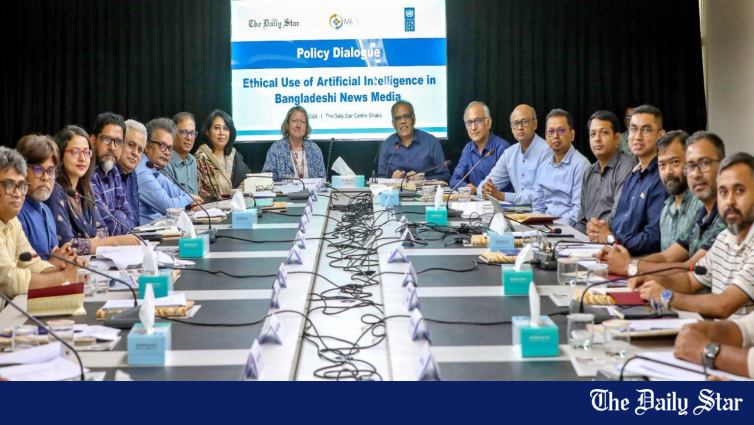
The rise of artificial intelligence (AI) in journalism offers unprecedented opportunities, but it also raises urgent ethical concerns, industry experts warned at a roundtable in Dhaka today.
The event, titled “Future of AI and Ethical Journalism in Bangladesh,” was organised by The Daily Star and Media Resources Development Initiative (MRDI), with support from the United Nations Development Programme (UNDP).
Speaking at the programme, Shakhawat Liton, executive editor of TBS, cautioned against legal regulation of AI in media.
“Our political and social culture is such that whenever a problem arises, we want to solve it through laws. By moving towards a legal framework for AI, we are indirectly handing the government another tool to control the media,” he said, adding that laws are generally designed to constrain rather than empower freedom.
Shawkat Hossain, head of online at Prothom Alo, argued that AI regulations should align with a media outlet’s editorial policy, and outsiders have no jurisdiction to dictate such rules.
Echoing this, Dr Md Saiful Alam Chowdhury, associate professor at Dhaka University, warned that seeking government regulation, given the authorities’ current level of AI literacy, could invite disaster.
Journalist Talat Mamun suggested that if 10 to 15 leading media houses set their own AI standards, it would create a trend, allowing the sector to self-regulate effectively.
MRDI Executive Director Hasibur Rahman outlined plans to develop a comprehensive AI guideline applicable to print, online, and television platforms, which any media organisation could adopt with ease.
Speakers also highlighted current AI applications in Bangladeshi media.
Shawkat noted that the 60-word news summaries in Prothom Alo’s “Shorts” app are almost entirely AI-generated. Yet, a lack of AI training among journalists remains a critical concern.
Kamal Ahmed, consulting editor at The Daily Star, said, “We are still far behind in using AI. But we cannot remain detached from this train. No matter how late, we have to get on board.”
Md Al Mamun, country director of BBC Media Action, stressed the importance of major investments in AI training, warning that unskilled oversight could result in significant errors.
Dr Sumon Rahman of ULAB highlighted the intellectual necessity of mastering “prompt writing” to avoid bias and misinformation.
Dr Susan Vize, UNESCO representative in Bangladesh, described the UN’s role in training journalists on AI tools, noting that around 3,500 journalists were trained alongside the Press Information Bureau before the elections.
“I was actually a little bit surprised at the lack of knowledge of many of these people about AI,” she said.
She stressed the urgent need for localised, flexible codes of practice in Bangladesh and suggested that regional examples, such as those in Southeast Europe, could provide guidance to balance AI-driven efficiency with accountability and reliability.