In the early 2000s, a goods train derailed near a village in Odisha’s Sundargarh due to a brake failure causing damage to livestock and livelihood of locals, leaving an indelible mark on two teenagers growing up in the vicinity. Years later, the boys found their calling after completing their engineering courses when they realised the need to upgrade the technologies to avert train accidents. Keeping this in mind, Sanjeet Kumar Mahato, 29, and Anurag Xaxa, 35 founded Teezash Labs- a deep tech startup in April 2025. The startup secured a pilot with Indian Railways to spot brake failures. Ready with the first IoT-enabled braking system, the duo is in the process of scaling the technology, creating similar models for the Indian Railways.
Born in a farming family in Odisha, a state that has witnessed some of the country’s most devastating railway accidents, Sanjeet is a first-generation college graduate and the first engineer in his family. From childhood, he had been exposed to safety incidents, experiences that strongly shaped his interest in safety-critical engineering and failure-prevention systems. “Life in my village gave me first-hand information on how a mechanical failure could destroy lives and livelihoods,” says Sanjeet, who holds a BTech in Electronics and Telecommunication from Padmanava College of Engineering, Rourkela. “It was a lack of technology that led to accidents. If one can understand the use and implementation of a machine, it can avert disasters,” he adds.
Anurag, who hails from a tribal family traditionally dependent on agriculture and forest-based livelihoods, is the first in his family to receive higher education. “Growing up near mining belts, railway corridors, and industrial zones, I witnessed how gas leaks, equipment failures, and infrastructure accidents were often treated as unavoidable risks. These early exposures influenced my decision to focus on building robust, sensor-driven systems capable of preventing failure rather than merely responding to it,” says Anurag, who pursued an MCA from Odisha University of Technology and Research in 2017.
Their solution combines rugged, distributed sensors with edge computing and cloud analytics. Sensors mounted on wagon components capture vibration, temperature and other signals; on-device algorithms flag anomalies and generate clear, actionable alerts for operators. The system is designed to withstand India’s extreme temperatures, heavy vibration, and limited power availability.
Incubation Pathway
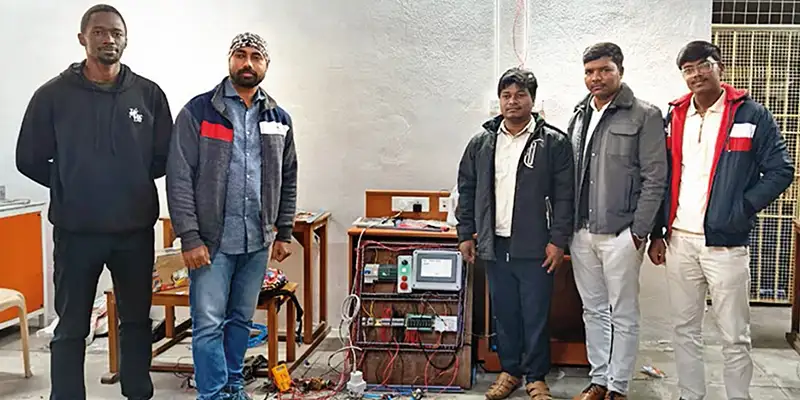
The risks of entrepreneurship have always been high for young founders. Sanjeet left a stable job in R&D team at Tata Elxsi and Anurag resigned from a banking job to return to Rourkela. The duo toyed with the idea, which was supported by NIT Roukela’s (NIT-R) Foundation for Technology and Business Incubation (FTBI). The incubator provided seed funding of Rs 5 lakh under the inclusive entrepreneurship programmes supported by the Department of Science and Technology (DST). FTBI provided mentorship, access to institutional labs, and helped the team navigate procurement and regulatory pathways which landed them their 58-wagon pilot project with the Chakradharpur Division of Indian Railways in October last year. Along with four interns, the team has been working on IoT-based braking health monitoring system for freight wagons.
In an interaction with Education Times, Prof Subrat Kumar Panda, president, FTBI, NIT-R, says the aim is to support startups that identifies and solves local problems. “FTBI has so far disbursed Rs 9.45 crore to various startup projects, which includes interest-free loans ranging from Rs 3 lakh to Rs 15 lakh to bridge shortfalls. We actively link startups to industry challenges, posed by our partners Tata Steel, Nalco and the Indian Railways among others,” Prof Panda says. The project has also emerged as an example of how campus incubators can convert local talent into commercially viable innovation. “We are not trying to replace the placement opportunities. However, if engineering education only ends with placements, we are limiting the potential of students. Through incubation, students are learning how to take a problem from the field, build a solution, test it under real conditions and engage with large public-sector clients,” Prof Panda adds.
Beyond railways, FTBI has been steering startups toward mining, agritech and rural technology solutions, sectors that dominate the western belt of Odisha and neighbouring Jharkhand. The incubator leverages CSR funding and District Mineral Foundation (DMF) resources to support projects with local impact and plans to open extension centres in nearby districts to extend its outreach beyond the Rourkela campus. “Many founders come from rural or tribal backgrounds and naturally work on problems they have lived with. Our role is to help them convert that insight into a viable product,” adds Prof Panda.
However, scaling remains a challenge. Even with pilots and institutional backing, startups face hurdles in regulatory approvals, large-scale manufacturing, and sustained market access. “A pilot validates the technology, but scaling requires patience, capital and long-term engagement. FTBI helped us reach this stage, but the journey ahead is demanding,” adds Mahato.
(The journalist was invited by NIT Rourkela to visit the campus)