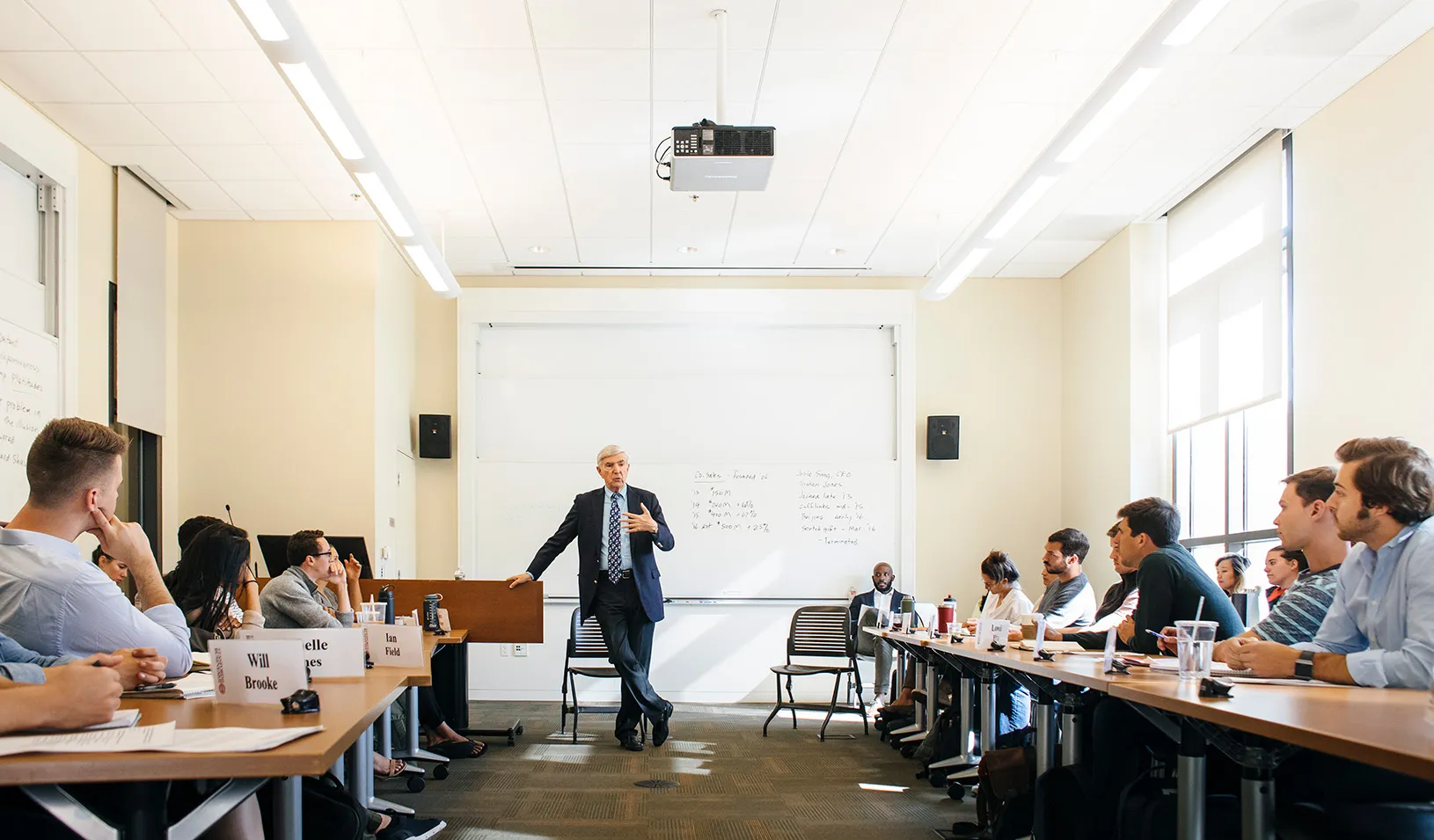
Over the past three decades, CES and its affiliated faculty have focused on building world-class learning experiences — both in the classroom and in co-curricular programs — and on conducting research projects related to entrepreneurship.
“Today the GSB offers more than 50 courses related to entrepreneurship and innovation,” says CES director Deb Whitman, “allowing entrepreneurially interested students to curate a course plan that suits their personal learning goals.” In addition, “they can augment their GSB courses with entrepreneurial classes at nearly every other Stanford school.”
Grousbeck developed and taught Formation of New Ventures before CES was established, and it remains a foundational course, along with Managing Growing Enterprises, which aims to help prospective founders deepen their understanding of challenges facing a company or nonprofit seeking to scale up. The courses use real-world cases as teaching modules.
Charles Holloway, Stanford GSB professor and co-founder of CES (at left) shown with John Morgridge, MBA ’57, former CEO and chairman of Cisco Systems; the pair taught together for several years after Holloway helped pioneer the co-teaching model at the business school. | GSB Archives
Early on, Holloway recognized that the program needed teaching partners who had founded or led companies themselves. His first call was to his friend John Morgridge, MBA ’57, the former CEO and chairman of Cisco Systems. “He had recently retired, so he and I taught together for several years,” Holloway recalls. It was a new model, a proof of concept, and it worked. “That was Chuck’s genius, pairing us with people from the outside,” says Grousbeck. And although alumni were often the best picks for practitioner-teachers, that wasn’t always the case. Grousbeck recalls co-teaching with Seattle Mariners owner and CEO John Stanton, even though Stanton had no association with Stanford.
One of the challenges, Holloway points out, was that the lecturers had deep domain expertise, but sometimes didn’t know much about teaching. But they were willing to learn. “They were very committed,” he says.
Garth Saloner, former CES faculty director and Stanford GSB dean, says the entrepreneurial coursework digs into the fundamentals first, answering questions that all founders will encounter: “What makes a great founder? How do you evaluate ideas? How do you raise money or put a board together? And then what do you do with your baby once it’s fully grown? There’s a set of conceptual frameworks that drive the arc of the courses.”
Those questions haven’t changed in 30 years, but the answers change depending on the current environment, says Saloner, the Botha-Chan Professor of Economics. “Right now, it’s all AI, all the time, in people’s minds, so, in a very frothy environment, how do you think about whether you should be going into that space?”
Quote
Today the GSB offers more than 50 GSB courses related to entrepreneurship and innovation, allowing entrepreneurially interested students to curate a course plan that suits their personal learning goals.
Author Name
— Deb Whitman
One of the most immersive exercises in Formation of New Ventures is Pitch Day. A venture capitalist is invited to class to hear students present their ideas and share feedback about each venture as the pitch progresses. Saloner stresses that this is not a simulation. “It’s a real opportunity for them to get in front of a VC. Sometimes it goes somewhere, but often, of course, it doesn’t. But learning happens in those interactions.” Students are taught to ask themselves, “What is the body language telling me about whether this is going well?”
“I found the entrepreneurship classes extremely stimulating — Formation of New Ventures and Managing Growing Enterprises were two of my all-time favorite classes,” says Ricket. “One lesson that sticks with me to this day came from the Family Business course. The key lesson for me was to see the issues of control of a business and economic interest in a business as two separate things.” He says that insight contributed to PayJoy’s success by making him more willing to take a smaller ownership stake to attract more investors, while maintaining control as the CEO/founder, so the company “remained true to its social justice mission.”
From the beginning, Grousbeck and Holloway recognized the value of developing cases about companies located on the West Coast. They hired recent graduates as case writers and began assembling a portfolio to provide a distinctive set of teaching materials. CES continues to update its library of cases to ensure contemporary relevance. “You can’t teach 30-year-old cases in entrepreneurship courses,” Whitman notes. “They have to be pretty current.”