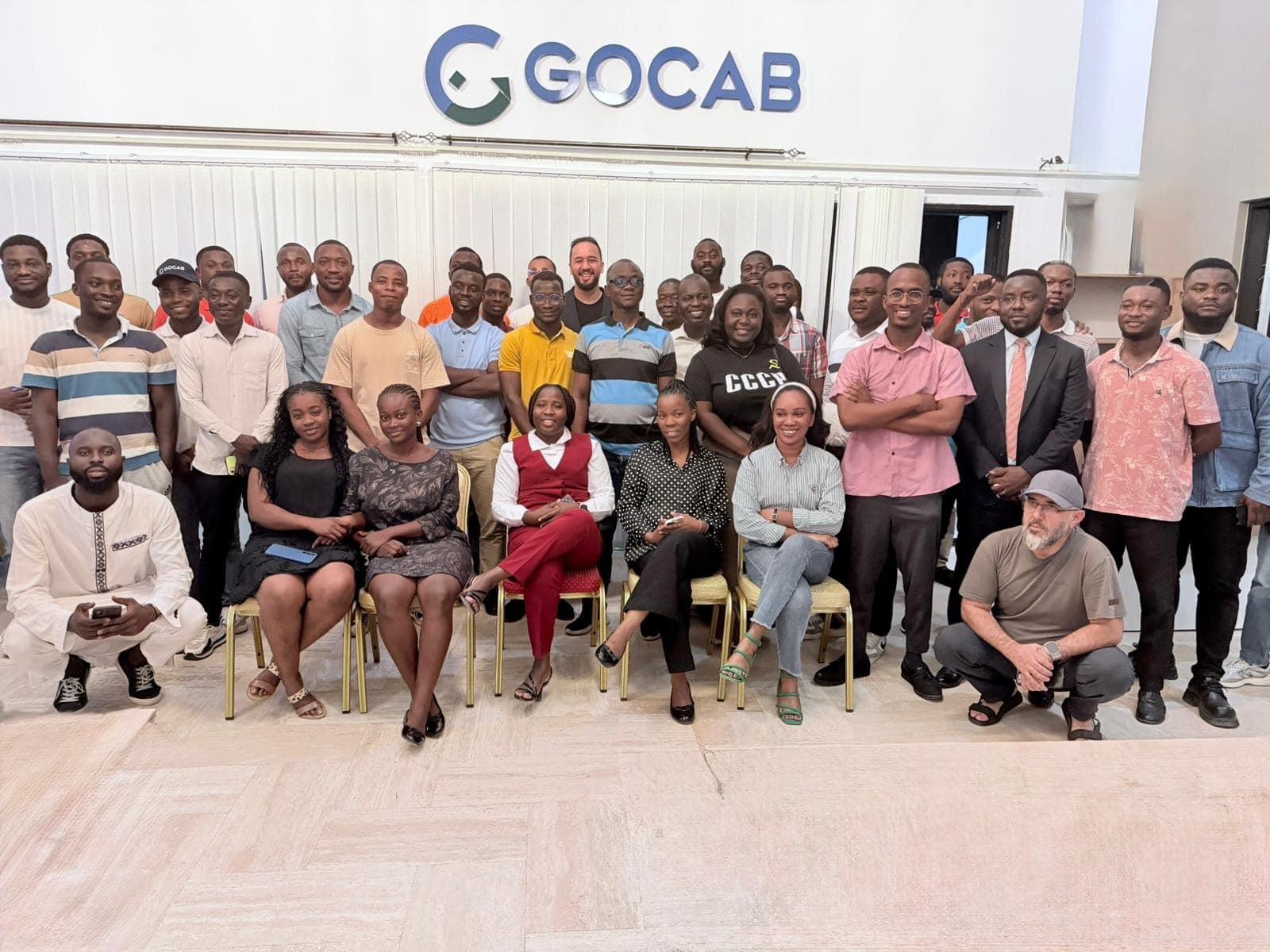
Azamat Sultan and Hendrick Ketchemen initially planned to start a private credit fund focused on Africa, but decided the market wasn’t big enough after conducting some research. GoCab was the next best option after both co-founders, who have a background in investment management, discovered Moove.
Like Moove, GoCab enables ride-hailing and delivery drivers to acquire brand-new vehicles they can fully own within three years by making daily payments. But the startup wants to be more than a mobility fintech.
Today, drivers can not only make their car payments on the app but also see their progress towards ownership transparently. In the future, though, it plans to offer buy now, pay later services for drivers, which can be used for things like getting a phone or paying for fuel. It’s also testing out the provision of health insurance for drivers through a partner.
At present, many of its activities are conducted through licensed partners, as the company does not yet hold a regulatory licence. However, the startup says it intends to obtain the appropriate licence in the future, which would enable it to operate more independently and develop a broader range of credit products for its users.
Validated by early success
GoCab has seen early success. The startup says it now generates $17 million in annual recurring revenue since its launch.
More than 1,000 vehicles have been financed in Abidjan, Côte d’Ivoire, where the company began operations. It also has operations in Senegal, Chile, and Morocco, where it launched only recently. The startup has its sights set on Nigeria and Ghana, although it is still developing a working playbook.
GoCab operates two pricing models. Under the first, drivers effectively rent the vehicle for a seven-day period but are only charged for five days. The second model involves a higher daily payment that contributes directly toward the driver’s eventual ownership of the vehicle, rather than simple rental.
The startup has pushed for profitability from the outset. That has led it to work on controlling much of the business’s value chain. For example, it works on getting vehicles directly from manufacturers rather than vehicle dealers. That allows it to save money on the associated markups and offer drivers a good deal.
Additionally, GoCab has an in-house team of more than 60 mechanics responsible for fixing and maintaining vehicles owned by its drivers. While this adds to operating costs, Sultan says maintenance is a core part of the company’s business model. The alternative, he notes, would be to rely on unqualified mechanics and lose control over repair timelines, which could affect a driver’s ability to work.

Victoria Fakiya – Senior Writer
Techpoint Digest
Make your startup impossible to overlook
Discover the proven system to pitch your startup to the media, and finally get noticed.
“Maintenance is not a drain on the P&L for us. It’s quite the opposite. In this business, most mistakes come from externalising critical functions. When you externalise, you end up with margin leakages,” he said, adding that the scale of vehicles owned by its drivers ensures the maintenance department essentially pays for itself.
Beyond repairs, GoCab also sources and procures spare parts for drivers directly from OEMs in China. This is especially important given that the vehicles it provides are not widely used in the country. As a result, GoCab generates revenue not only from leasing vehicles but also from maintenance and parts services.
Initially, drivers could get cars without making deposits, but the startup has since changed that policy, with some cars now requiring a deposit. Sultan says the decision was made after infractions by drivers led to additional costs.
The success it has recorded so far has also attracted investment, including its first equity investment round. The startup says it has raised $15 million in equity and $30 million in debt in a seed round, valuing it at $51 million post-money. E3 Capital and Janngo Capital led the round, with KawiSafi and Cur8 Capital providing additional funding.
“With this funding, GoCab now has the scale to deploy thousands of productive vehicles, each supporting a full-time income. With a clear operational roadmap toward 10,000 active assets and $100 million in recurring revenue, GoCab illustrates how ethical financing can translate into tens of thousands of decent jobs, household resilience, and sustainable growth at scale,” Fatoumata Bâ, Founder and Executive Chair of Janngo Capital, said in a statement.
It’s also in talks to raise an additional $60 million in Shariah-compliant debt. $30 million has been raised so far from investors like Cur8, Cumberland, and Verdant, while conversations continue with another lender to secure the final $30 million.
Building GoCab is not simply a money-making endeavour for its founders, and its focus on impact has led the startup to commit 1% of its net annual revenues to giving back to society, including the launch of a waqf fund to support underprivileged children.
Adapting to unique operating conditions
Both founders attribute their progress so far to several factors, chief among them the ability to adapt their business strategy to the realities of each market they operate in. Rather than applying a one-size-fits-all approach, the company has learnt to localise both its operations and messaging.
For example, when the company launched in Senegal, it initially deployed onboarding staff from Côte d’Ivoire, assuming that the shared use of French would be sufficient. However, it quickly became apparent that the instructors struggled to connect with drivers, and nearly 70% did not fully understand the company’s value proposition.
In response, the company switched to conducting onboarding sessions in Wolof, a language drivers were far more comfortable with, significantly improving comprehension and engagement.
The startup has also had to adapt its incentive structures to align with local attitudes toward work. In Côte d’Ivoire, Sultan explains, drivers instinctively understand that working longer hours directly translates into higher earnings. In Senegal, however, many drivers place greater emphasis on maintaining a balance between work and personal life. This difference forced the company to rethink both its messaging and incentive design to better resonate with drivers in that market.
While the drive-to-own business model is not new to Africa, it has historically been vulnerable to abuse. In some cases, operators have altered terms midway through agreements, forcing drivers to work longer than initially agreed or, in extreme situations, abandon the vehicle altogether.
GoCab says it mitigates these risks by prioritising transparency in its dealings with drivers. The company’s ambition to layer additional financial services onto its platform also acts as a constraint, as it cannot afford practices that erode trust. Operating in a Sharia-compliant manner provides an additional guardrail for the business.
“The more we are able to reduce the information asymmetry between us and the driver,” Sultan says, “the better the relationship will be over the three- or four-year term that the model typically runs.”
Over the past 18 months, the startup has focused on testing its core assumptions across a limited number of markets. Having seen those hypotheses largely validated, it is now preparing to scale aggressively.
According to Sultan, more than 5,000 drivers are currently on the company’s waitlist, and the immediate goal is to onboard as many of them as possible while continuing its expansion across Africa.