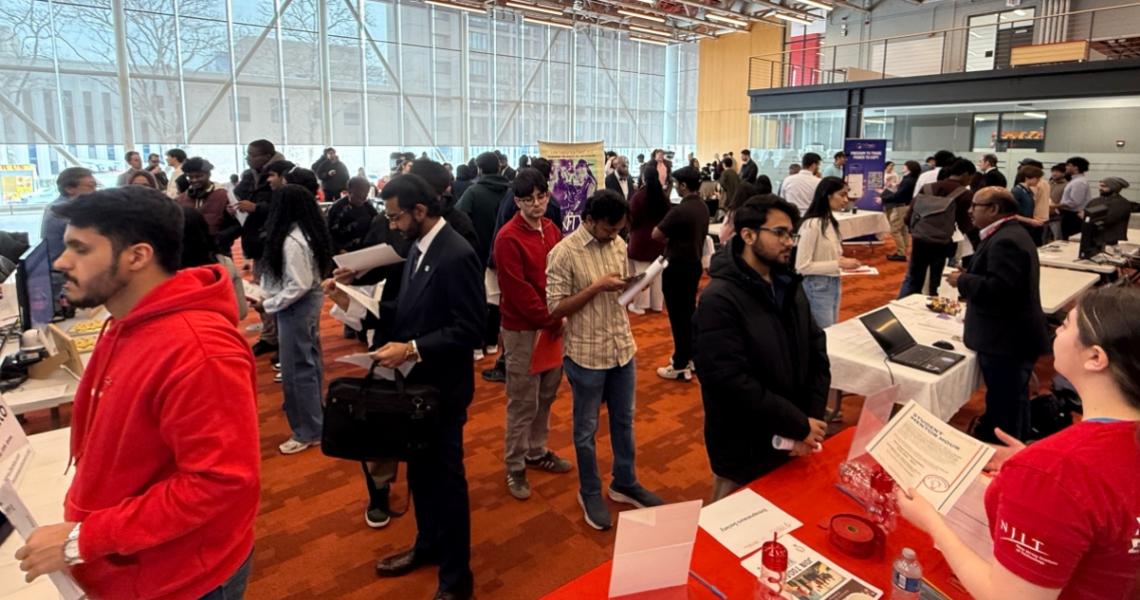
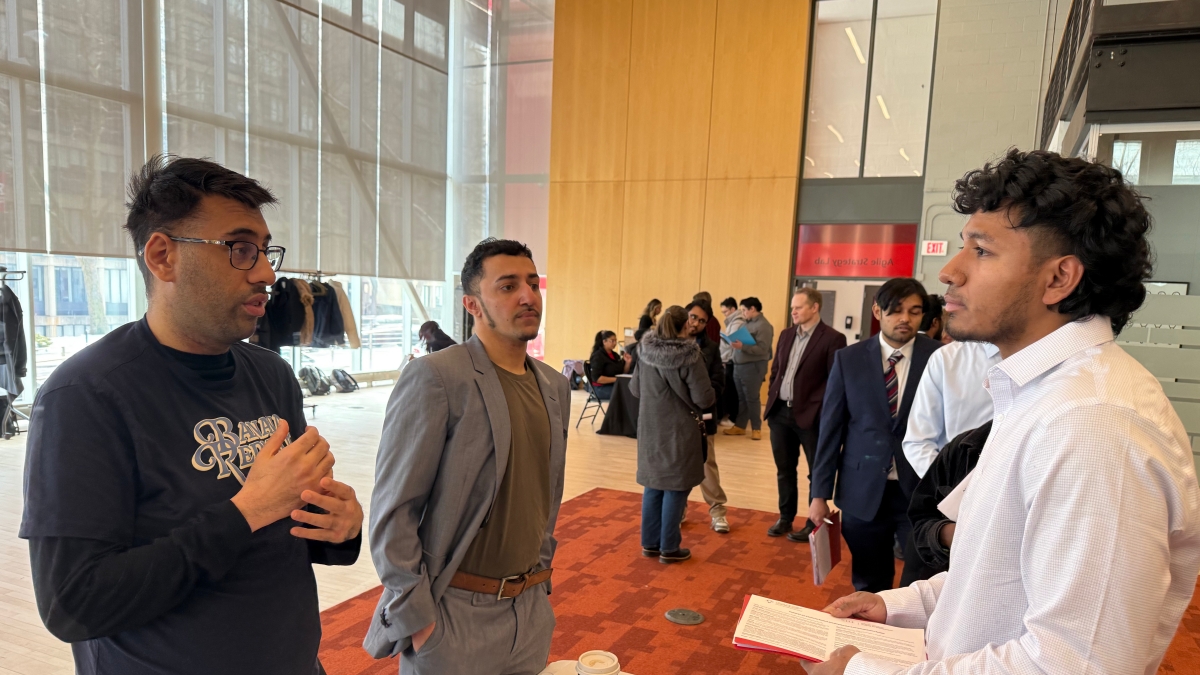
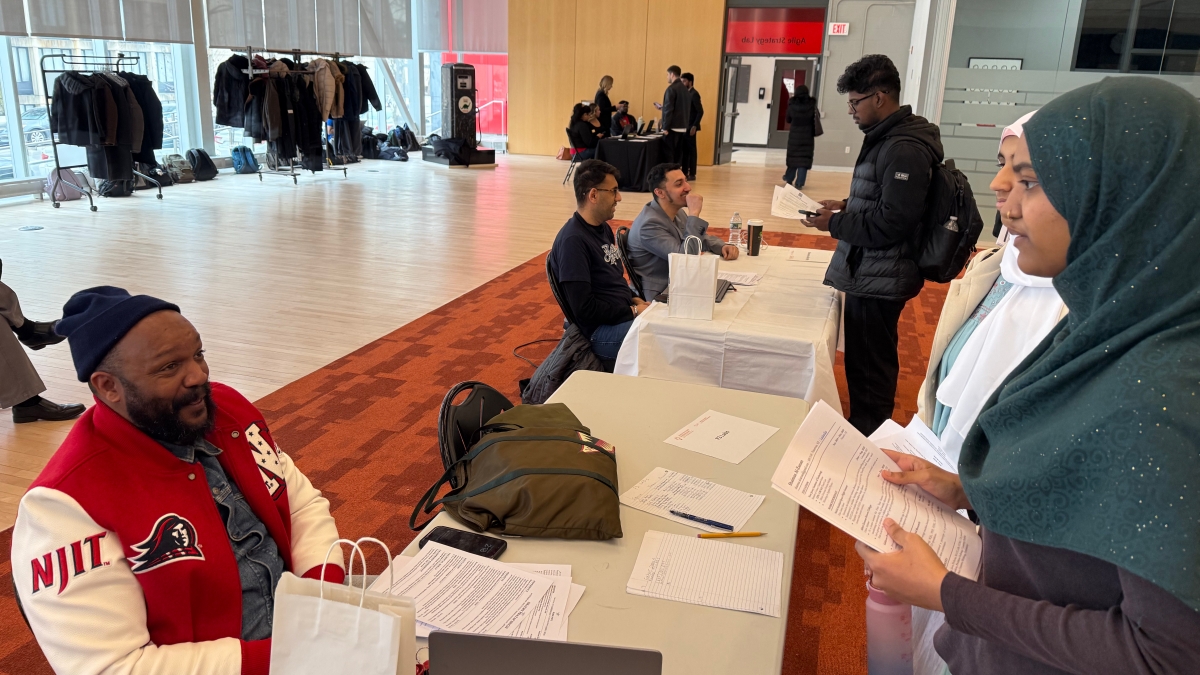
For the fifth year running, NJIT’s Startup Job Fair brought a buzz to campus, as hundreds of students turned out to meet face-to-face with CEOs of local startups inside the Central King Building recently.
The space hummed with activity, drawing a strong turnout of early-stage companies eager to connect with NJIT’s entrepreneurial-minded talent.
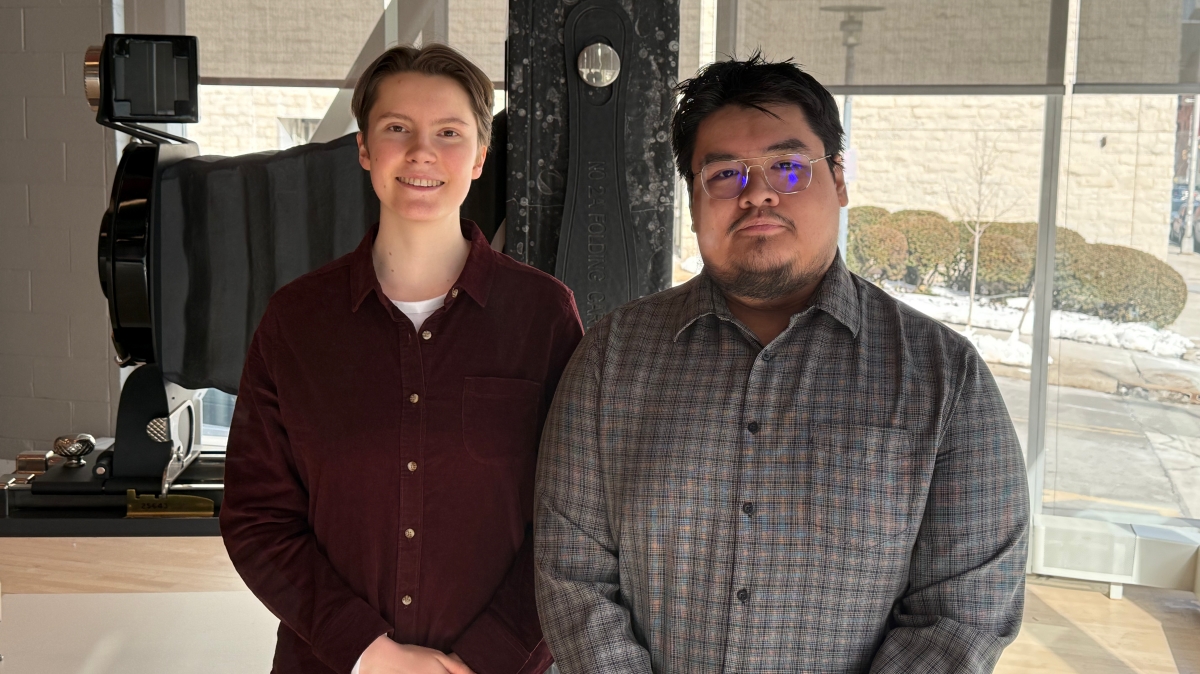
Among them was Emilia Savich, a senior data science major from Little Egg Harbor, New Jersey, and co-founder of AnatomyQuest, an aspiring educational nonprofit focused on teaching anatomy through active, visual learning.
“It’s exciting to talk to people who’ve actually built something at an event like this,” said Savich, an Albert Dorman Honors Scholar. “Hearing their stories—the challenges they faced, the successes they’ve had—helps me learn and feel part of a community of people who are building something from the ground up.”
She says the new site aims to improve how young learners study anatomy by making it interactive and engaging. The idea grew out of her search for better resources as she prepares to attend Rutgers New Jersey Medical School next year through NJIT’s fast-track medical program.
“Most anatomy resources rely on dense text and static images,” Savich explained. “Our site lets students explore structures from different angles and learn by doing, which makes the material easier to understand and remember.”
Savich and co-founder, NJIT undergraduate Favio Jasso, are working closely with NJIT’s Center for Student Entrepreneurship, which co-hosted the event with the Entrepreneurs Society, to bring AnatomyQuest to Newark schools and under-resourced communities. The Center is guiding their nonprofit’s development, outreach strategy, and connections to local education partners.
“NJIT offers incredible resources, dedicated professors, and a collaborative environment that really prepares students to succeed. It’s not just about classes—it’s about learning how to build and grow real projects,” she said. “The Center for Student Entrepreneurship has been the most valuable resource I’ve had here. It creates a collaborative environment and lets you learn the startup world firsthand.”
Connor Melton, a computer science major and honors student originally from Oak Ridge, Tennessee, was among those seeking internships and direct connections with startups at the fair.
“I came here to see what the startup world is like and hopefully land an internship,” said Melton. “It’s different from big career fairs. It’s more personal, where it feels like you can make real connections with startup founders. There are a lot of growing companies here in NJIT’s backyard where I might make a difference. Having them all in one room like this makes this event a great way to build bridges for my future.”
Kathleen Naasz, research professor at NJIT’s Martin Tuchman School of Management who heads the Center for Student Entrepreneurship, calls the event’s success connecting students and startups a “win-win.”
“NJIT students benefit from learning alongside entrepreneurs while startups gain access to talented students with deep skills in AI, computer science, and tech management,” said Naasz. “We want NJIT to be the place startups come to find talent—and boost their chances of success.”
For startups like Signal Sights Technologies, led by founder Sanjit Singh, that talent is the main draw. Singh’s company builds AI-powered augmented reality for high-stakes environments.
“Instead of more dashboards and screens, we bring critical information right into the user’s field of view to improve speed, safety, and decision-making,” Singh said. “We want people who want to work on real-world AI, AR, and sensing problems. NJIT has a reputation for fostering talent that excels in practical engineering, applied research and building things that work in the real world.”
“We’re an early-stage, mission-driven startup, which means students who get involved won’t just be observers—they’ll help shape the product, the technology, and the company’s direction.”
Also at the fair was Fakhair Spence, founder of F3 Labs, which aims to make AI more accessible and culturally aware for Black and Brown communities.
“This isn’t just another tech event. It’s a chance to activate students who understand innovation must reflect the communities it serves,” Spence said.
Spence says his team is building neural technology and training AI models that recognize African American Vernacular English, diverse hair textures, skin tones, and decision-making patterns unique to these communities.
“We’re ensuring AI doesn’t misrepresent us because it was never trained to see us,” said Spence, who came to recruit NJIT students passionate about shaping AI that serves everyone, right here in Newark.
“NJIT students bring the proximity and passion needed to create AI that serves everyone, not just a narrow demographic,” Spence added.
NJIT’s growing reputation for entrepreneurship is gaining notice. The university recently earned a top-20 international ranking in the field from The Princeton Review.
Naasz says the Center for Student Entrepreneurship, just over a year old, is already reshaping how students and startups connect.
Each year brings more companies, more students, and more stories like Savich’s, Naasz said, noting that since last year, startup participation and student attendance have more than doubled.
“We’re filling a gap in New Jersey’s startup ecosystem,” Naasz said. “This is where diverse ideas flow—and where new companies are born.”
Source link