South Korea’s financial and technology sectors are converging on the same frontier: stablecoins. As the Digital Asset Basic Act nears final passage, banks and fintech startups are rushing to design compliant infrastructure for what could become the country’s next-generation financial system. This stablecoin and digital asset transition signals not just regulatory progress but a foundational shift in how Korea plans to manage liquidity, settlement, and global digital money flows.
Fintech and Banks Accelerate Stablecoin Projects as Regulation Nears
South Korea’s Digital Asset Basic Act—including a legal framework for stablecoin issuance—is expected to pass within the first quarter of 2026. For the first time, domestic issuance of KRW-backed stablecoins may be authorized, following nearly nine years of prohibition on local coin launches.
This pending change has set off a race between fintech companies equipped with blockchain technology and traditional banks armed with capital and compliance networks.
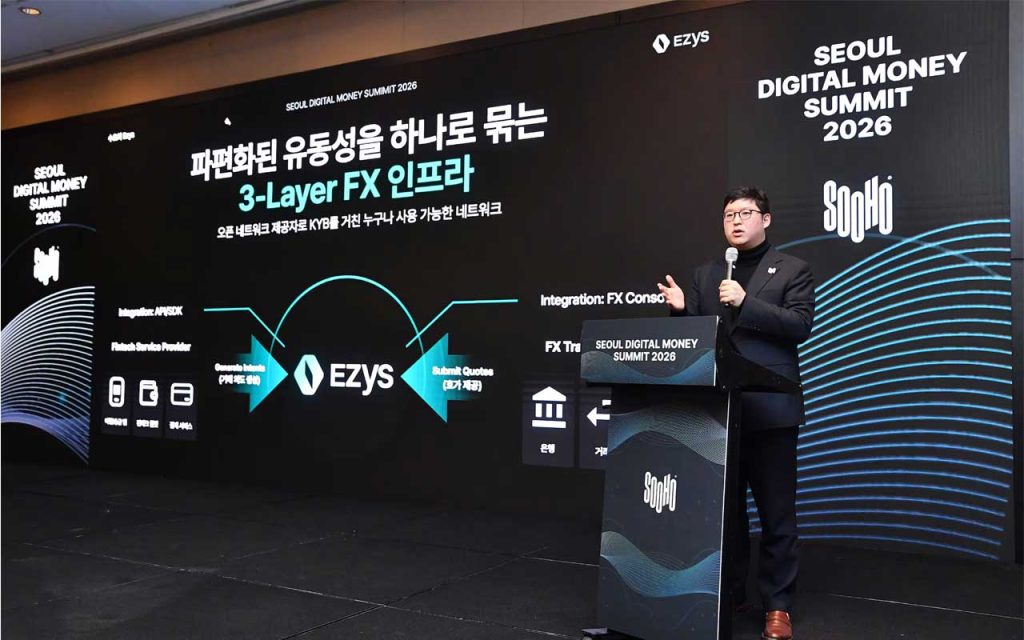
Blockchain infrastructure firm Sooho.io hosted the Seoul Digital Money Summit 2026 on February 4 at Conrad Seoul, where it unveiled Ezys, a next-generation stablecoin-based foreign exchange (FX) and settlement platform. Sooho.io, the first Korean company to receive investment from Ethereum co-founder Joseph Lubin’s ConsenSys, showcased how stablecoin settlement can reduce cross-border transfer fees and time while meeting regulatory standards.
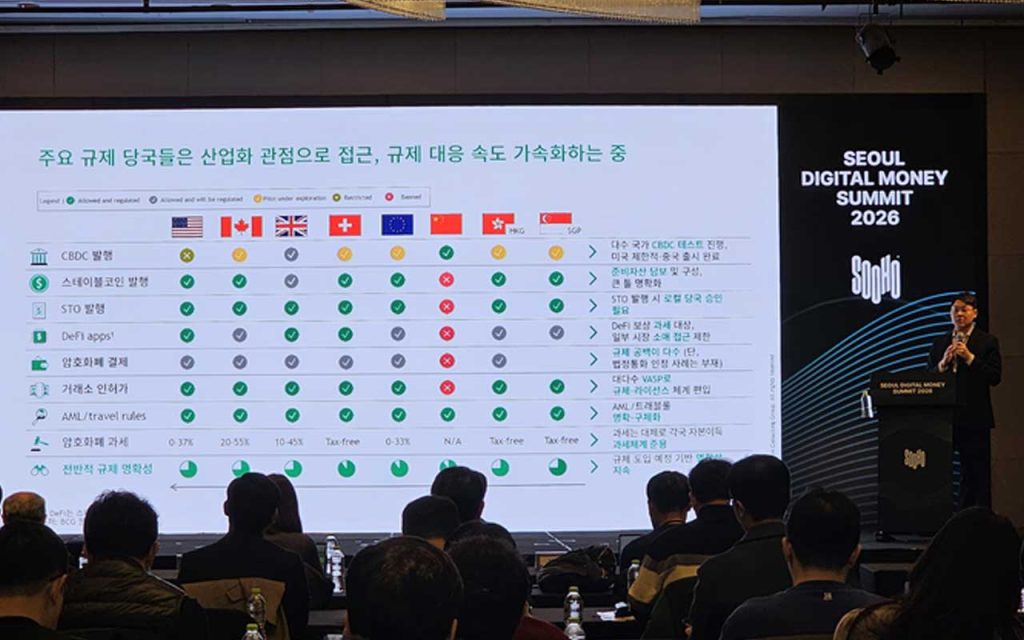
Boston Consulting Group (BCG) partner Shin Seung-hwan, speaking at the summit, described stablecoins as “the fastest-commercializing sector among all digital assets,” adding that global banks have already entered pilot and infrastructure stages. BCG projects the global digital asset market to grow from USD 0.6 trillion in 2025 to USD 18.9 trillion by 2033, with stablecoins potentially reaching USD 1–4 trillion by 2030.
Korea’s Stablecoin Policy Crossroads
The 2024 Virtual Asset User Protection Act established investor safeguards, but the upcoming Digital Asset Basic Act (Phase 2) takes a more proactive approach—integrating issuance, trading, and disclosure within formal financial governance.
A central policy dispute remains unresolved: whether only bank-led consortiums with at least 51% ownership should be allowed to issue KRW stablecoins, or if fintech firms should also have access to issuance rights.
The Bank of Korea advocates for majority bank ownership to ensure monetary stability, while the Financial Services Commission (FSC) and fintech industry argue that such concentration could stifle innovation and limit competition.
Industry groups including the Korea Internet Corporations Association have publicly criticized the “51% rule,” calling it a protectionist barrier that undermines Korea’s innovation agenda.
Legal experts like Joo Seong-hwan of Law Firm Gwangjang highlight that Korea, Japan, and the EU are all designing frameworks that define stablecoin issuance conditions, redemption obligations, and interest prohibitions. He notes that domestic financial firms still face restrictions under “separation of banking and commerce” rules and VASP dual-licensing regulations—both of which must evolve for the stablecoin economy to mature.
Intent-Based Finance and Institutional Readiness
At the Seoul Digital Money Summit 2026, Sooho.io CEO Park Ji-soo introduced the concept of “Intent-Based Finance,” arguing that financial services are moving toward real-time, user-driven architectures:
“Finance is shifting from providers selling fixed products to systems that detect user intent and assemble optimal solutions instantly.”
He identified three core technologies driving this shift: programmability through smart contracts, composability across financial layers, and 24-hour real-time settlement.
Sooho.io’s Project Namsan—a pilot involving 2,000 foreign tourists—demonstrated how stablecoin payments could reduce retail FX fees from around 1% to 0.3%, while enabling merchants to receive immediate settlements without additional costs.
CEO Park stated,
“Ezys will become a critical pipeline linking institutional liquidity with fintech demand.”
At the same event, BCG’s Shin Seung-hwan noted that Korea’s mature payment ecosystem gives it a strategic advantage in cross-border remittances and digital asset finance, even if domestic retail replacement remains limited:
“Stablecoins won’t replace card or mobile payments overnight, but their impact on cross-border finance will be transformative.”
Korea’s Race to Build Digital Money Infrastructure
The competitive landscape around KRW stablecoins reflects Korea’s broader ambition to establish itself as a regulated financial technology hub in Asia.
Sooho.io is positioning itself as a fintech infrastructure enabler with Ezys, targeting institutional-grade FX and liquidity operations. Its settlement model uses an automated “Solver Network” that compares multiple banks’ real-time FX quotes and executes trades under optimal conditions—a practical use case aligning blockchain’s efficiency with compliance-grade auditability.
Traditional finance players are also expanding their experiments:
- Hana Financial Group, BNK Financial, iM Bank, and SC First Bank have formed a KRW stablecoin consortium.
- Shinhan Financial is testing stablecoin transactions via food delivery platform Ddangyo.
- Woori Financial is integrating stablecoin settlement within Samsung Wallet.
- KB Kookmin Card has patented a hybrid payment system where credit cards automatically cover shortfalls in stablecoin balances.
- Fintech majors Naver Pay, Kakao Pay, and Toss are also developing stablecoin payment networks as they compete in Korea’s offline payment market.
Together, these initiatives show how fintech and banking institutions are aligning under a shared regulatory horizon—building interoperable infrastructure rather than speculative tokens.
For Korea’s startup ecosystem, this race marks a pivotal moment. Blockchain-native firms are now being invited into mainstream financial architecture, with the potential to export compliant digital money frameworks across Asia. For global investors, it positions Korea as one of the few markets where stablecoin experimentation is government-aligned rather than prohibited.
Toward a Regulated, Scalable Stablecoin Economy in South Korea
As Korea nears full legalization of domestic stablecoin issuance, the country’s financial sector is undergoing structural realignment. Fintechs bring innovation speed whereas banks bring regulatory credibility. Between them lies the test of whether Korea can build a digital currency ecosystem that satisfies both compliance and competitiveness.
If policy consensus is achieved within 2026, Korea could become the first major economy in Asia to institutionalize a fully bank-integrated stablecoin framework—blending private-sector innovation with central oversight.
That outcome would mark not just a financial milestone, but the foundation for a new digital money infrastructure that defines Asia’s next chapter in financial technology.
Key Takeaways on Korea’s Stablecoin Development
- Korea’s Digital Asset Basic Act is expected to legalize domestic KRW stablecoin issuance within Q1 2026.
- Fintech innovators like Sooho.io and major banks such as Hana, Shinhan, and Woori are rapidly developing compliant infrastructure.
- Sooho.io’s Ezys platform demonstrated a 70% reduction in FX fees through real-time stablecoin settlement.
- Key policy divide: Bank of Korea favors 51% bank ownership; FSC and fintechs advocate open participation.
- The convergence of blockchain and institutional finance signals Korea’s ambition to lead Asia’s regulated stablecoin infrastructure.
- Global stakeholders should monitor Korea’s model as a blueprint for balancing trust, regulation, and innovation in digital money ecosystems.
– Stay Ahead in Korea’s Startup Scene –
Get real-time insights, funding updates, and policy shifts shaping Korea’s innovation ecosystem.
➡️ Follow KoreaTechDesk on LinkedIn, X (Twitter), Threads, Bluesky, Telegram, Facebook, and WhatsApp Channel.
Source link