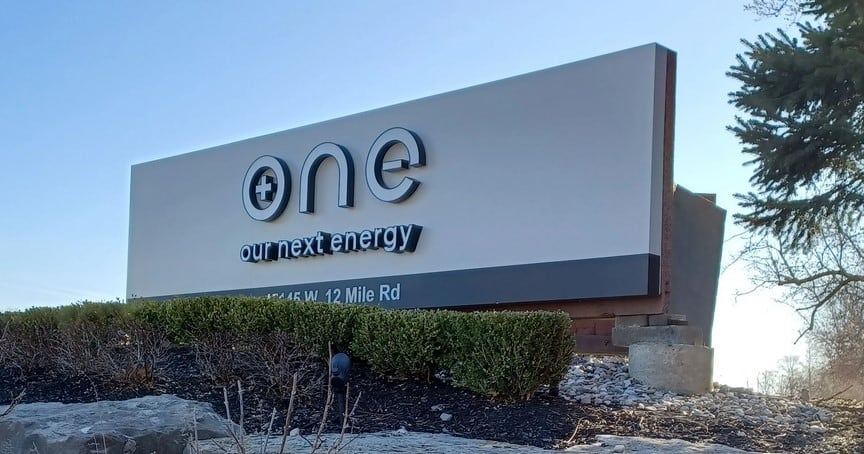
Electric vehicle battery startup Our Next Energy is planning to vacate the lease on the bulk of its factory space near Detroit in Van Buren Township, Mich., where its plan to invest $1.6 billion and create 2,112 jobs faces further uncertainty.
The battery manufacturer is in talks with landlord Ashley Capital to exit 450,000 square feet, or just more than two-thirds of the plant. A deal has not been finalized, though the space is being marketed for lease by CBRE.
The Michigan Economic Development Corp., which has so far disbursed $70.2 million of taxpayer funds to the company, said no further payments will be made under its current agreement to support the project.
Our Next Energy founder and CEO Mujeeb Ijaz told Automotive News affiliate Crain’s Detroit Business on Sept. 16 that the move is the result of EVs failing to launch in the U.S. at the previously predicted scale.
Sign up for the weekly Automotive News Mobility Report newsletter for the latest developments at the intersection of transportation and technology.
“Our contracting effort on automotive looks to be delayed by several years based on the current macro condition, and we’ve just adjusted our business to manage that,” Ijaz said.
Our Next Energy made a major splash in fall 2022 with plans to be the first U.S. company to establish a domestic lithium iron phosphate battery plant. The factory — backed by $237 million in taxpayer subsidies — was to feed EV-crazed automakers with a less costly, more sustainable battery than the standard nickel-manganese-cobalt chemistry.
But demand for EVs failed to launch, automakers pulled back investment dramatically and the business case for battery plants imploded. The Trump administration’s rollback of EV tax credits and fuel emission regulations has further chilled electrification in the auto industry.
Our Next Energy will continue to operate its cell production pilot line in Van Buren Township. The company has created about 70 jobs and invested $117.6 million in eligible costs under its deal with the state. It employs a total of 180 people in Novi, Mich., a Detroit suburb.
Per terms of the contract, Our Next Energy has until December 2029 to meet its investment and jobs commitment. The cash it has received from the state was not dependent on creating jobs, but on meeting private financing benchmarks.
The Michigan Economic Development Corp. is in regular contact with Our Next Energy and reviewing “potential impacts to the incentive agreement,” spokeswoman Danielle Emerson said.
“While the jobs requirement milestone for this project is not due until December 2029, we are being proactive in working with ONE to ensure the agreement reflects any updated scope of the project,” Emerson said. “In the meantime, no new disbursements will be made under the current agreement.”
The statement continued: “We are optimistic about the company’s path forward given the potential benefit from the federal One Big Beautiful Bill tying tax credits to domestic content … The MEDC is committed to protecting those disbursed public dollars and ensuring this opportunity stays in Michigan.”
Our Next Energy has been treading water since its Series C fundraising round fell through at the end of 2023, but notably, the company has avoided total collapse — a fate that has befallen many EV companies and projects over the past couple of years.
Most recently, Australian mining giant Fortescue scrapped plans for a $210 million EV battery factory in Detroit that had been expected to create up to 600 jobs, citing “current policy settings and market conditions.”
Ijaz also pointed to regulatory upheaval as a force delaying EV growth in the U.S.
“Basically, a lot of noise in the system in the last six months regarding tariffs, incentives, customer demand, all of the interest rate, economic considerations have just pushed the automotive market out, and we just can’t predict how long that will be,” he said.
Ijaz said the company aims to achieve break-even by the end of next year. The CEO has been focused on reducing cash burn and finding revenue streams. While its long-term goal is landing a major auto contract, its primary focus now is energy storage systems for the power grid. It is also working to grow business in other sectors including defense and even locomotives.
The company declined to disclose revenue or the state of its fundraising efforts. Ijaz said he is confident that Our Next Energy has enough runway to see through to brighter days in the auto sector.
Our Next Energy’s nonbinding agreement with Ashley Capital to develop an automotive battery factory next to its current building remains in place when that time comes, Ijaz said. It did not make sense to pay millions of dollars to lease all of the current space without using it. The new development would be built taller and specifically for battery manufacturing, unlike the current one.
Ijaz also remains confident that LFP technology will withstand the test of time even as auto companies work furiously for the next tech breakthrough.
“I don’t believe iron phosphate is a chemistry that is going to be forgotten for the advancement of some other chemistries,” he said. “It is safe, it is very durable, it is cost-effective, using materials that are abundantly available around the world, and it is well industrialized now around the world.”
Have an opinion about this story? Tell us about it and we may publish it in print. Click here to submit a letter to the editor.