


Dear subscribers,
This week, Indonesia’s tech and digital economy narrative reflects disciplined growth amid regional normalization. Capital continues flowing into operationally efficient models such as Jago Coffee and Green Rebel, while edtech and venture players pivot toward profitability and stronger monetization. On the macro front, EV downstreaming is nearing full investment realization and AWS is deepening AI infrastructure commitments, reinforcing Indonesia’s industrial and digital backbone. Regionally, QRIS expansion across APEC with South Korea as an early implementation corridor. As APAC fintech is entering a structural growth phase, creating momentum for Indonesia to scale beyond payments into broader digital finance.
Stay tuned as we continue tracking the capital flows, policy shifts, and strategic moves shaping Indonesia’s evolving digital economy.
Stay ahead,
DailySocial Team
Jago Coffee reportedly raises $12.5M Series B
Investor appetite for tech-enabled F&B models remains intact as mobile coffee operators continue to scale across urban clusters. Reports indicate that Jago Coffee secured $12.5 million in Series B funding led by Beenext, reinforcing confidence in its route-based, neighborhood distribution model. The hybrid approach—offline carts powered by digital demand mapping—keeps capital expenditure lean while maximizing reach. In a maturing startup environment, operational efficiency and repeat consumption are becoming stronger signals than pure growth velocity.Green Rebel Foods raises Rp209.8B
Alternative protein continues to attract capital despite a cooling funding climate. Plant-based startup Green Rebel Foods raised Rp209.8 billion to expand product innovation and market reach. While domestic adoption is still building, ESG-driven investment logic and rising health awareness strengthen its long-term positioning. The move reflects how food-tech players are aligning sustainability narratives with local taste adaptation to build defensible brands.Edtech shifts toward sustainable monetization
Margin clarity is replacing growth-at-all-costs in the education technology sector. A closer look at emerging edtech profitability strategies shows startups pivoting to hybrid B2C-B2B models, institutional contracts, and stronger ARPU discipline. Investor scrutiny is pushing operators to prove recurring revenue stability rather than headline user growth. In a price-sensitive but high-demand education landscape, durability now outweighs rapid expansion.Koltiva pilots AI-powered traceability
Supply chain transparency is gaining urgency amid tightening global ESG requirements. Agritech firm Koltiva launched an AI-driven traceability pilot to improve monitoring across agricultural commodities. Data-backed traceability enhances compliance and export credibility. The move highlights how Indonesian agritech players are embedding AI to strengthen global competitiveness.EV investment realization nears full deployment
Industrial downstreaming efforts are translating into measurable progress in the EV sector. Recent data shows that EV investment realization has reached nearly 90%, with 155% growth. Commitments span battery ecosystems, assembly facilities, and supply chain integration. The figures reinforce Indonesia’s ambition to evolve from resource exporter to integrated EV manufacturing base.AWS deepens AI infrastructure commitment
Cloud providers are accelerating AI infrastructure expansion as enterprise demand intensifies. AWS reaffirmed its investment focus in Indonesia, emphasizing AI workload readiness and scalable cloud capacity. As more corporates embed AI into operations, hyperscale infrastructure becomes foundational rather than optional. The continued capital deployment strengthens Indonesia’s positioning as a regional digital and data hub.


QRIS Expansion Tied to APEC Trade, Korea Becomes Early Implementation Case
Indonesia is positioning QRIS as part of its broader APEC trade strategy, with the bloc accounting for roughly 70% of the country’s total exports. The push to expand QRIS adoption across APEC economies frames digital payments as infrastructure to support export growth, tourism flows, and MSME cross-border transactions. As the initiative moves from agenda to execution, South Korea emerges as one of the first concrete bilateral corridors under this strategy. Bank Indonesia and the Bank of Korea are finalizing the rollout of cross-border QR payments between the two countries, scheduled to launch in April 2026 under the Local Currency Transaction framework.ASEAN advances AI governance in broadcasting
As generative AI tools scale in media workflows, policy alignment is moving higher on the agenda. Regional stakeholders are progressing toward AI standardization frameworks in ASEAN broadcasting. Clear guardrails may reduce compliance uncertainty while maintaining innovation space. For Indonesia’s creative and media-tech players, harmonized rules could ease regional expansion.Kakao Bank’s Record Profit Fuels Indonesia Play
Kakao Bank posted record 2025 earnings, with net profit rising 9.1% to KRW 480.3 billion and noninterest income surpassing KRW 1 trillion for the first time. The stronger revenue mix provides greater flexibility to expand beyond South Korea. Its stake in Indonesia’s SuperBank, which turned profitable within a year and recently listed, has generated valuation gains. Solid performance at home is reinforcing Indonesia’s role in Kakao Bank’s regional growth strategy.Payoneer expands cross-border capabilities
Cross-border payment infrastructure is becoming critical as digital exports scale. Payoneer expanded its capabilities in Indonesia to better support SMEs, freelancers, and global sellers. Enhanced payment rails can reduce settlement friction and improve cash flow reliability. The development strengthens Indonesia’s participation in global digital commerce networks.Semiconductor roadmap signals higher-value ambition
Industrial policy is expanding beyond resource downstreaming into advanced manufacturing. The government is drafting a semiconductor roadmap, including plans for a domestic chip design center, as detailed in this semiconductor development update. While fabrication remains capital-intensive, design specialization could be a strategic entry point. Talent cultivation and ecosystem coordination will determine long-term competitiveness.🚀 What’s Next: APAC Fintech Enters High-Growth Phase in 2026
The Asia-Pacific fintech market enters 2026 in strong structural growth mode, projected to reach USD 167.7 billion in 2026 and expand at a 15.76% CAGR to USD 348.1 billion by 2031. Growth is driven by mobile-first adoption, real-time payment rails, digital ID expansion, and super-app ecosystems integrating payments, lending, insurance, and investments. While digital payments dominate today, the next growth wave is shifting toward embedded finance and neobanking.
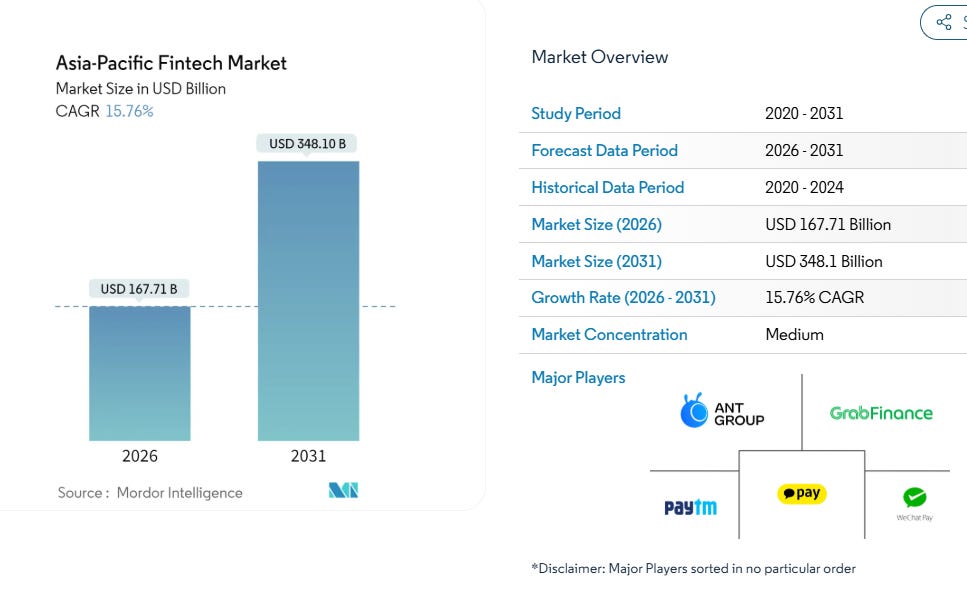
Digital payments account for 64.9% of market share, but neobanking is the fastest-growing segment at 30.46% CAGR. Retail users still dominate volume at 70.9%, yet business users especially SMEs are expanding faster at 25.47% CAGR. Mobile applications represent over 72% of interface usage, while POS and IoT devices are growing rapidly as QR and contactless infrastructure deepen across markets. India leads geographic growth at 27.25% CAGR, while China maintains the largest share.
For Indonesia, the outlook reinforces three strategic angles: real-time payment infrastructure, SME digitization, and super-app ecosystems. As one of Southeast Asia’s largest mobile-first markets with expanding QR adoption and strong financial inclusion programs, Indonesia stands to benefit from embedded finance and SME-focused fintech models. However, regulatory fragmentation, data localization rules, and rising fraud risks may shape competitive dynamics. The opportunity lies in scaling beyond payments into lending, neobanking, and cross-border financial services, especially as regional interoperability frameworks continue to expand.
Source link