If you’ve taken a winter road trip in an electric vehicle, you’ve seen your range drop every time you blast the defroster just to see the road.
Unlike gas-powered cars, which use waste heat from the engine to clear ice and condensation from the windshield, EVs rely on electric heaters and fans.
That draws power from the battery and is one reason EVs typically lose 20 to 30 per cent of their range in cold weather.
A Canadian startup has developed a method to clear windshields in a fraction of the time, using far less energy, by heating the windshield itself.
“This idea of blowing [hot air against the glass] has been around for a long time and really hasn’t changed much,” said Derrick Redding, chief executive officer of Oakville, Ont.-based Betterfrost Technologies Inc. “[EVs need a better solution] because three-quarters of winter range loss is heating the cabin.”
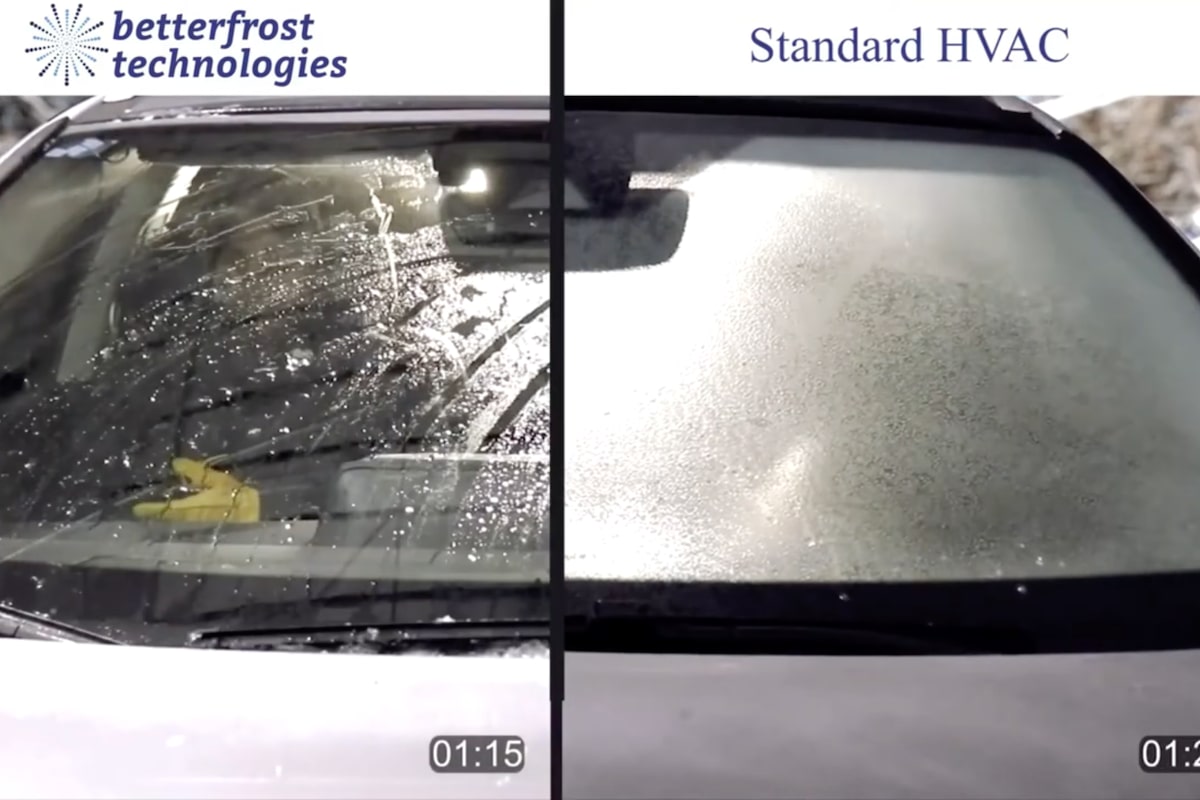
A screen grab from a video showing how quickly the BetterFrost technology removes ice from a windshield compared to traditional defrosters.Supplied
Heated windshields aren’t new. Automakers including Mercedes-Benz, Volkswagen and Audi have offered them for years, Redding said. Many existing systems embed fine wires in the glass or add a transparent conductive layer, he said.
“Most of the heated windshields on the road today are designed to assist the conventional defroster,” he said. “We want to have a conductive surface that’s very close to where the ice is, and then heat from inside the windshield.”
Heated discussion?
Betterfrost’s technology is intended to replace the defroster entirely, Redding said. It works with windshields made from low-E glass, which contains a thin metallic layer used to reflect heat from the sun.
When an electric current is applied to that layer, the entire windshield heats evenly.
“You can reflect heat in the summer and then in the winter it becomes active heating,” Redding said.
A few automakers, including Volkswagen, use low-E glass now in some higher-end models to keep cabins cooler on sunny days.
The goal isn’t to melt the ice, but to heat the surface just enough to break the bond between the ice and the glass so it slides off. That saves time and energy, Redding said.
In a controlled test at –20 degrees Celsius using a half-millimetre layer of ice, the ice slid off the windshield in about 70 seconds, he said.
Under the same conditions, a conventional defroster had cleared only about two-thirds of the windshield after 16 minutes.
That’s because a forced-air defroster concentrates heat near the vents, leaving ice higher up on the windshield, he said.
Betterfrost’s system uses 96-per-cent less energy than a conventional defroster and works in roughly the same amount of time for any thickness of ice, he said.
The tech also keeps glass warm enough to prevent fogging up.
“We just keep the glass above the dew point so you never get condensation,” Redding said.
The point isn’t to make ice scrapers obsolete, but to keep EV windows clear on the road without blasting the defroster.
On longer highway trips, that could translate into “somewhere between [16 to 32 kilometres]” of additional EV range, he said.
Cold reality?
Redding said the technology is relatively cheap, with materials costing around $100.
But it won’t be something drivers can buy aftermarket and install themselves.
It has to be integrated into the windshield and the car’s electrical infrastructure when the car is built, Redding said. If it ever reaches dealerships, it will likely be on EVs or hybrids rather than gas-powered vehicles, Redding said.
That’s because most gas-powered cars still rely on 12-volt electrical systems, which can’t deliver power quickly enough for this kind of heating without major redesigns.
EVs and some hybrids already use higher-voltage systems, including 48-volt architectures, that can.
Another hurdle is the glass itself. Most cars still don’t have low-E windshields.
“I think all cars, especially EVs, are going to have low-E coatings in the future,” Redding said.
Founded at Toronto’s MaRS incubator in 2015, Betterfrost expects its technology to first appear in production in a commercial transport truck sometime next year, Redding said. Redding wouldn’t name the manufacturer. While several automakers have shown interest, the technology is likely years away from appearing in passenger vehicles.
A year ago, he expected it to be used only in EVs.
“My opinion on this has completely changed,” he said, adding that it could also make sense in some newer hybrids, which don’t produce enough consistent waste heat to melt ice with hot air.
As some companies scale back EV plans after slower-than-expected sales growth, the company is looking to other applications, including clearing ice from airplanes and from air intakes at data centres.
“It works with any conductive coating,” he said. “You could do it on a driveway if you built a conductive layer into it. But that would be an expensive proposition.”