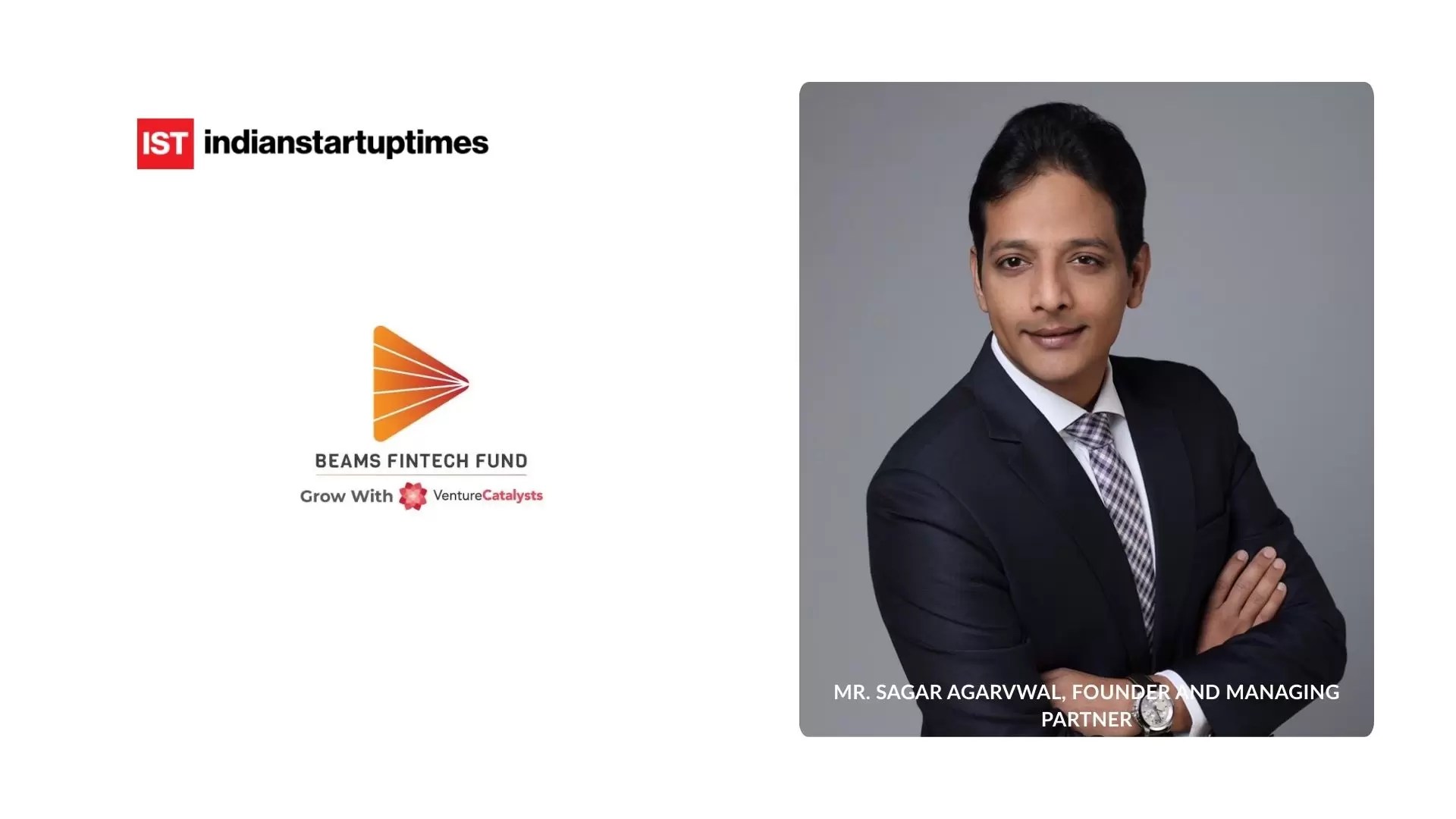
India’s fintech story has evolved from early wallet experiments and digital lending pilots to a full-stack financial services transformation powered by DPI, UPI, and deep regulatory reform. While early-stage capital has been abundant, growth-stage fintech funding has remained concentrated among a handful of global investors.
In a detailed conversation with Indian Startup Times, Sagar Agarvwal, Founder and Managing Partner of Beams Fintech Growth Fund, shared why he launched a dedicated growth-stage fintech fund, the structural shifts reshaping Indian financial services, and what it truly takes to build an enduring fintech institution today.
From Capital Markets to Building Beams
With over 17 years of experience across financial services and investing, Sagar’s journey toward launching Beams was shaped by a simple observation: fintech and financial services were dominating both capital flows and exit outcomes in India.
He traces the inflection back to 2015–16. Demonetization, smartphone penetration, Aadhaar-based verification, and the rollout of digital rails fundamentally changed how Indians interacted with money. Fintech-native companies began emerging at scale.
Yet there was a gap.
Early-stage venture capital was crowded. At Series B and C, global funds were active. But domestic, specialist growth-stage managers focused purely on fintech were scarce.
Beams was created to address that gap. The idea was not just to deploy capital, but to build India’s first dedicated growth-stage fintech platform with deep ecosystem relationships and sector specialization.
Why Growth-Stage Fintech Needed a Specialist
Sagar believes that Series B/C fintech companies require a different kind of investor.
At that stage, founders are no longer validating product-market fit. They are scaling regulated businesses, navigating compliance, expanding distribution partnerships, and preparing for institutional capital or public markets.
According to him, two pieces were missing in India’s growth fintech landscape:
- A strong domestic specialist manager
- A curated fintech ecosystem beyond just capital
Beams positions itself as more than a cheque writer. The fund has built partnerships across banks, NBFCs, insurers, payments firms, and wealth platforms. This enables founders to co-create products, secure distribution faster, and scale in a structured manner.
Rather than spreading attention across multiple sectors, Beams focuses only on fintech and financial services, allowing deeper operational support and ecosystem leverage.
The Five Pillars of Beams’ Investment Thesis
When asked about the core evaluation framework, Sagar outlined five clear pillars that guide every investment decision:
- Capital efficiency
- Long-term market outlook
- Team quality and talent depth
- Founder–investor alignment
- Business-model sustainability
He explained that growth capital should be deployed at clear inflection points. Companies must demonstrate revenue traction and improving margins. Growth should not be speculative. It should be supported by numbers.
Quantitative checkpoints such as revenue scale and margin profile matter significantly before Beams writes a cheque.
Non-Negotiables Before Writing a Series B/C Check
Certain fundamentals are non-negotiable for the fund:
- A strong founding team and capable second-line leadership
- Clear regulatory positioning with no grey areas
- Reasonable valuations
- Sustainable business models that can compound over a decade
Fintech, by nature, operates in regulated environments. Regulatory ambiguity is not something Beams is willing to overlook.
Structural Shifts Powering Fintech’s Institutional Evolution
Sagar emphasized that fintech companies today resemble financial institutions more than startups from a decade ago. Several structural enablers have driven this shift:
- Clearer regulatory frameworks
- DPI and UPI infrastructure
- Seamless eKYC and onboarding stacks
- Improved underwriting data layers
- Availability of experienced talent
- Maturing domestic capital markets
He also highlighted cross-pollination of talent between banks and fintechs. Senior professionals are now comfortable moving between traditional financial institutions and digital-native platforms. That maturity, he believes, reflects a stronger ecosystem.
Are Founders Thinking Long-Term From Day One?
According to Sagar, yes.
After more than a decade of market cycles, founders are more aware of sustainability and governance. The “growth at any cost” mindset has evolved into calibrated scaling.
Today’s fintech founders understand that long-term institutional value creation requires:
- Governance discipline
- Unit-economics clarity
- Regulatory compliance
- Durable business models
Consumer-First vs B2B Fintech: Different Capital DNA
The discussion also explored how business models influence capital requirements.
Consumer-first fintechs typically require:
- Significant marketing investment
- Brand-building spend
- Distribution expansion
- Trust-building costs
In contrast, B2B or B2B2C fintechs often scale through product and engineering strength, requiring relatively lower marketing burn.
Sagar stressed that both models can work. The key is understanding the capital DNA and aligning growth expectations accordingly.
Board-Level Discipline and Public Market Signals
At the board level, discipline has strengthened considerably.
Growth is no longer approved without:
- Proven early cohorts
- Positive unit economics
- Clear path to operating leverage
Public markets have also played a validation role. Listings such as Paytm, PolicyBazaar, and others have demonstrated that fintech businesses can scale with cross-sell, upsell, and lifetime-value economics.
These public benchmarks now shape how private growth investors assess valuation and sustainability.
Portfolio Highlights and Check Sizes
Beams targets category leaders at clear inflection points.
One example Sagar shared was Niyo, a cross-border travel banking platform that crossed one million customers and hit a scale milestone before Beams’ investment.
The fund typically deploys INR 50–100 crore initially, with the ability to scale participation toward INR 100–150 crore in larger rounds, along with structured follow-on capital.
Other portfolio names discussed included:
- InsuranceDekho
- SK Finance
- Credgenics
The focus remains consistent: back leaders with the potential to define their category.
Where Beams Is Deploying Next
Looking ahead, Beams is actively evaluating opportunities across:
- Payments
- Capital markets infrastructure
- Personal lending
- AI-enabled financial products
- Embedded finance across sectors such as agriculture and healthcare
- Enterprise SaaS within financial services
Sagar also mentioned interest in India-first companies expanding into the US and global markets.
AI as the Next Structural Wave
Artificial intelligence, both generative and agentic, is emerging as a major disruptor.
Sagar expects AI-driven personalization, workflow automation, and infrastructure optimization to create large fintech companies across both consumer and enterprise segments.
He sees AI not as a feature layer, but as a foundational shift in how financial services are built and delivered.
Advice to Founders Building Enduring Fintech Institutions
In closing, Sagar shared four clear priorities for founders:
- Prioritize regulatory compliance from day one
- Invest in cybersecurity seriously
- Raise capital from aligned, long-term investors
- Hire high-quality talent early
Fintech, he emphasized, is not just about building an app. It is about building a trusted financial institution.
Conclusion
India’s fintech ecosystem has matured from experimentation to institution-building. As capital becomes more disciplined and regulation more structured, growth-stage specialization is becoming essential.
Through Beams Fintech Growth Fund, Sagar Agarvwal is betting that focused capital, deep ecosystem partnerships, and governance-led scaling will define the next chapter of Indian financial services.
If early-stage capital built India’s fintech startups, specialist growth capital may well build its enduring financial institutions.
-Interview Conducted by Sandhya Bharti