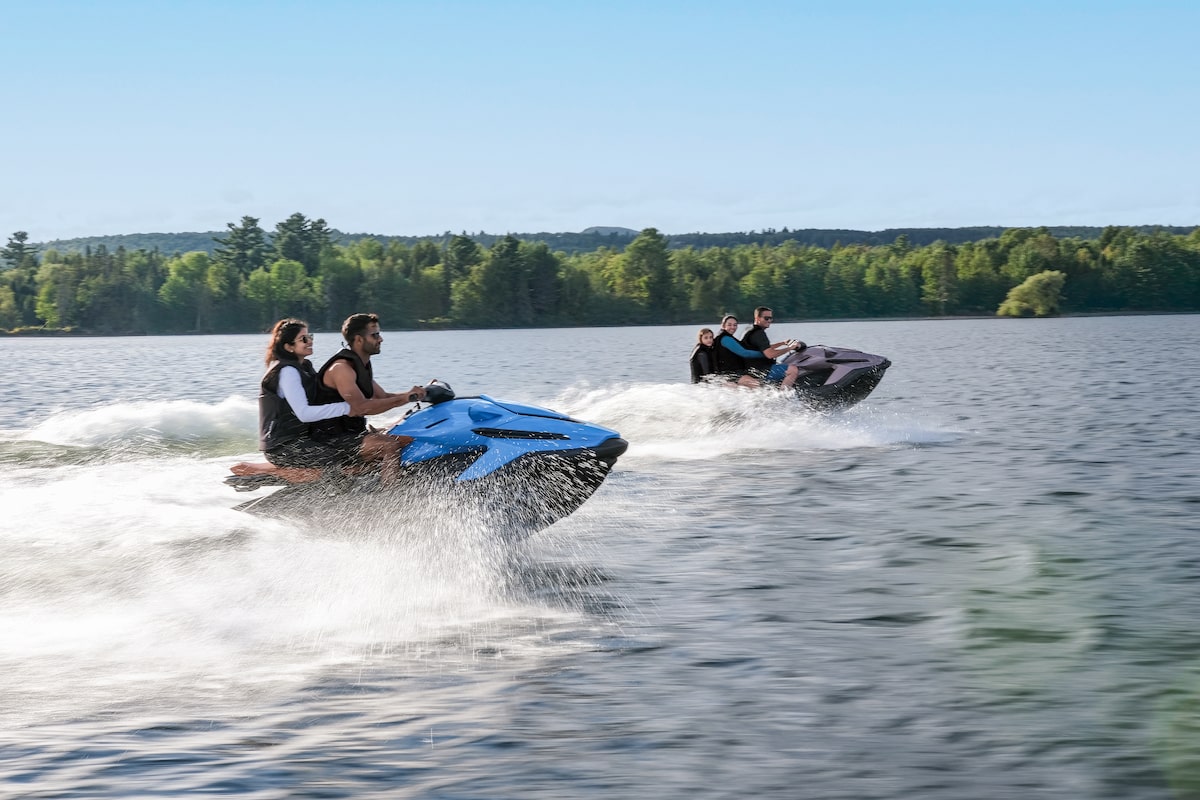
At the Monaco Yacht Club on the shores of the French Riviera on Tuesday, Montreal-based startup Taiga Motors Inc. made its first big splash since emerging from bankruptcy protection by launching a new electric three-seat personal watercraft called the Orca WX3.
The made-in-Canada WX3 is the first new product from Taiga, maker of electric watercraft and snowmobiles, following the company’s rapid rise and fall on the heels of going public in 2021. After seeking bankruptcy protection in 2024, Taiga was acquired by U.K. investor and entrepreneur Stewart Wilkinson, whose portfolio includes marine electrification brands Vita boats and Aqua Superpower chargers.
The WX3 is an electric three-seat personal watercraft with 160 horsepower.Courtesy of manufacturer
Taiga co-founder Samuel Bruneau, who remains as chief executive officer of the reborn company, explained that the launch on Cote D’Azur is intended to mark Taiga’s entry into the European watercraft market, where the company sees strong demand for its electric offerings.
[There’s] huge excitement in Europe about electrification in general, but especially in this marine [market] there’s a really big push back against the noise, against the pollution of Jet Skis,” Bruneau said.
“We have a lot of people [from Europe] placing calls with us, like, ‘Hey, I run a Jet Ski business. I don’t want to lose the business. I need these electric models to keep going,’” Bruneau said in an interview ahead of the WX3 launch.
Chief executive officer Samuel Bruneau at the company’s Montreal facility. Bruneau founded the company in 2015 with two other McGill University engineering classmates.Courtesy of manufacturer
The company is targeting tour operators and resorts for fleet sales, as well as individual customers and wealthy yacht owners in Monaco and the Middle East looking for an eco-friendly tender.
Wilkinson, who will be chairman of the reborn Taiga Motors and its largest investor, already has a sales team in Europe – through his other marine electrification companies – which, he says, will help Taiga expand into that market and establish a European hub in Milan.
“I see huge demand here,” said Wilkinson, a Brit who now lives primarily on the island of Malta. He noted that Taiga’s electric snowmobile, the Nomad, is already sold out for the year, in part because of strong demand in Europe.
Taiga’s product lineup now includes one snowmobile, the Nomad, and two watercraft, the three-person Orca WX3 and the two-person Orca P2.
The WX3 is made in Montreal and starts at at US$23,999.Ash Rashid/Courtesy of manufacturer
The company’s electric watercraft are generally quieter, cleaner and quicker accelerating than cheaper gas-guzzling rivals, but of course that comes with a price and likely also some range anxiety.
The new Orca WX3 is more expensive than traditional combustion-engine Jet-Skis and Sea-Doos. Prices for the Taiga start at US$23,999, which translates to roughly $33,200 Canadian. It has 160 horsepower, DC fast charging from zero to 90 per cent in 30 minutes – or around three hours on a 240-volt outlet – and a 24-kilowatt-hour battery pack assembled in-house at Taiga’s Montreal-area plant. That battery grants the WX3 a claimed range of around 40 kilometres, or approximately two hours of towing a wakeboard or tube, Bruneau said.
The battery lasts for about two hours of towing a wakeboard.Courtesy of manufacturer
Deliveries are slated to begin in 2026.
This is a second chance for Taiga, and for its CEO. Bruneau founded the company in 2015 with two other McGill University engineering grads. The firm went public with a Special Purpose Acquisition Company (SPAC) in 2021, which put the young company’s value at a lofty $537-million. Back then it was targeting annual sales of 25,000 units by 2028.
To date, the company has shipped just over 1,500 vehicles including 800 Orca watercraft, Bruneau said.
In his analysis of what went wrong, he said Taiga hit the infamous “production hell” Elon Musk spoke about, combined with pandemic supply chain disruptions, followed by a downturn in the powersports market and the “SPAC bubble” bursting. (High profile EV startups Nikola and Fisker also went public through SPACs and both have since gone bust.)
“We didn’t have a war chest to lean back on as an established manufacturer,” said Bruneau. “It’s very frustrating of course. Not just for me but everyone, the team put a lot of blood sweat and tears into this thing.”
Laying off so many employees who had poured their hearts into the company, Bruneau said, was the worst day of his life. “It’s just a really terrible thing to have to do,” he said, “and I definitely never want to do that in my career again.”
Wilkinson heaped praise on Bruneau, his team, their work ethic and Taiga’s technology, and laid blame on the investment bankers who wanted extremely rapid growth.
“I get annoyed when entities or people complain – you see it online sometimes – complain about Sam and the team, because they came with their technical capability, and they’ve delivered that, you know. What they couldn’t deliver – because people required them to deliver something that was too much, too fast, too soon – is 15,000 units of sales within two years,” Wilkinson said. He added that Bruneau and his colleagues made, “no money out of this, and they’re back in the game.” Unlike other founders who went public with SPACs, Taiga’s co-founders didn’t cash out and sell their stock when it was high.
Samuel Bruneau, CEO & co-Founder, Taiga Motors rides their electric snowmobile the Taiga EKKO outside their offices in Montreal, Quebec, February 17, 2021. (Christinne Muschi /The Globe and Mail)Christinne Muschi/The Globe and Mail
For Wilkinson’s part, in addition to taking on the company’s roughly $23-million debt to its main secured lender Export Development Canada, he said he has put around $15-million into the company so far. “It’ll require more over time and I stand behind that,” he said.
“The $15-million goes to supporting the business getting back into production and getting to profitability, so we’ve sized it to do that. … And, that’s going pretty well. We’re on plan for this year,” Wilkinson said.
Shareholders and investors in the old Taiga Motors, or anyone who lost a deposit of between $100 and $1,000 placing an order for one of Taiga’s electric vehicles, might reasonably be shocked (or worse) to see the company is up and running again. As unsecured lenders, shareholder and investor liabilities were excluded from the new company, Taiga’s spokesperson confirmed. Public shares were cancelled and deposit holders can’t get their money back.
The March 2024 financial report showed Taiga had $1.1-million in customer deposits still on its books.
“Even though we can’t refund those [deposits] through the restructuring, we can honour them,” said Bruneau. “If they’re ever buying a Taiga product, we’re gonna be honouring those deposits,” he said.
For this second chance, he said, Taiga is aiming for slower growth, with the goal to produce 2,400 vehicles in 2026, ramping up to 10,000 annually – all made at its Montreal facility – within the next 3-5 years.
At its peak, the company had around 300 employees. Today it’s down to 70, the vast majority of whom are old “Taigans” as Bruneau calls employees. The intention is to scale up to about 150 employees by the end of 2026, Wilkinson added.
Jordan Chittley rides the electric Taiga Orca Carbon on Lake Joseph in Ontario in 2023.Phil Henderson/Courtesy of manufacturer