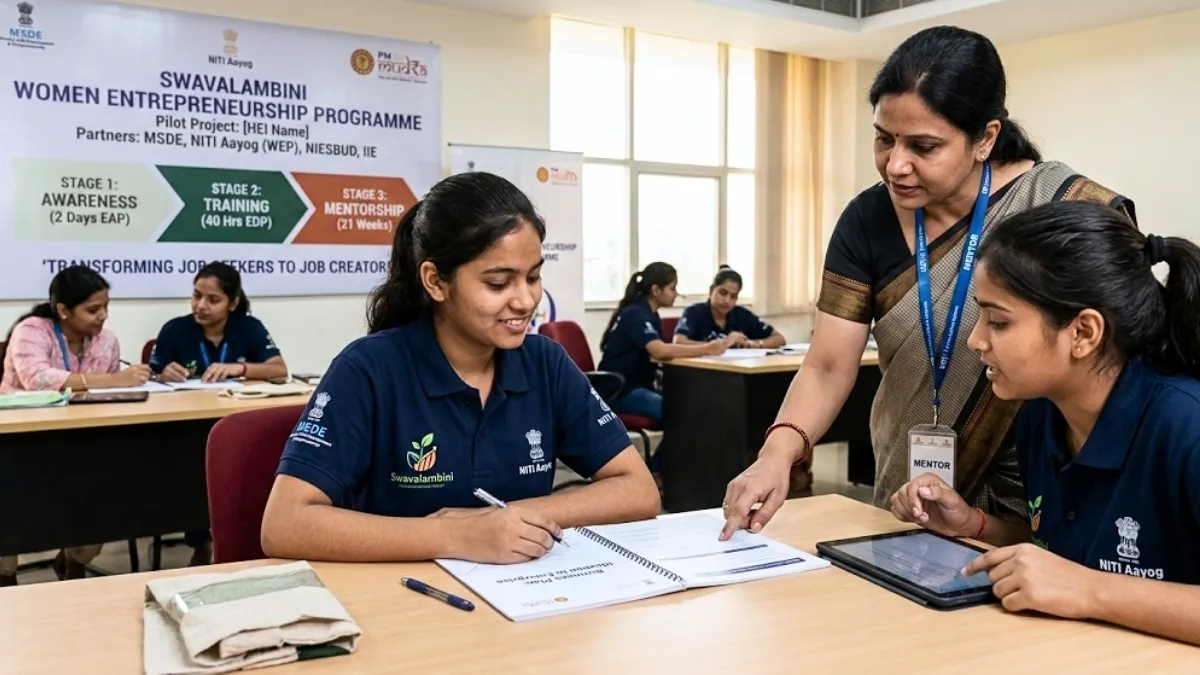
The Swavalambini Scheme is a strategic initiative to move from women-centric development to active women-led development. It is launched by the Ministry of Skill Development and Entrepreneurship (MSDE) and NITI Aayog. The Swavalambini program is specifically designed to promote women entrepreneurship among female students in Higher Education Institutions (HEIs) by focusing on a “college-to-campus” model.
The Swavalambini scheme aims to build a robust entrepreneurial mindset through structured entrepreneurship awareness programmes and skill training. Swavalambini programme provides a continuous mentorship support system over 21 weeks, ensuring that young entrepreneurs have the guidance needed to launch women-led startups.
What is the Swavalambini Scheme?
The Swavalambini Scheme is a national pilot program designed to instill an entrepreneurial mindset in female students.
In other terms, it is a start-up incubator for colleges, providing girls with the “know-how” and “do-how” of starting a business. It isn’t just a workshop; it is a comprehensive support system that guides a student from a raw business idea to a registered, sustainable enterprise.
Objectives of the Swavalambini Scheme:
-
The main objective of the scheme is to ensure that at least 10% of participants successfully launch their own businesses. Key objectives include:
-
Promote Women Entrepreneurship by breaking socio-economic barriers that prevent women from entering the business sector.
-
Develop an Entrepreneurial Mindset and move beyond traditional employment to foster innovation, risk-taking, and leadership.
-
Support Women-Led Startups by providing a structured pathway for student-led ideas to become commercially viable ventures.
-
Create Local Role Models by building a network of successful young female founders who inspire their peers.
Key Features of the Swavalambini Scheme
The scheme operates through a multi-stage training model implemented by autonomous institutes like NIESBUD (Noida) and IIE (Guwahati).
|
component |
Description |
|
Entrepreneurship Awareness (EAP) |
A 2-day introductory workshop covering basic concepts and market opportunities for 1,200 students. |
|
Entrepreneurship Development (EDP) |
A 40-hour intensive training for 600 selected students focusing on business planning, finance, and legal compliance. |
|
Mentorship Support |
A 21-week (approx. 6 months) handholding phase where industry experts guide students through actual business setup. |
|
Faculty Development (FDP) |
A 5-day training for professors to ensure HEIs have “In-house Mentors” for long-term sustainability. |
|
Recognition & Rewards |
The “Award to Reward” (ATR) initiative by NITI Aayog rewards top-performing entrepreneurs with recognition and seed funding. |
Benefits of the Swavalambini Scheme
-
For Women Students: to gain financial literacy, leadership skills and access to a professional network of industry leaders.
-
For Young Entrepreneurs: Direct assistance with business registration, market linkages, and access to government credit schemes like PM Mudra Yojana.
-
For the Startup Ecosystem: Strengthens the pipeline of women-led MSMEs, contributing to a more balanced and inclusive economy.
Eligibility Criteria:
To participate in the Swavalambini Scheme, candidates must meet the following criteria:
-
Gender: Only female students.
-
Educational Status: Currently enrolled in a recognized Higher Education Institution (HEI) or University (preferably final-year UG or PG students).
-
Location: Currently being implemented as a pilot in selected institutions across Assam, Meghalaya, Mizoram, Uttar Pradesh, and Telangana.
Implementation and Training Structure
The scheme is a collaborative effort:
-
Nodal Ministry: MSDE oversees the execution and monitoring.
-
Implementing Agencies: The National Institute for Entrepreneurship and Small Business Development (NIESBUD) and Indian Institute of Entrepreneurship (IIE) conduct the actual training on the ground.
-
Knowledge Partner: NITI Aayog (via the Women Entrepreneurship Platform) provides the mentorship framework and facilitates seed funding.
-
Institutional Hubs: Training takes place directly within college campuses to make it accessible to students.
Impact of the Swavalambini Scheme on Women Entrepreneurship
Swavalambini Scheme addresses the “missing middle” in women’s entrepreneurship—the gap between having an idea and having the confidence to register a company by providing 21 weeks of mentorship, it ensures that startups don’t fail in their first few months due to operational hurdles. This leads to economic empowerment and a direct increase in the Female Labour Force Participation Rate (FLFPR) through self-employment.
The Swavalambini Scheme is more than just a training program; it is a movement to make entrepreneurship a mainstream career choice for Indian women. By combining institutional support with industry mentorship, it lays the foundation for a Self-Reliant India (Atmanirbhar Bharat) driven by the power of women innovators.
Also read: ASMITA Initiative : Objectives, Features and Benefits
First Published: Mar 10, 2026, 10:40 IST