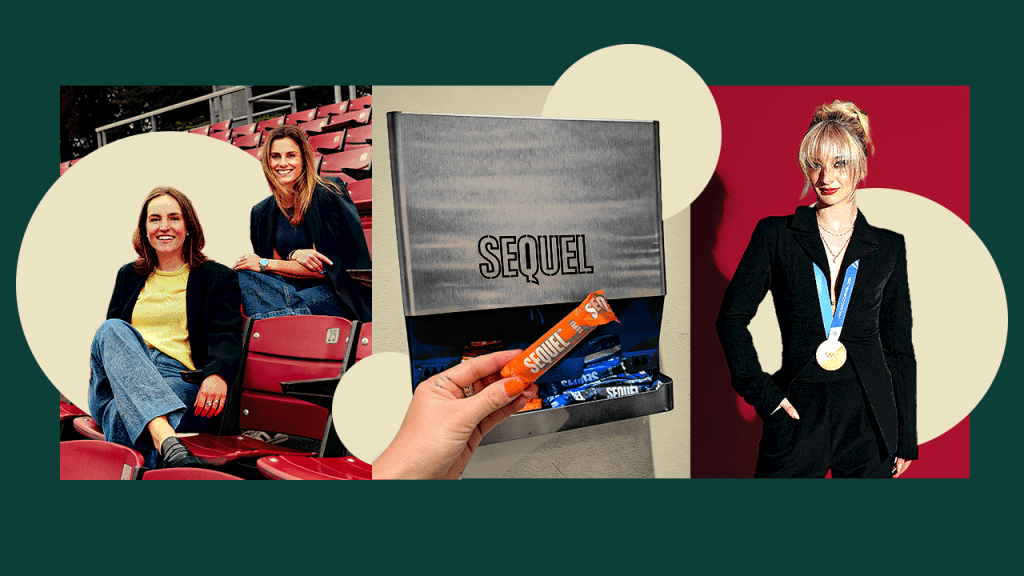
Amanda Calabrese and Greta Meyer are looking to fix one of the most persistent problems facing women athletes—leaky tampons. With their startup Sequel, the duo has re-engineered the tampon to prevent fluid from escaping around the edges, providing a solution they say could transform the lives of not only athletes but women everywhere.
Calabrese and Meyer, both 28, launched Sequel in late 2018, taking on a growing sector dominated by large incumbents. For example, Kotex, a Kimberly-Clark brand, has 16% of the global market share.
The market for tampons is expected to hit $12.61 billion in 2034, up from $7.44 billion this year, according to Fortune Business Insights. Procter & Gamble, with its Tampax brand, is the biggest player with 22% global market share, followed by Johnson & Johnson’s O.B. brand at 18%.
Sequel has raised over $8 million in funding, Forbes reported in June. Investors include MaC Venture Capital, Pear Accelerator and RRE Ventures. Next up for Sequel is an official Series A round but Calabrese declined to comment on timing.
In late 2025, Sequel received funding from Tipt Ventures, a VC firm that invests in companies adjacent to sports that seek to unlock growth through women. The investment was the second from Tipt’s debut fund, which is targeting up to $50 million, according to Ami Galani, a Tipt co-founder and managing partner.
“It’s a big issue they are solving,” Galani said. “Doubting the reliability of your feminine hygiene product on game day, or even on practice days, is a terrible experience for athletes, from youth to pro.”
The design for tampons hasn’t changed much since they were invented in 1931. Traditional tampons have vertical channels that can lead to fluid leaks and premature failures. Calabrese and Meyer, who both trained as mechanical engineers, introduced a spiral shape to their tampon that redirects the fluid to the absorbent core. The design aims to prevent failure and promote even absorption, Calabrese said.
Calabrese and Meyer met in 2018 during a product design class while they were undergrads at Stanford. Both were athletes—Meyer played lacrosse at Stanford, often competing in an all-white uniform, while Calabrese had to wear a red, white and blue bathing suit for the nine years she represented the U.S. in national and global lifesaving competitions.
The possible embarrassment of bleeding through the uniforms was a common distraction while competing, said Calabrese, who is the company’s chief marketing officer. “We have never been able to find period products that work for sports.”
Meyer and her teammates would often ask each other, “Can you check me?”
Athletes rarely discuss competing while having their periods, and Team USA Olympic figure skater Amber Glenn recently broke this taboo. Female figure skaters often wear short dresses made from spandex, Lycra or mesh that are designed to stay in place while they jump and spin.
“I’m on my period right now, so it’s always really hard, especially when you’re wearing something like this and have to perform in front of the world,” Glenn said after skating at the Olympics in February. “That’s hard and people don’t talk about it.”
Sequel’s Calabrese and Meyer spent roughly five years conducting R&D for their product. Because tampons are considered Class II medical devices, Sequel had to go through much testing before securing FDA approval in 2023. “We pulled some ex-P&G, ex-J&J engineers out of retirement to help us,” Calabrese said.
Sequel tampons have yet to hit store shelves but are available on their website and TikTok Shop. Earlier in March, Sequel entered a partnership with the New York Yankees to provide Sequel tampons for free in women’s restroom at Yankee Stadium this season. About 1.5 million women pass through Yankee Stadium each year, according to a release.
“It’s very exciting,” Calabrese said in an interview. “It’s the first partnership of its kind in MLB.”
Sequel has similar deals with D.C. United, the Indiana Fever and Athletes Unlimited.
Sequel has seven employees, all remote, and no current plans to hire more. With only one product at the moment, the startup is focused on making the tampon “as great as we can,” Calabrese said.
Having reliable personal hygiene products could help stem the flight of young girls from sports, Tipt’s Galani said. About 43% of young girls who considered themselves “sporty” disengage from sports after primary school, according to a 2022 study from Women in Sport. More than two-thirds, or 78%, said they avoided sports when they had their periods.
“Girls are playing younger, harder and faster than they’ve ever played before,” Galani said. “There is a dearth of high-quality performance products available for them from protective gear to equipment and performance footwear to injury prevention and beyond.”