Is India’s demographic sweet spot turning sour by the day?
Perhaps, going by the UN estimates, at least. India’s elderly population of 153 Mn – aged 60 and above – is expected to reach a staggering 347 Mn by 2050, as longevity became the centre of attention after the world wriggled out of the COVID blues. India, like most major economies, races to reduce the effect of one’s biological age and increase the healthspan, with nearly half of its 1.5 Bn population prioritising longevity.
The pursuit of living longer and staying healthier attained greater importance with large swathes of the country reeling under a spate of disorders caused by lifestyle-related issues. According to media reports, the rise of cancer cases among Indians outpaces the global average at 1.57 Mn, while more than a third of deaths in India are being caused by cardiovascular disorders, and diabetes continues to claim more lives in India than in any other country.
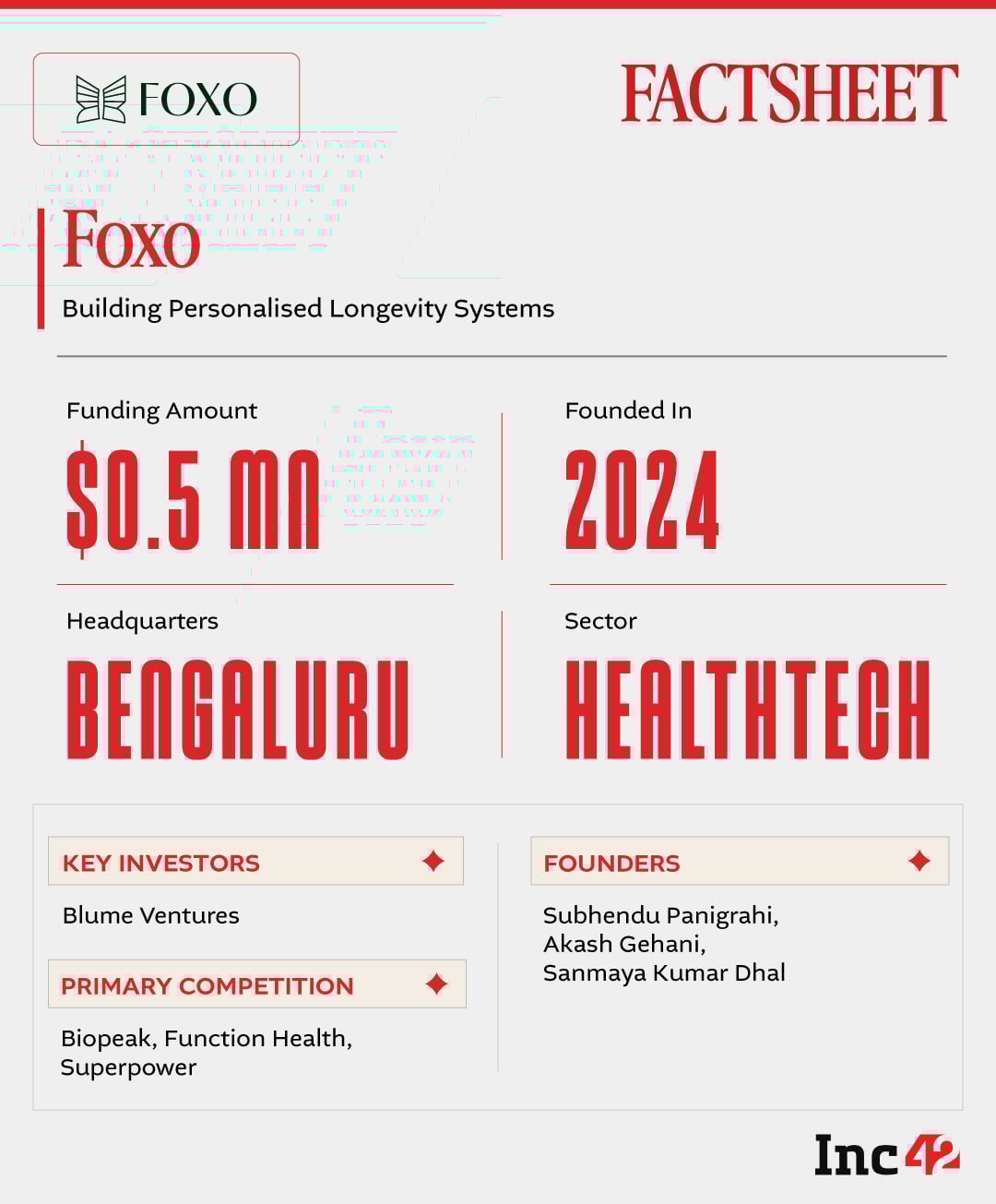
The fourth-largest global economy finds itself locked in a paradox. The deep-pocket, upwardly rising, urban Indians are hit the hardest by this silent epidemic. “We realised the dire need for guidance to help India heal its woes,” said Subhendu Panigrahi, one of the trio behind the making of Foxo, a premium membership-based platform focussed on health and longevity.
“We use advanced science and systems to tell you what is happening inside your body and the probability of getting severe lifestyle diseases like heart attacks or diabetes in the next 5-10 years with 85-90% confidence. Our promise is to tell each customer where they stand and where they are heading.”
Panigrahi teamed up with Akash Gehani and Sanmaya Kumar Dhal to set up the startup in Bengaluru to offer its members a personalised support system built using AI inputs and advice from wellness experts.
While Foxo races with brands like Next Health and Lucis on the global turf, Foxo’s closest competitor in India is Rainmatter Capital-backed Biopeak. In March 2025, the startup raised its first funding of $0.5 Mn in a pre-seed round led by Blume Ventures.
Born Out Of A Personal Problem Statement
Like many founders, Panigrahi founded Foxo to tackle a problem he faced himself. The IIT-Kharagpur graduate founded Skillenza, a challenge-based hiring platform, in 2014. But during the pandemic, Skillenza ran into a rough patch because of hiring freeze, and began looking at how to pivot.
“After Covid, my stomach issues started getting worse and I was taking standard medicine like Digene. I kept pushing myself to save the company, but by the second wave, my issues became so much worse that I had to go to the emergency room,” the founder recounted his personal sufferings after he contracted COVID.
Panigrahi was diagnosed with a stomach ulcer and put on a course of antibiotics, but the relief was short-lived as he soon began suffering rapid weight loss and hair loss. Despite repeated hospital visits and tests ruling out several possibilities, his case appeared to confound most doctors. So, he took matters into his own hands by reading up.
In his research, Panigrahi came across the idea of systems biology – a relatively recent paradigm that sees the body as a network of interconnected organs, cells, and conditions. The traditional approach to healthcare tends to prescribe issue-specific treatments that face limitations when it comes to chronic illnesses, as Panigrahi had seen for himself. The study of systems biology reveals that these cases arise from multiple interacting factors, and the root cause is highly specific to an individual.
Panigrahi went through advanced diagnostic tests under the guidance of various AI tools that had started gaining popularity until the root cause was spotted by the doctors. It was a stomach infection caused by a bacteria. Revised medication and treatment helped him recover.
This journey helped him thrash out the roadmap for his next venture. “I found people not getting answers for their lifestyle diseases from the healthcare ecosystem, which is built for acute cases like fever and trauma. If you have diabetes, the doctor gives you medicine; if you have gut issues, they say don’t eat outside and avoid spicy food. These are just blanket statements which don’t get to the root cause. That’s where I saw the gap.”
One Vision That Binds Three Minds
Panigrahi wanted to provide personalised guidance and support to people who wanted to work on their health and improve their lifestyle. In this process, he found himself aligned with two friends. The trio soon teamed up to become cofounders. “Akash (Gehani) has never taken pills or medication and has focussed on his health for almost 15 years. For Sanmaya (Dhal), who is a techie, healthcare plus AI was an interesting challenge,” he said.
The founding team started off with the launch of their Flagship membership tier. Foxo selectively accepts membership applications based on alignment with the startup’s goals and capabilities; not everyone who expresses interest is enrolled.
A flagship member needs to pay an annual fee amounting to a few lakhs. This includes an initial full battery of diagnostic tests administered on onboarding and a subset of tests that are repeated every three months to track biomarkers; as well as weekly consultations with the clinical team and access to the mobile app. There are also a few requirements that are not included in the cost, like access to a wearable with health-tracking features and fitness memberships.
Given its premium positioning, Foxo serves its Flagship-class members – usually founders, operators, and senior executives who need some handholding and personalised support to stay healthy in their busy, high-stress life.
“There are two yardsticks for our ICP. One is the ability to pay – someone who can afford a few lakhs a year on a membership and then another few lakhs on things like gym memberships, supplements, and good food. The second is the intent – someone who looks at health as an asset, rather than an expense, like those who buy organic food or use health wearables,” Panigrahi explained.
“We tell our members that they are the CEO of their own health. We can only show them the path but they have to walk it. We bring in a board of mentors to guide them. And just like running a company, we set quarterly goals to help the member implement changes and address the issues in their body.”
Blending Human Brains With Artificial Intelligence
Foxo’s clinical team is the backbone that underpins the entire value proposition. It consists of doctors who specialise in lifestyle diseases, biotechnology scholars who understand genomics and aging, nutritionists, movement coaches, and behavioural or mindset instructors.
“From day one, we knew our clinical team had to be cross-functional and multidisciplinary. They work together to understand the data of our customers and coach them through the year while they are implementing lifestyle changes,” said Panigrahi.
Foxo’s promise is that when a member consults its clinical experts every week, the advice they receive is highly personalised to their body’s specific biomarkers and their own story. For example, someone suffering from gut or kidney issues may not be able to consume protein the same way as others and an executive who travels frequently may need advice on how to work out regularly even in the confines of a hotel room. It could even be something as simple as Foxo’s nutritionists suggesting a recipe that is tailored to the customer’s taste.
Tech is an important part of Foxo’s system as well. To begin with, there is the mobile app, which presents insights on their body derived from the diagnostic tests they take and data synced through the member’s wearable. It also has photographic food logging to track the member’s diet.
The app also comes with a gamification aspect to encourage a healthier lifestyle. Based on the member’s personal goals, it assigns them daily activities to be completed, such as sunlight exposure 15 Min after waking up, avoiding screen time before bed, or going on a post-meal walk.
Foxo uses AI primarily behind the scenes. “In healthcare, it gets tricky if the AI is exposed to the consumer because it runs the risk of hallucinations. We decided that AI should only be in the hands of an expert. AI is used to make our clinical team’s life easier so that they have more time to spend with the members,” Panigrahi said. The company relies primarily on Claude and some open source LLMs.
Foxo, for example, uses AI to assist its doctors in analysing a member’s biomarkers and symptoms to understand the status of their body and decide the right treatment and interventions. Its app uses AI to check whether the customer’s diet is meeting their personal benchmarks and produces an automated food score that is reviewed by the nutritionist, who then gives the member their own feedback.
The other main use of AI is to facilitate internal workflow. A member generally converses with different clinical team members. AI acts like an assistant that listens to these calls, extracts and shares the relevant action items, and enables the entire team to be on the same page.
Mapping The Way To A Healthier Future
As a fairly young startup, Foxo’s next goal is to roll out a host of services. “In the next 12-18 months, we will experiment with different price points to make longevity and systems biology more accessible for the next 100 Mn Indians,” Panigrahi said.
For the less solvent consumer class, the startup has the Primer membership, priced at ₹10,000. It includes the initial battery of tests and offers one doctor consultation. The product aims to give curious customers a taste of the concept and help them understand their body initially, with the possibility of upgrading them to the Flagship band.
The company has onboarded 50 Flagship members, ranging from youths in their twenties to seniors aged above 60. It plans to accept 100 members in the first run of its Primer tier and those slots are expected to be filled within the month, he said.
Foxo will also start experimenting with membership options differentiated by proposition, rather than pricing. “We are seeing different types of people coming to us – from young professionals looking to optimise their body to people who are suffering from a disease and want to rely less on pills. Going forward, we want to go into more specialised programmes for members, like focussed on women’s health or cancer survivors,” Panigrahi said.
[Edited by Kumar Chatterjee]