Researchers at the University of Nebraska Medical Center are working with a medtech startup to get their innovations into the hands of health care professionals combating infectious diseases. Carecubes specializes in deployable isolation units — giving hospital staff and visitors safe access to a patient while not worrying about the costs and limitations of personal protective equipment (PPE).
“These hospitals that are teetering on the edge, and where one infectious patient could end up turning the hospital inside out, I really would like to be able to be helpful by giving them the isolation capacity that they heretofore couldn’t afford,” said Carecubes Co-founder and CEO Alex Laskey.
Carecubes evolved from grant-funded research and prototypes made in response to global health crises. The company manufactures and sells an FDA-cleared device that turns standard hospital beds into isolation beds in a matter of minutes.
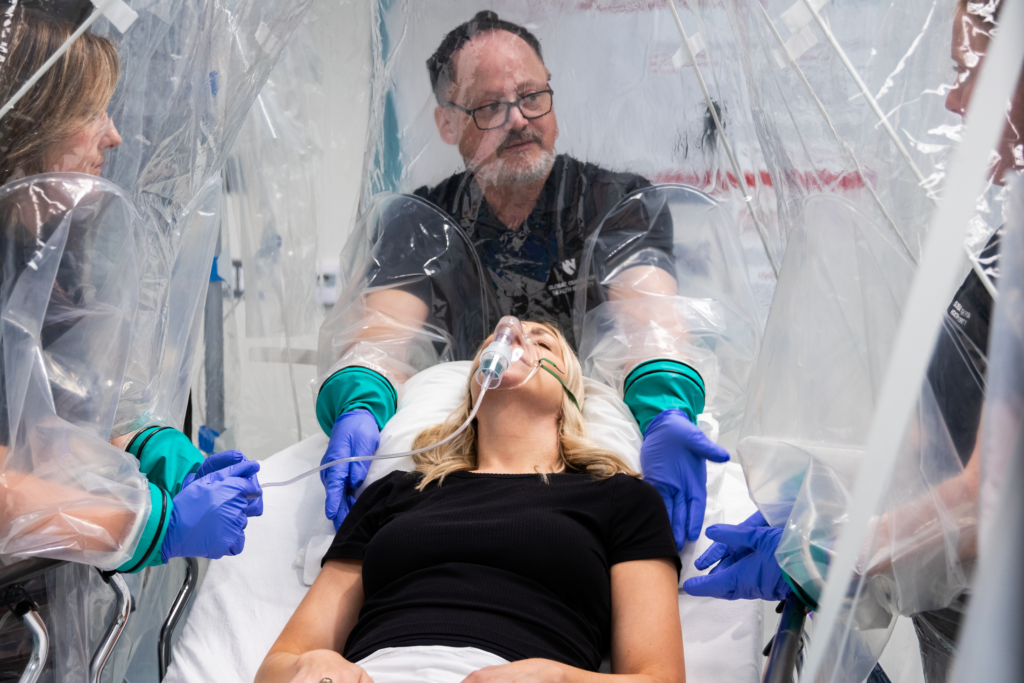
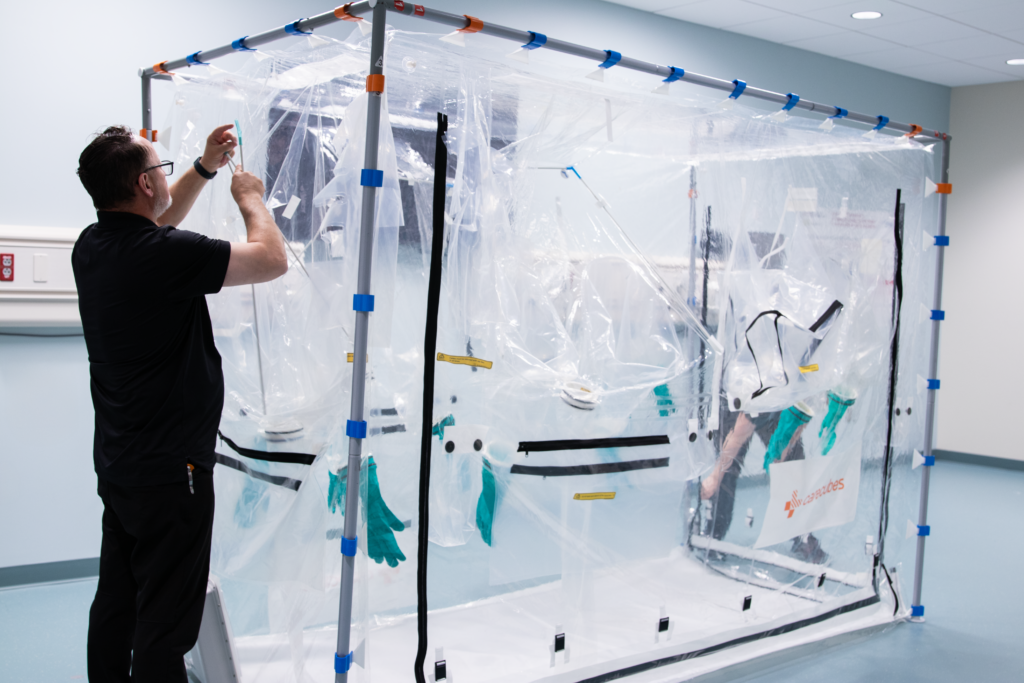
The Carecube ISTARI looks like a see-through canopy that surrounds a patient: filtering air, maintaining negative pressure and allowing caretakers to perform duties face to face while outside and away from harm.
This month, Carecubes announced that its product has been purchased by hospitals and other providers in more than 36 communities across 13 states and territories of the U.S. The startup also shared that it closed a $6.5 million Series A venture capital round.
Investors include Schooner Capital, Lifeforce Capital, CQuence Health and individual investors affiliated with Radiate Capital and other leaders in the health care and insurance industries.
Although Laskey said Carecubes — through a corporate perspective — is based with him in Arlington, Virginia, the company has a nationwide presence.
Manufacturing takes place in Minnesota. Suppliers and partners operate out of North Carolina, Connecticut, California and Ohio. But its clinicians and some key investors remain in Nebraska, Laskey said.
“One thing we find exciting is that the technology was developed locally,” CQuence Health CEO Kyle Salem said in an email to SPN. CQuence Health is based in Omaha and invests both venture capital and mentorship into health care startups located locally and throughout the country.
“We like the idea that it’s close by and connected, and for us, kind of a hometown story,” Salem added.
Development history
The origins of Carecubes lie in the Ebola outbreak in 2014. Otherlab, an independent research and design firm in San Francisco, took on a DARPA contract through the Department of Defense to help create a containment solution.
Under Saul Griffith, the founder of Otherlab and eventual co-founder of Carecubes, that work would be the basis for the present-day product.
While the idea would be put on hold for a few years, the concept would experience renewed interest under Dr. James Lawler and other experts at the UNMC Global Center for Health Security around 2018 — when another Ebola outbreak occurred. Lawler said his time serving in the U.S. Navy made him aware of Griffith’s initial work and what impact it could potentially make around the world and in rural communities at home.
The UNMC researchers received funding and support from the CDC and the U.S. Department of Health and Human Services. They also joined forces with Otherlab. The team would progress its Isolation System for Treatment and Agile Response for High-Risk Infections (ISTARI) from an academic project to a product ready for commercialization.
UNeMed CEO Michael Dixon said the UNMC tech transfer lab got involved with commercialization efforts around 2020 — when COVID began disrupting and exposing cracks in the health care system. Griffith would reach out to Laskey, an experienced founder in the energy and utilities space with whom he had previously collaborated, to lead the new company.
With his own brother treating medical workers on the front lines as a psychiatrist during the pandemic, Laskey said he felt moved to help those with the “heroic professions” he knew were struggling.
“We started treating nurses and doctors like they were disposable commodities,” Laskey said. “And so for me, this is a product that helps restore dignity to nurses and doctors.”
Laskey said the technology received FDA approval in January 2024. Additional testing and improvements were completed before the products were shipped out to hospitals in the spring of last year.
Innovations in the works
Describing Carecubes as a “hand-off partner,” Lawler said he and his UNMC colleagues maintain a separated but close collaborator relationship with the startup and Otherlab. As the university side seeks grant-funded opportunities to create and test prototypes, Carecubes acts as more of an adopter, manufacturer and marketer that provides design inputs.
In addition to the Carecubes ISTARI device, UNMC and Otherlab have other technology in the works for various isolation and containment scenarios. These range from a transportation solution for ambulance and helicopter rides to a full-on, improvised health care setting for situations where there isn’t a hospital or other medical infrastructure.
“Domestically at home, we have things like measles — a highly transmittable infection that we’re bringing into health care facilities more and more,” Lawler said. “I certainly think (Carecubes) gives hospitals and health care facilities a lot more flexibility … to keep beds free, keep hospital staff more efficient (and) obviously reduce supply chain strain and waste management issues.”
Laskey said Carecubes was interested in exploring and getting the products to market. With the recent investment round, he said, the company will use the funds for current product improvements, R&D, marketing, sales and hiring.
Additional goals include readying the device for more routine care instead of just emergency events, as well as establishing more in-person operations in the Twin Cities. Laskey said he could envision a future where office space opens in Omaha, but he emphasized the current presence of the startup though UNeMed and UNMC.
“I’m really excited about rolling this out in Nebraska,” Laskey said. “I’d love to get this into the smallest hospitals and rural clinics throughout the state.”
Salem with CQuence Health said the advancement of local medtech startups and medical research help position Nebraska as a global leader and resource for improving patient outcomes.
“It shows that Omaha and the state as a whole have a thriving ecosystem that’s filled with innovators conducting groundbreaking work in health care,” Salem said. “Carecubes isn’t the first and they won’t be the last, and I’m thrilled we get to be a part of it.”