

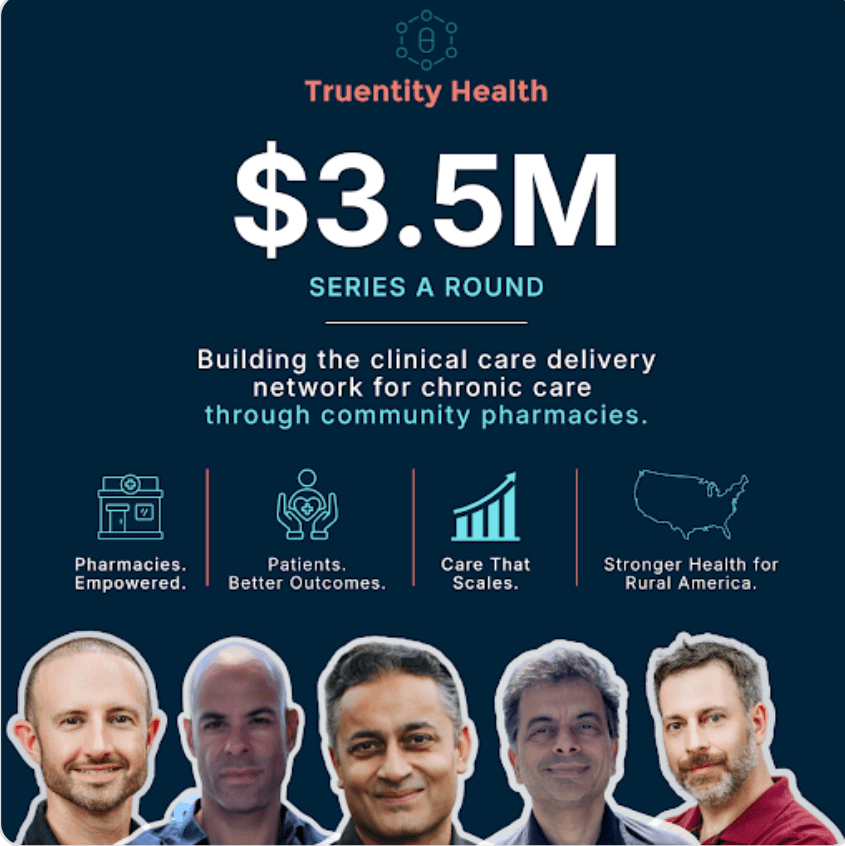
This morning, Chapel Hill startup Truentity Health announced that it has closed an oversubscribed $3.5M Series A to, per release, “scale a tech-enabled clinical care delivery network that turns community pharmacies into continuous care settings for chronic disease management.”
The round was led by Evidenced VC—whose Founder and Managing Partner, Sean Glass, will join the Truentity board—with additional participation by Cofounders Capital and K-Street Capital.
GrepBeat last covered Truentity Health in 2024, when the startup merged with what was then IndyCare Health. The merger effectively resulted in a product that could enable pharmacies to become more robust clinical hubs.
Truentity Founder and CEO Mike Desai said at the time that this would benefit patients by making pharmacies more efficient and keeping them from having to deal with multiple vendors and technologies.
“They get it all in a single platform,” he said.
In the almost two years since then, Desai said Truentity Health has moved from proving that concept to scaling a repeatable model. That model revolves around an AI-powered platform that helps pharmacies seamlessly deliver and manage care for Medicare and Medicaid populations.
“Early on, we were focused on showing that community pharmacies could deliver clinical care beyond dispensing,” he said. “Today, we’re operating a multi-state network where pharmacies are consistently delivering reimbursable chronic care services as part of their day-to-day operations.
“We’ve also built out the full infrastructure [around] physician-governed clinical oversight, billing, compliance, and workflow, so this isn’t a pilot anymore,” he added. “It’s a model that can be deployed and scaled across markets.”
How the raise came about
Desai characterized Truentity Health’s raise as something that developed through existing relationships rather than a broad, outbound process.
“With Evidenced, there was strong alignment early,” he shared. “They understood that this isn’t a software play, it’s a care delivery model enabled by technology. That’s a more complex story, but also where the long-term value is.”
Echoing that point, Evidenced VC’s Sean Glass stated for the official release that “Truentity has built a unique model that combines deeply integrated technology with a differentiated clinical layer, setting it apart from software-only approaches.” He added that this approach is “driving rapid growth and addressing a critical gap in communities that lack the resources to support chronic care management.”
While Evidenced led the round, Desai said that other investors (such as Cofounders and K-Street) were attracted for similar reasons.
“They saw real traction, real outcomes, and a model that fits where healthcare is going, especially around chronic care and community-based delivery,” he said. “It was less about selling a vision and more about showing what’s already working and where it can go.”
Desai indicated that this approach—demonstrating traction over vision—is particularly important in the healthcare space, where there is, as he sees it, a higher bar.
“There’s less appetite for purely conceptual or narrative-driven companies,” he said, adding that investors in this space in particular are looking for real revenue, customers, and outcomes.
In a more big-picture sense, he also stated, “The biggest lesson is that clarity matters. You need to be very clear on what you are and what you’re not. If your story is even slightly ambiguous, it gets discounted quickly. And the second piece is capital efficiency….
“If you have a model that works and you can show disciplined execution, capital is still available.”
What’s next for Truentity Health?
As for what Truentity aims to accomplish with the funding, Desai spoke to three key priorities.
First among these is expansion, both by “scaling the pharmacy network across additional states” and by deepening presence in existing markets. Second is continuing to improve product and infrastructure to ensure that pharmacies can “run these programs without adding operational burden.” And third is to address clinical programs—expanding the set of services and care pathways they support, “especially around chronic conditions where continuous engagement drives outcomes.”
Desai noted that across all three of these focal points, Truentity is applying AI “in a way that’s embedded in day-to-day operations.”
“We’ve been able to do all of this in a capital-efficient way so far,” he said. “This funding lets us accelerate without changing the fundamentals of how we operate.”
As for overarching goals after hitting a significant milestone, Desai indicated that the focus is largely on “scaling with consistency.”
He added, “At a higher level, the goal is to establish this as a standard model for how chronic care is delivered outside traditional settings.”
See Truentity’s own announcement here.
Source link