
Money20/20 Asia returned to Bangkok from April 21 to 23, 2026 to explore how the next wave of financial innovation is delivering tangible outcomes across the Asia-Pacific (APAC) region.
The conference examined the region’s rapid financial innovation, characterized by enhanced cross-border interoperability and strengthened digital infrastructure. It also explored Thailand’s push for open finance, the integration of artificial intelligence (AI) in financial services, and the transition of stablecoins from niche crypto assets to foundational payment rails.
Marking its third year in the Thai capital, Money20/20 Asia 2026 welcomed over 4,500 attendees, representing a 40% increase from the previous year. More than 1,400 companies were represented, and the number of sponsors rose from 105 to 150.
Over 360 speakers delivered more than 100 hours of content across four stages, while the bustling Money Hall show floor connected delegates, sponsors and exhibitors from 90 countries. Companies reported a surge in commercial activity, with hundreds of partnership meetings, product demos, and investor conversations driving tangible deal flow throughout the three days.
Thailand moves towards open finance

On the first day of the main conference, Daranee Saeju, Assistant Governor of the Strategy and Special Projects Division at Bank of Thailand (BOT), discussed the country’s progress in establishing a safe and inclusive digital finance infrastructure, highlighting two established layers of digital public infrastructure.
Digital identity systems, like the National Digital Identity (NDID), a decentralized cross-bank platform, and government-led initiatives like ThaiID, are now serving almost 30 million. Additionally, Thailand’s instant payment system PromptPay boasts over 92 million registered accounts and processes an average of over 80 million transactions daily.
Despite these achievements, Saeju identified the critical remaining challenge as breaking down the “data islands” where financial information still sits in silos across banks, telcos, and e-commerce platforms. This fragmentation creates gaps in financial inclusion and weakens fraud detection, she said.
To address this, BOT is building the rails for open finance through initiatives like YourData and Digital-RD, in collaboration with the Revenue Department. With YourData, the government will be establishing national standards for a consent-based ecosystem, giving citizens a “digital remote control” to port their data wherever they see fit. Concurrently, Digital-RD will allow users to utilize their verified tax history as a secure, instant digital credential, replacing paper documentation.
Thailand’s overarching vision is a regulated “data highway” where individuals control their data and are able to port it to the institutions they choose, expanding access to credit, and accelerating innovation, Saeju said.
Ant Digital Technologies’ Southeast Asian push

Later during the day, Garry Sien, Chief Innovation and Solutions Office of International Business at Ant Digital Technologies, delivered a keynote titled “Beyond the Super-App: The AI-Driven Platform-as-a-Service (PaaS) Model for Global Finance.” He discussed the accelerating adoption of AI in the financial services industry, driven by agentic AI and innovative applications that create value for financial institutions and their customers.
Sien also shared how Ant Digital Technologies is working on democratizing access to the underlying technology of super-apps, including mini-programs, risk engines, and AI development toolkits like Agentar. These modular, AI-native solutions allows institutions to innovate rapidly, enhance user experience, and compete with big tech, without needing to build everything from scratch.
Ant Digital Technologies, an independent business unit for technology commercialization under Ant Group, launched an operation center in Malaysia earlier this year, and initiated a recruitment drive across Southeast Asia.
Across Asia, Ant Digital Technologies has cooperated with partners and clients including Touch ’n Go, Kenanga Investment Bank Berhad (KIBB), Bank CenterCredit, and FPT software. The company’s global network encompasses over 300 partners, serving more than 10,000 enterprise customers worldwide.
Cross-border transactions surge
FXC Intelligence and Money20/20 presented new findings from their New Era of Asia’s Cross-Border Payments report, underscoring Asia’s rapid growth, rising interoperability, and the convergence of key technologies shaping cross-border finance.
The report revealed that in 2025 outbound cross-border payments from the APAC region totaled US$13.5 trillion, representing 31% of outflows globally. They are set to grow faster than global averages to reach US$24 trillion, representing a 36% share, by 2033.

Growth in Southeast Asia is set to be particularly critical to this, with ongoing digitization driving business-to-business (B2B) volume while increased tourism and online retail are expected to help boost consumer-to-business (C2B).
System interoperability and bilateral partnerships are key enablers of this growth, exemplified by initiatives like the Bank of International Settlements (BIS)’s Project Nexus, which seeks to connect different countries’ domestic instant payment systems. Blockchain technologies, along with AI, are also seeing increased interest to support growing payments interoperability and broader infrastructure enhancements.
Though Asia is notable for being a region with highly diverse financial systems and capabilities, the continent is now on a trajectory towards unprecedented interoperability, positioning it to capitalize on future cross-border growth.
EBANX accelerates ASEAN expansion
EBANX, a leading payment technology firm from Brazil, announced at Money20/20 Asia 2026 the expansion of its recurring alternative payment method (APM) offerings to six more countries across Southeast Asia, Africa and Latin America, namely the Philippines, Indonesia, Thailand, South Africa, Colombia, and Peru.
The rollout includes recurring capabilities for digital wallets in Southeast Asia, such as Maya and GCash in the Philippines, OVO and DANA in Indonesia, and TrueMoney in Thailand. They will be available to merchants in Q2, Q3, and Q4 this year.
The announcement followed EBANX’s recent entry into Indonesia, Thailand, Turkey, Malaysia, and Vietnam, with the latter two scheduled to go live in Q3 2026. These operations will be supported by EBANX’s new APAC headquarters in Singapore, inaugurated in March 2026.
“We are seeing a strong expansion movement of APAC merchants into emerging markets, especially in Latin America and Africa,” said João Del Valle, CEO and Co-founder of EBANX. “In the current global landscape, companies are searching for new growth opportunities, strengthening South-South ties and building diversified and resilient global partnerships.”
At Money20/20 2026, EBANX spoke in two key sessions. In the panel “Ecosystem Readiness: Turning Isolated Progress into Coordinated Scale”, Eduardo de Abreu, Chief Product Officer at EBANX and Regional CEO of EBANX Singapore, joined other industry leaders from Nium, Boku, and Bitpace to discuss how fragmented advancements across regulation, infrastructure, and market demand can be aligned to drive scalable ecosystem growth.
@fintechnewsnetworkWith its latest expansion, EBANX is building a recurring payment infrastructure beyond cards across Southeast Asia, Africa, and Latin America. #fintech #payments #Money2020 #Money2020Asia
In the session “Innovation Without Borders”, Vladimira Artopé, Regional Director for Southeast Asia at EBANX, explored the transformative impact of fintech and education solutions for underserved women in Asia, particularly in maternal and financial health. The panel highlighted how technology can support greater financial inclusion in resource-constrained environments.
Policy20: sovereign intelligence and collaboration
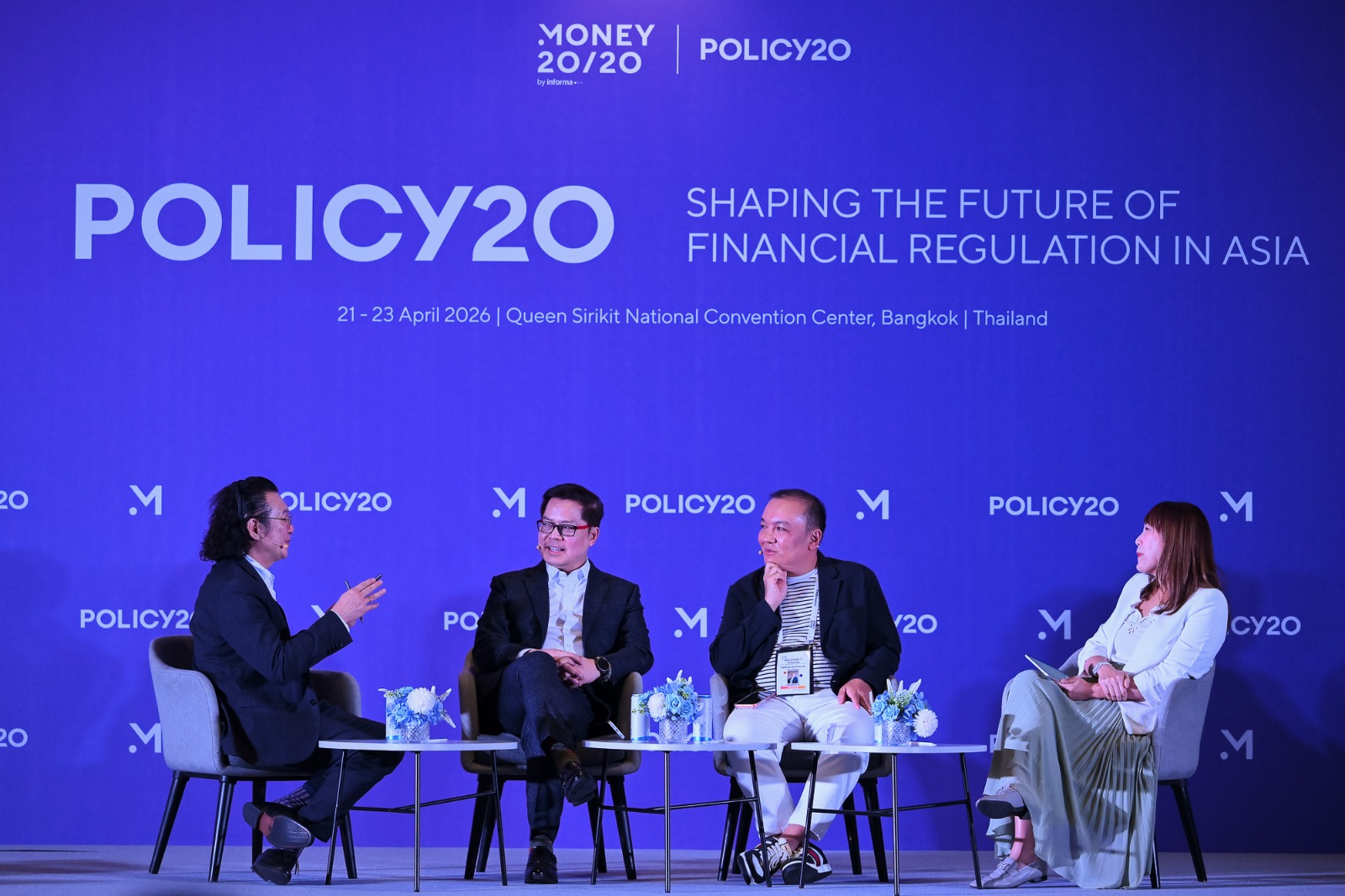
Policy20 at Money20/20 Asia 2026 delivered a premier regulatory summit convening more than 80 of Asia’s top policymakers, regulators, and industry leaders to address the rapid convergence of technology, finance, and regulation, and the urgent need for collaborative approaches to navigate this evolving landscape.
A key highlight of the program was a closed-door Governors’ and Chairs’ Strategic Roundtable on “sovereign intelligence,” where senior policy leaders met under Chatham House Rule to address the challenge of maintaining national policy autonomy in an era of AI and digital finance.
The session reached consensus on three strategic pillars: protecting national policy autonomy through proactive participation in global standards; building cross-border financial rails on shared governance protocols that respect national priorities; and shifting to “intelligence-led governance” by leveraging AI and real-time data tools for oversight.
A dominant theme emerging from Policy20 was the industry-wide shift from traditional regulatory models toward co-creation, with regulators increasingly positioning themselves as enablers rather than enforcers, working alongside the private sector to design frameworks that evolve in real time with technological advancements.
Experts also highlighted that innovation without usability is problematic. Discussion points centered on the idea that true financial inclusion in Asia depends on intelligent infrastructure and systems that are not just accessible, but also intuitive and affordable enough to remove friction for underserved populations at scale.
Stablecoins take center stage
Stablecoins were a key topic at Money20/20 Asia 2026. During the closing day of the three-day conference, four industry leaders from Ripple, Paxos Labs, Yellow Card, and Capitalixe convened in the “Money’s Next Evolution, Stablecoins, CBDCs and the New Payment Stack” panel to debate the role of stablecoins, central bank digital currencies (CBDCs), and tokenized deposits in the future of finance.
These experts emphasized that stablecoins have moved beyond cryptocurrency trading to become foundational infrastructure for the next global payment stack, with Rahul Advani, Global Co-Head of Policy at Ripple, noting that while CBDCs remain experimental, stablecoins are already production-ready across multiple use cases, the Nation reports.
The panel agreed that the future of finance will not be defined by any single form of digital money, but by how well these instruments work together. They shared concrete real-world applications where stablecoins are already solving existing problems, including enabling cheaper remittances between the US and Bolivia, enabling crop insurance in Africa to be settled in stablecoins, and supporting cross-border payments for businesses that struggle to access the SWIFT network.
Looking ahead, the panel identified AI and machine-to-machine transactions as a potentially transformative future trend, where autonomous agents manage payments, treasury operations, and capital allocation without human intervention. However, they identified the lack of mutual recognition of regulatory regimes as a critical gap, warning that siloed licensing frameworks could recreate the inefficiencies plaguing traditional finance.
Other corporate announcements and winning startups
Beyond presentations and panels, several corporate announcements underscored the momentum in stablecoins. Nium, a real-time payment specialist co-headquartered in San Francisco and Singapore, announced a partnership with Coinbase to enable USDC stablecoin payments across its platform. The integration allows Nium’s clients to send and receive stablecoins and convert stablecoin to fiat for payouts.
@fintechnewsnetwork With Nium and @dlocal.payments ♬ original sound – Fintech News Network
Additionally, dLocal, an Uruguayan cross-border payments firm, launched Stablecoin Full, a solution enabling global merchants to accept and send payments in stablecoins, fund and settle transactions in digital assets, and optimize their treasury operations across more than 40 emerging markets through a single API.
Money20/20 Asia also spotlighted five startups redefining the future of money. These startups, which are Boost Capital, TrustPlus AI, Continuum, Eazy Digital, and zkMe, were showcased during Money20/20 Asia’s Startup Media Panel.
Boost Capital is building a document intelligence layer for underwriting in Southeast Asia. Its VerifyIQ platform uses AI agents to read, cross-check, and fraud-screen bank statements, pay slips, identification documents (IDs), and merchant documents in real time delivering structured, trusted data to banks and e-wallets.
TrustPlus AI transforms enterprise credit risk management through an AI-powered workflow platform built by and for credit risk experts.
Continuum is a tech platform focused on enabling seamless infrastructure and connectivity across digital and financial ecosystems, helping organizations streamline data, services, and operations in one unified layer.
Eazy Digital is an insurance technology company helping insurers and managing general agents (MGAs) digitize and streamline their operations, replacing manual, paper-heavy workflows with automated tools that improve efficiency, reduce errors, and enhance customer experience.
zkMe, a decentralized identity protocol, was named this year’s Startup Competition winner. zkMe uses zero-knowledge proofs to let users verify personal or financial information without revealing the underlying data. It enables privacy-preserving know-your-customer (KYC) and credential verification for Web3 and digital finance applications.
Featured image: Edited by Fintech News Singapore, based on image by Money20/20
Source link