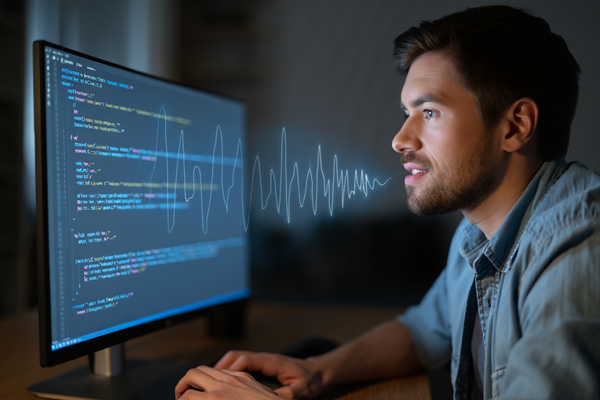
As AI is bringing various changes to how people work, the share of work done by speaking rather than typing by hand is growing and drawing attention.
It may irritate those nearby, but as AI spreads, more people appear to be working by voice rather than by hand, led by tech startups.
A recent Wall Street Journal report said engineers at credit-card startup Ramp can often be seen sitting at their desks wearing gaming headsets. They wear the headsets used for gaming to speak loudly to AI assistants, it said.
Edward Kim (에드워드 킴), co-founder of HR platform startup Gusto, said, “The office of the future will look like a sales floor,” and is encouraging employees to experiment with dictation technology that converts speech into text, the WSJ reported.
Kim, who considers himself a good typist, said, “These days I work by talking to my computer almost all the time. I don’t type unless I absolutely have to.”
Working while speaking as if muttering to oneself is not a familiar scene for many. It can feel a bit awkward if someone is next to you. It can be somewhat better at home. Kim said, “At home, it feels like Tony Stark talking to Jarvis. In the office, it’s just a little awkward.”
In an office, etiquette becomes more important out of consideration for others nearby. Users try to keep their voices as low as possible. Some wear headphones to block out the sound of people using voice input around them. The WSJ reported that this is meant to reduce annoyance for each other.
The WSJ also quoted a venture capitalist as saying that when he visits AI startups these days, the people communicating with AI by voice make it feel like he has walked into an upscale call center.
Dictation is not a new technology, but until recently it was not good enough to perform even basic tasks. That has changed. Apps such as Wispr can edit text in real time and improve grammar and tone, the WSJ reported.
As dictation technology spreads, some power users are buying various gear to use it properly. Some buy programmable foot pedals used for gaming to run Wispr with their toes. Others place 60-dollar gooseneck microphones on their desks, with long, bendable necks like those used by sports broadcasters or pastors. LinkedIn co-founder Reid Hoffman calls himself “voicepilled,” meaning he is deeply into voice, the WSJ reported.
As more people work by voice, competition over the AI dictation app market is also intensifying. In addition to Wispr, Aqua Voice, Willow Toltastic, Typeless and Superwhisper have joined the race.
Google’s moves are also drawing attention. TechCrunch reported on May 12 that Google added an AI voice dictation feature called Rambler to its Android keyboard app Gboard.
The company said Rambler automatically removes filler words such as “um” and “uh,” and can handle mid-sentence revisions in context, such as “Wednesday at 3 p.m… oh, see you at 2.” It also supports code-switching that follows context without losing track when switching languages, such as changing from English to Hindi mid-sentence, by using a Gemini-based multilingual model.
With Rambler’s launch, Google will also directly compete with AI dictation apps such as Wispr and Typeless. Most dictation apps have grown mainly on desktop and iOS so far, and competition has been relatively less intense in the Android ecosystem, TechCrunch reported.
Rambler’s strength is its large user base. Gboard is used as the default keyboard by most Android users worldwide and comes pre-installed for hundreds of millions of people. New features including Rambler are set to roll out first this summer on Samsung Galaxy and Google Pixel devices, before expanding to other Android devices.