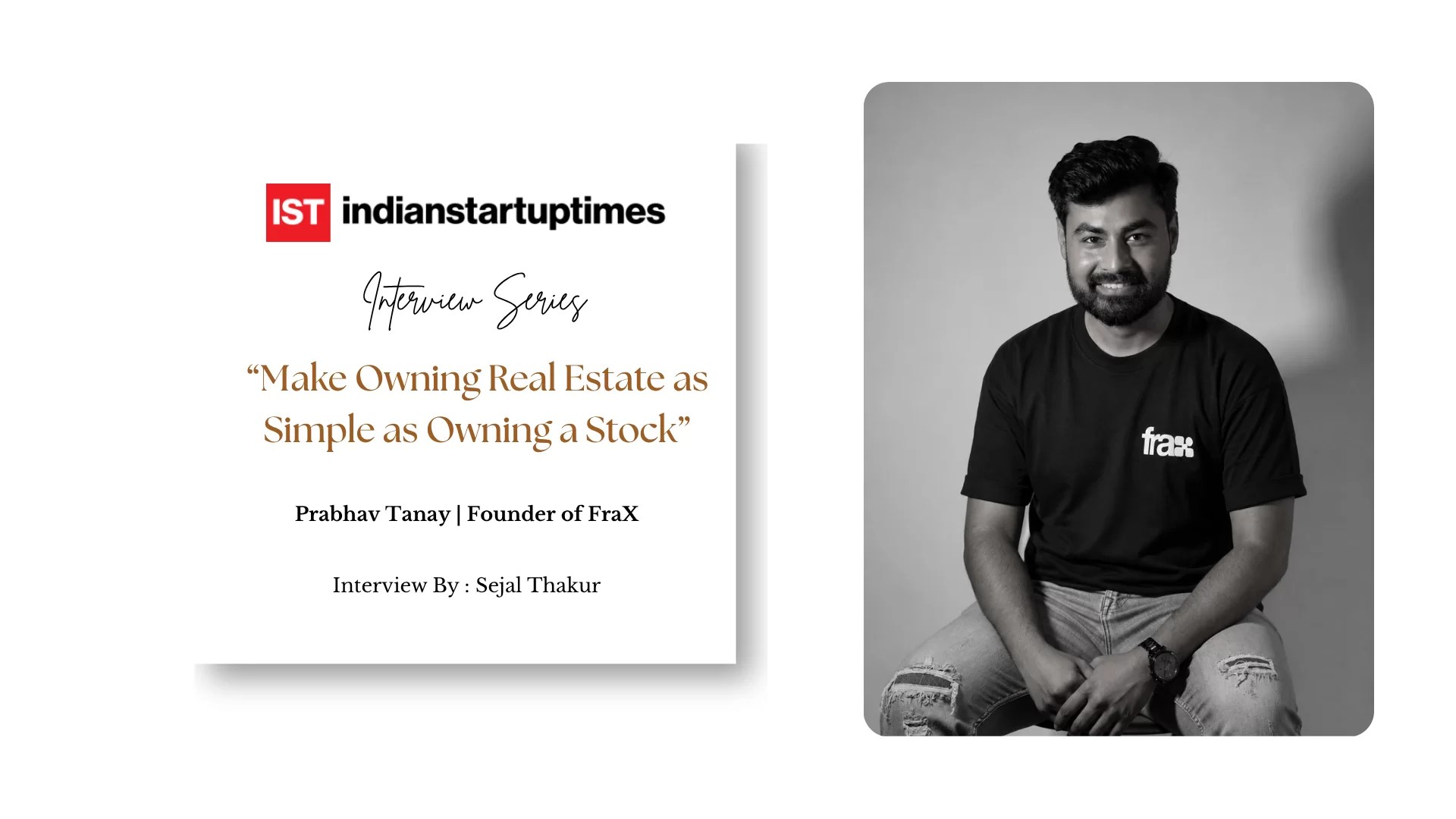
After over a decade building products across PropTech, FinTech, HealthTech, and Hospitality, Prabhav Tanay, Co-founder & CEO of FraX, took the entrepreneurial leap to transform real estate investing for India’s next generation. Alongside co-founder Tushar, Prabhav launched FraX in November 2025 with a bold vision: make premium real estate as simple, liquid, and accessible as trading stocks.
The Disconnect: Young Investors Manage Money on Apps, But Real Estate Still Feels Like Decades Ago
“I’ve always been drawn to solving large problems,” Prabhav says. “When I started speaking to young investors, I noticed a clear disconnect. This generation manages money on investment apps, orders food in minutes, and books travel with a few taps. Yet when it came to real estate, they were expected to deal with paperwork, brokers, large ticket sizes, and a process that hadn’t changed much in decades.” What stood out was that the desire to own real estate was still very strong. The problem wasn’t demand. The problem was access. “Once we saw how strongly people wanted real estate exposure but how difficult it was to participate, starting FraX became a very natural decision. We believed that if India could make stocks, bonds, and gold accessible to everyone, real estate should be no different.”
Real Estate Is Going Through the Same Transition as Bonds, Mutual Funds, Digital Gold
Prabhav had always observed affluent people build wealth through real estate. He wanted to create his own growth story but was never able to participate in premium real estate. “After being timed out multiple times, I felt that something is definitely not right.” For a long time, investors faced three major challenges: high entry barriers, limited transparency, and low liquidity. Technology is now helping solve all three. Fractional ownership makes participation affordable. Digital platforms make information easier to access. Liquidity mechanisms give investors greater flexibility. “What has changed is not the investor’s desire to own real estate. That has always existed. What has changed is our ability to make the asset class work in a way that aligns with how modern investors expect to invest.”
FraX = Fractional Exchange
FraX stands for Fractional Exchange. The idea came from a simple observation: many valuable assets are either difficult to access or don’t make sense for one person to own entirely. Real estate is probably the best example of that. “We wanted a name that represented shared ownership, accessibility, and exchange. While we’re starting with real estate because it’s India’s largest asset class, the broader vision has always been to make ownership more accessible for assets that have traditionally been out of reach for most people.”
Biggest Challenge: Creating Strong Safeguards Around Investor Money and Ownership
Technology was never the hardest part. The real challenge was creating strong safeguards around investor money and ownership. “In any investment product, people need confidence that their funds are secure and that ownership is clearly defined.” That’s why FraX spent significant time building the right financial and legal infrastructure before focusing on growth. Getting ICICI onboard as their escrow partner and Universal Trustees as an independent oversight partner was a major milestone. “In financial services, trust is built long before a customer makes their first investment. We wanted that foundation in place from day one.”
Product-First Mindset: Customers Care About Simplicity, Not Complexity
Prabhav has spent most of his career building consumer products, and one lesson has stayed constant: “Customers don’t care how complex something is behind the scenes. They care about how simple it feels to use.” Real estate is naturally a complex asset class. FraX’s responsibility is not to expose customers to that complexity. Their responsibility is to simplify it without removing transparency. “The best products are the ones that absorb complexity and deliver a seamless experience.”
Founding FraX: $20,000 Own Capital + $100,000 from Angels
Prabhav and Tushar started FraX in November 2025 with about $20,000 of their own capital and $100,000 from angel investors who believed in the vision before the product even existed. From the beginning, they were deliberate about where they spent money. Since they’re building a financial product, compliance and partnerships came first. They invested heavily in understanding the regulatory landscape and building relationships with banks, trustees, and ecosystem partners. Technology and product development followed soon after. They brought Chirag, who previously worked at Blinkit, to lead technology. Only once confident about infrastructure and product experience did they begin focusing on customer acquisition—in March 2026.
Trust Is Center, Not Add-On: Transparency + Accessibility
Trust is not an add-on for FraX, it has been at the center of everything they’ve built. “Investors don’t need less information. They need better access to information.” That’s why FraX makes partnership agreements, valuation reports, projections, and transaction records available on the platform. Customers can see investment activity in real time and understand exactly what they’re investing in. They also believe trust comes from accessibility. Every customer has access to an Investment Manager and can connect with fellow co-owners through dedicated WhatsApp communities.
Pre-Seed: $100,000 at $8.5M Valuation
FraX raised $100,000 at an $8.5 million valuation during its pre-seed round. Their journey was relatively straightforward because the problem itself was highly relatable. Almost every investor understood the importance of real estate in wealth creation but felt there weren’t enough modern ways to participate. Interestingly, several early investors became customers before they became investors. What resonated most was timing. Indian investors are becoming increasingly sophisticated and actively looking beyond equities to build balanced portfolios.
Zero to One: ₹10,000 Entry + SIPs for Real Estate
One of FraX’s earliest lessons was that accessibility drives adoption. When they launched, the minimum investment was ₹50,000. Many wanted to experience the product before committing larger amounts. Reducing the entry point to ₹10,000 became a major turning point. The second major milestone was launching SIPs for real estate. “SIPs had already transformed mutual fund investing in India. Bringing the same behavior to real estate made the asset class feel far more approachable.” In fact, 37% of their customers are already re-investing with FraX. Their cashback program also worked well, rewarding early customers and encouraging reinvestment.
Customer Insights: Start Small, Geographic Flexibility, Gen Z Dominance
Key insights from early users:
- People prefer to start small when trying something new. Once confident, many increased participation.
- More than half invest in properties outside their city. Customers from 18 states have invested in Gurgaon-based properties.
- Nearly 80% of users are Gen Z and younger Millennials. Real estate is no longer just for older investors.
Future: REITs, SM REITs, RWAs Tokenization in Gift City
FraX sees the future of fractional ownership and digital real estate investing unfolding rapidly. “Over the last decade, India has built world-class infrastructure across payments, identity, and digital financial services. The next evolution is making ownership more accessible across asset classes.” They’re already seeing encouraging developments through REITs and SM REITs. REITs are a $2.5 trillion market in the US—expecting the same story in India. Another movement is in Gift City Ahmedabad, where IFSCA is taking a regulatory approach towards RWA (Real World Asset) tokenization, with real estate as the major use case.
5-Year Vision: Real Estate as Standard in Every Indian Portfolio
FraX’s long-term vision is simple: “We want real estate to become a standard part of every Indian investor’s portfolio.” Today, diversification is often viewed through different categories within equities. FraX believes true diversification comes from participating across different asset classes. “If FraX succeeds, millions of Indians will be able to participate in an asset class that has played a significant role in wealth creation but has traditionally remained difficult to access.”
Their ambition is straightforward: make owning real estate as simple, transparent, and accessible as owning a stock.
Interview By : Sejal Thakur