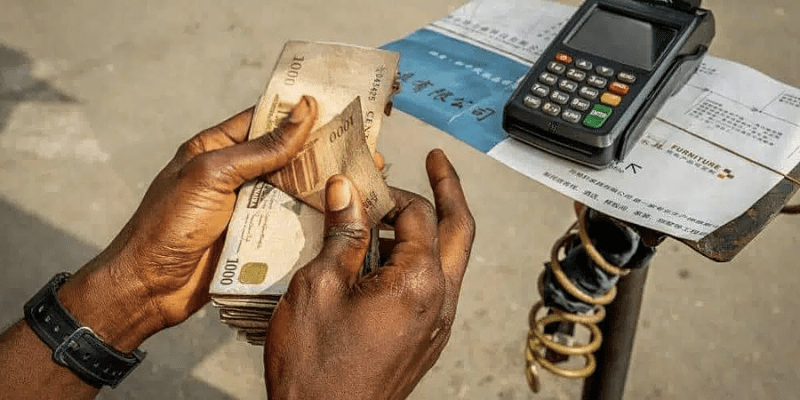


The Corporate Affairs Commission has said it will place fintech companies on notice, warning that firms found enabling unregistered Point of Sale operators will be blacklisted and reported to the Central Bank of Nigeria for regulatory action.
The Commission issued the threat in a public notice on Saturday, December 6, describing the practice as “reckless” and damaging to Nigeria’s financial system.
The warning targets the business model that has powered the explosive growth of mobile money operations across Nigeria, where fintech platforms aggressively expand their agent networks without ensuring compliance with registration requirements.
Opay, Moniepoint and Palmpay are the dominant players in Nigeria’s agency banking ecosystem.
According to a 2023 report, Opay operates the largest agent network in the country with over 563,000 agents, representing approximately 37 per cent of all banking agents.
Moniepoint follows with more than 303,000 agents, capturing about 20 per cent of the market, while Palmpay publicly disclosed in June 2023 that it had surpassed 500,000 PoS agents nationwide.
These fintech companies collectively control the majority of Nigeria’s estimated 1.9 million PoS agents, positioning them at the centre of the CAC’s enforcement action.
The Commission’s statement makes clear that the responsibility for ensuring agent compliance does not rest solely with individual operators but extends directly to the fintech platforms that provide them with terminals and infrastructure.
The CAC warning comes as PoS transaction volumes have reached unprecedented levels. Data from the Nigeria Inter-Bank Settlement System shows that PoS terminals processed 10.51 trillion naira in the first quarter of 2025, representing a 301.67 per cent increase from the previous year.
With 8.36 million registered PoS terminals nationwide and 5.90 million actively deployed as of March 2025, the sector has become a critical component of Nigeria’s payments infrastructure.
The Commission stated that effective January 1, 2026, no PoS operator will be allowed to conduct business without CAC registration. Security agencies will enforce the directive nationwide, with unregistered terminals subject to seizure or shutdown.
The CAC described the surge in unregistered operators as a violation of both the Companies and Allied Matters Act 2020 and CBN Agent Banking Regulations, warning that such operations put citizens’ investments at risk.
This represents the Commission’s second major attempt to enforce registration requirements on PoS operators.
In May 2024, the CAC issued a directive requiring agents under fintech platforms to register by July 7, 2024. The deadline was subsequently extended to September 5, 2024, with threats of prosecution and business closure for violators.
Read also: POS registration: Has CAC enforced its deadline or was it just another media announcement?
However, that enforcement effort met resistance from the Association of Mobile Money and Bank Agents in Nigeria, which argued that the requirement contradicted provisions in the 2004 Companies and Allied Matters Act. The dispute landed in court, with hearings scheduled for September.
The threat to report non-compliant fintech firms to the CBN carries significant weight given the regulatory pressures already facing the sector. In August 2025, the CBN imposed restrictions requiring all PoS terminals to operate within a 10-meter radius of their registered addresses, part of a broader effort to combat fraud and improve oversight.
The apex bank’s data shows that PoS channels accounted for 26.37 per cent of all fraud incidents in 2023.
More recently, in October 2025, the CBN issued comprehensive new agent banking guidelines that will force PoS operators to choose exclusive relationships with a single principal institution by April 1, 2026.
The rules prohibit agents from operating terminals for multiple fintech platforms simultaneously, a common practice that has allowed operators to maximise transaction volumes.
The CAC emphasised in its statement that compliance is mandatory, though the Commission did not specify what additional penalties the apex bank might impose.
Source link