(People’s Daily Online) 10:02, July 13, 2026
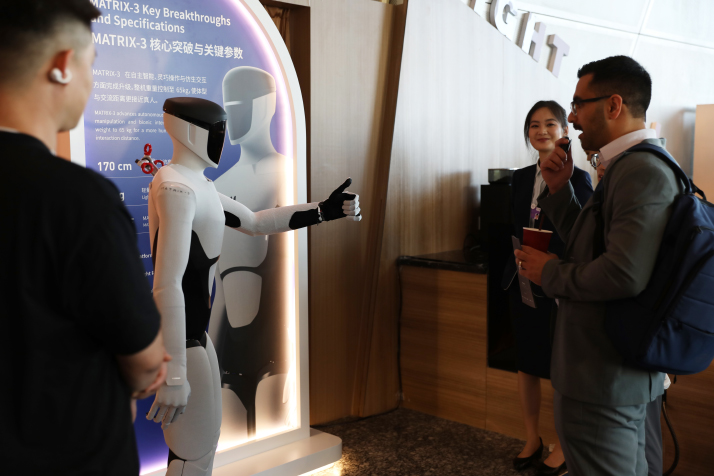
A robot responds to a visitor’s comment with a thumbs up during a conversation at the World Economic Forum’s 17th Annual Meeting of the New Champions in Dalian, Liaoning Province, on June 23. (XINHUA)
China has achieved successive landmark technological breakthroughs spanning aerospace, quantum communications, 5G, hypersonic systems and AI. Yet certain Western analysts, still confined by Cold War mentality, have rushed to cast this pivotal technological leap as a new Sputnik Moment. To the West, this phrase carries fixed Cold War connotations: a technological shock that signals a power shift, evokes strategic alertness and justifies zero-sum bloc confrontation. This superficial, stereotyped narrative fundamentally misinterprets the core spirit of the DeepSeek Moment—a paradigm rooted in thousands of years of Chinese civilizational thought, alongside China’s commitment to global peace and shared development.
The 1957 launch of the Sputnik satellite emerged directly from the bipolar standoff of the Cold War. The successful Soviet launch shattered U.S. technological supremacy, igniting an all-out military and space race between Washington and Moscow. Cutting-edge core technologies were strictly walled off within each rival bloc, weaponized as tools for military deterrence and geopolitical containment. Within that historical context, technological advancement prioritized unilateral strategic advantage, widened global technological decoupling, and cleaved the globe into hostile, competing factions.
This zero-sum mentality remains deeply embedded in Western strategic thinking. As a result, whenever a non-Western country achieves a major technological milestone, analysts automatically resort to this adversarial analytical lens to interpret the progress.
Coined in early 2025 following the launch of Chinese tech startup DeepSeek’s open-source AI model DeepSeek-R1, the term DeepSeek Moment has evolved into a widely recognized label for China’s transformative, cost-effective technological breakthroughs.
Civilizational origins
Core tenets of China’s millennia-old civilization revolve around harmony, inclusiveness and delivering shared benefits to all under heaven. It advocates harmony without uniformity and “cultivating oneself to support others,” rejecting hegemonic expansion and exclusive technological monopolies.
This profound cultural heritage shapes China’s guiding principle for innovation: Cutting-edge technologies exist to deliver public goods for all humanity, not to outcompete rival powers. Unlike Cold War-era technological progress, which centered on military rivalry, research and development (R&D) as represented by DeepSeek prioritize industrial upgrading for civilian use, digital inclusion and broad popular access to advanced technology. This civilizational underpinning fundamentally sets it apart from the confrontational legacy of the Sputnik era.
China’s global vision
President Xi Jinping has expounded on China’s vision for technological innovation and global governance at major international events, grounding the country’s innovation endeavors in the vision of building a community with a shared future for humanity. The following statements translate China’s millennia-old inclusive civilizational philosophy into actionable global governance practices, making clear the diplomatic significance of the DeepSeek Moment.
Core principles that define the essence of the DeepSeek ethos:
Abandon the zero-sum mentality. “It has been proven time and again that the Cold War mentality would only wreck the global peace framework, that hegemonism and power politics would only endanger world peace, and that bloc confrontation would only exacerbate security challenges in the 21st century,” President Xi emphasized at the Boao Forum for Asia Annual Conference in 2022. Tech decoupling and arbitrary chip restrictions only widen the global digital divide, whereas open and inclusive international cooperation delivers common progress for all countries.
Uphold dialogue over confrontation and partnerships over blocs. On November 6, 2023, President Xi sent a congratulatory letter to the First Belt and Road Conference on Science and Technology Exchange, pointing out that China will advance international exchanges on scientific and technological innovation, and work with all countries to tap the potential for innovation-driven growth and strengthen innovation partnerships.
China rejects the outdated Cold War binary logic of “friends versus foes.” Chinese tech diplomacy is anchored in win-win cooperation. China has put forward the International Science and Technology Cooperation Initiative, championing open, fair, equitable and non-discriminatory global scientific and technological exchanges and cooperation.
Science knows no borders, and technology must benefit all humanity. In a congratulatory letter to the 2023 Zhongguancun Forum, President Xi demonstrated China’s firm resolve to ensure that innovation achievements benefit more countries and peoples. China firmly pursues a mutually beneficial strategy of opening up, President Xi said, adding that it stands ready to work with all countries to boost scientific and technological innovation together, so that science and technology can better deliver benefits to people across the world.
On June 10, the Ministry of Industry and Information Technology issued a three-year plan to accelerate the integration of AI with the country’s information and communications sector. The document outlines that China will deepen exchange and cooperation with all countries across technology, standards, industrial applications, cybersecurity and other fields related to the integrated advancement of AI and information and communications technology, to forge shared development consensus worldwide.
Advance global tech governance through extensive consultation, joint contribution and shared benefits. President Xi views AI as a global public good that benefits humanity. He has highlighted the need to narrow international disparities by increasing the voice of developing countries in AI governance. He has also cautioned that scientific and technological advances should not be used to curb and contain other countries’ development.
China earnestly implements the Global AI Governance Initiative proposed by President Xi in October 2023. It has released the AI Capacity-Building Action Plan for Good and for All, put forward the Global AI Governance Action Plan, and jointly launched the Initiative on International Cooperation in Open Science with Brazil, South Africa and the African Union. China’s core propositions on global AI governance are built on its robust experience in domestic technological governance, with fairness and justice as the overriding guiding principle. China has called on all countries to jointly develop a global AI governance framework, offering Chinese insights and solutions for the responsible development of this transformative technology worldwide:
First, uphold the dual emphasis on development and security. China advocates harnessing AI to fuel economic and social advancement while effectively preventing and defusing potential risks. It strives to completely unlock AI’s positive value for society.
Second, uphold fairness and inclusiveness and oppose technological hegemony. Science and technology must not be tools to forge an iron curtain; they ought to be shared assets benefiting humanity. China firmly rejects academic barriers, exclusive blocs and unjust technological monopolies. It calls on the international community to build an open, equal, fair and non-discriminatory ecosystem for AI development. All countries should enjoy equal rights to participate in AI research and global governance.
Third, uphold multilateralism with the United Nations as the core platform. AI transcends national and industrial boundaries, and the risks brought by its development carry global repercussions.
Fourth, uphold openness and promote mutual learning among civilizations. Nations vary greatly in their historical legacies, cultural traditions, social systems and development stages. A one-size-fits-all approach has no place in global AI governance. Instead, consensus should be built on the premise of respecting diversity.
By grounding the legitimacy of global governance mechanisms in inclusiveness and universal participation, China’s approach differs fundamentally from Western paradigms. Moreover, rather than seeking to supplant the existing international order, China’s vision for global AI governance aims to complement and improve it. Embracing the philosophy of “creating new opportunities instead of competing for existing ones,” China’s model breaks away from conventional power struggles over governance dominance.
A fresh global paradigm
The Sputnik era was defined by global division, relentless arms races and exclusive geopolitical blocs. By contrast, the DeepSeek epoch pioneers a non-confrontational model of innovation underpinned by openness, inclusiveness and shared prosperity.
While certain Western countries respond to China’s technological advancement with unilateral chip restrictions and industrial decoupling, China remains committed to building interconnected, borderless global AI ecosystems.
For years, cutting-edge global AI technology has been dominated by a handful of Western tech giants. These corporations sustained their competitive edge by pouring massive capital into R&D and erecting closed-source barriers, locking most developing countries out of access to AI infrastructure. China calls for greater attention to boosting the scientific and technological capacity of the Global South, providing an affordable, replicable innovation template for resource-constrained emerging economies across the globe. Chinese developers have open-sourced DeepSeek’s full codebase and model weights to users worldwide.
Developers in developing countries across Africa, Southeast Asia, Latin America and other regions have leveraged China’s open technological resources to develop intelligent agricultural tools for rural development, affordable online education systems and digital transformation packages for micro, small and medium-sized enterprises that are tailored to local realities. This all-round open sharing translates President Xi’s vision of narrowing the global digital divide and pursuing common development over technological containment into tangible outcomes.
China continues to make enduring and irreplaceable contributions to global peace and common development. Empowered by millennia of profound Chinese civilizational wisdom and guided by Xi Jinping Thought on Diplomacy, China’s innovation epitomized by the DeepSeek breakthrough is reshaping the global innovation landscape, delivering tangible digital dividends and steering global governance away from bloc confrontation toward inclusive, win-win collaboration.
Milestones That Define the DeepSeek Moment
January 2025: DeepSeek-R1 release
This open-source model delivered performance on par with leading closed proprietary AI systems at a mere fraction of computational costs. Its debut sent shockwaves across Silicon Valley and overturned long-standing industry consensus, proving that world-class technological leaps do not need to rely on reckless capital expansion or resource hoarding. Media outlets subsequently adopted the phrase DeepSeek Moment to describe paradigm-shifting innovations that dismantle Western technological monopolies through lean, efficient algorithmic advancement.
March 2025: AI chips for automotive intelligence
Major vehicle manufacturers have integrated DeepSeek large language models into affordable, mass-produced cars, bringing premium-level intelligent cockpit capabilities, and, by extension, smarter assisted-driving interfaces, within reach of ordinary consumers. Industry observers have dubbed the rollout the auto sector’s DeepSeek Moment.
December 2025: Tsinghua’s TurboDiffusion framework
Tsinghua University’s open-source architecture accelerated AI video generation speeds by 100 to 200 times, sparking another DeepSeek Moment among global AI developer communities.
May 2026: Huawei’s Tau Scaling Law for semiconductor breakthroughs
Global investment firm Bernstein has characterized Huawei’s advanced packaging and chip architecture innovations, which deliver near-cutting-edge chip performance without extreme ultraviolet lithography equipment, as the DeepSeek Moment for China’s semiconductor industry.
The author is a geopolitical expert and international affairs observer.
(Source: Beijing Review)
(Web editor: Zhang Kaiwei, Du Mingming)