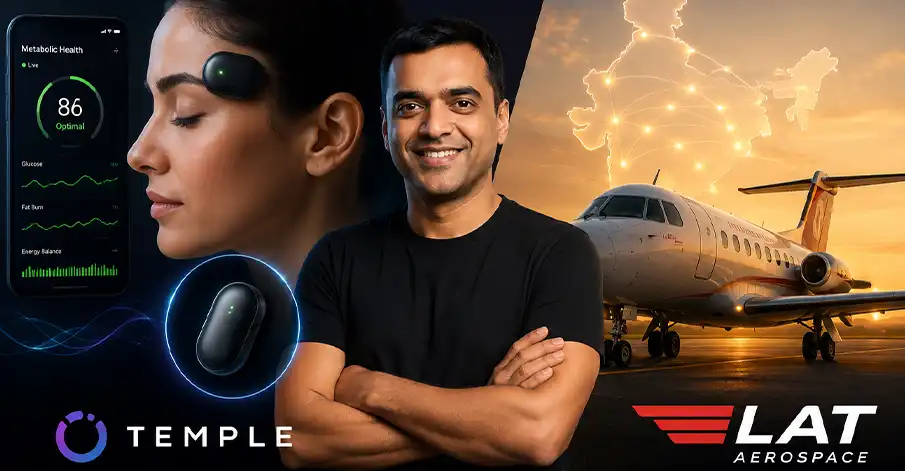

Deepinder Goyal is preparing two major post-Eternal ventures spanning health technology and aviation, marking a new chapter for one of India’s best-known consumer internet founders after stepping back from the food-delivery company he built over nearly two decades.
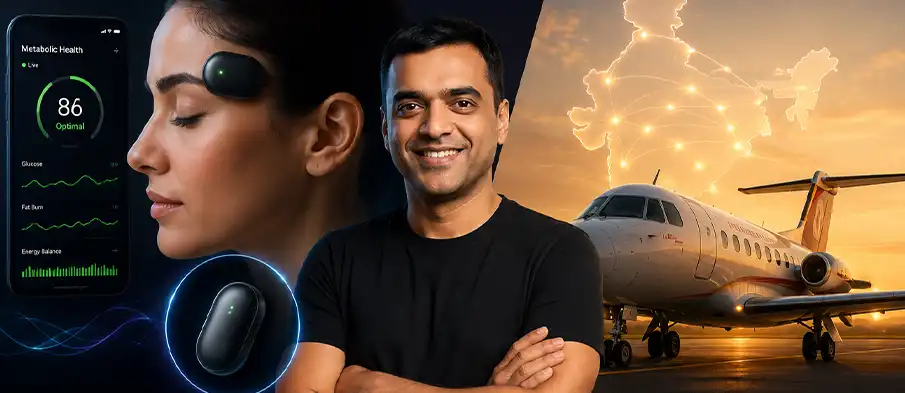
The first venture is Temple, a premium wellness wearable that Goyal plans to launch in as little as six months. The device is described as a bean-shaped product worn at the side of the forehead and designed to measure the body’s metabolic state in real time. The product places Goyal in the fast-growing intersection of health tracking, wearables, preventive wellness and AI-led personal analytics, a category already attracting global consumer technology and health-tech players.
The second bet is LAT Aerospace, an aviation startup aimed at regional air travel in India. Goyal has personally invested $20 million in the company. The venture is being positioned around the challenge of making short-haul and regional aviation more accessible in a country where air travel demand is growing but regional connectivity remains constrained by infrastructure, economics and fleet suitability.
The two ventures extend Goyal’s operating interests beyond restaurant discovery, food delivery and quick commerce. Temple represents a move into consumer hardware and health data, where product success depends on sensor accuracy, form factor, clinical credibility, regulatory confidence and subscription or services economics. LAT Aerospace, by contrast, is a far more capital-intensive infrastructure and mobility bet, involving aircraft strategy, regulation, airport access, route economics and safety certification.
For India’s technology ecosystem, the moves are notable because they show a seasoned consumer internet founder moving into categories that combine deep technology, hardware, data and regulated operations. Health wearables in India have generally been led by fitness trackers, smartwatches and diagnostics-linked products. A premium metabolic wearable would need to create a sharper value proposition around continuous health insights, medical-grade reliability or lifestyle intervention.
The aviation venture is equally ambitious. Regional mobility has been a long-standing policy and market priority in India, but profitability remains difficult because of aircraft costs, airport availability, fuel expenses and uneven demand. A founder-backed startup entering this space will need to prove that technology, aircraft design or operating model innovation can materially improve regional air economics.
Goyal’s new direction keeps him within consumer behaviour and access-driven markets, but the complexity profile is markedly different. Both ventures will depend on execution across product, regulation, capital and trust.
Source link