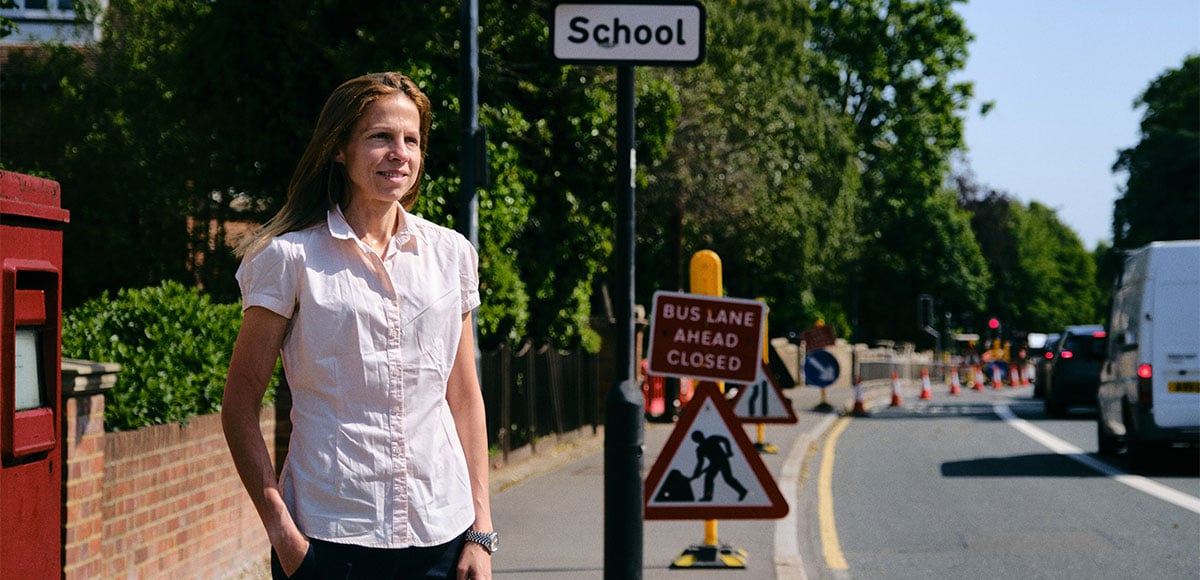
Congestion around schools, polluted air, and families frustrated by the morning drop-off are being addressed by entrepreneur Moria Bennett, whose company KIGO has created an AI platform to cut private vehicle use on the school run.
With support from Connected Places Catapult, the ‘School-Run Optimiser’ primarily helps local authorities understand movement patterns and identify priority areas for improvement – such as introducing School Streets schemes, safer routes and 20mph zones – and understand their likely impact before committing resources.
For schools, KIGO supports sustainability and climate action priorities by helping them promote active travel, reduce emissions and parking problems; as well as encouraging safer, healthier school journeys and delivering education for pupils.
And for parents, the platform makes it easier to organise and share the school run; while helping families encourage children to become more confident, independent and healthy by walking, cycling, scooting, or sharing journeys to school.
Moria is now looking to secure commercial contracts with councils and raise investment to scale operations. She also aims to further develop the service to allow more shared, sustainable and affordable journeys among all transport users in the UK and abroad.
This spring, KIGO was one of three startup firms to win the ‘Smarter Transport Systems – AI in Transport’ competition, delivered on behalf of the Department for Transport.
Within weeks, Moria unveiled her service to delegates at the Connected Places Summit.
In March, KIGO received a social venture award from Anglia Ruskin University, and in June was announced as one of three winners of the Greenshoots 2026 seed finance award from Henley Business School.
KIGO has also been shortlisted for Berlin’s ‘Raptor’ Project on road safety and school travel, for Best Use of AI at the Women in Tech Employer Awards 2026, for the Supply Chain Excellence Awards’ Smart Mobility Award, and reached the final of Entrepreneur of the Year for Sustainability at the Great British Entrepreneur Awards.
“At its core, KIGO is building the intelligence infrastructure for school mobility: an AI-powered data and decision-support platform for local authorities that brings fragmented travel, road-safety, air-quality and community data into one place,” says Moria.
“It helps councils identify where interventions will have the greatest impact, while verified journeys create the evidence needed to measure changes in car use, emissions and active travel.”
Awarding points to pupils
Change on the ground is delivered primarily through a pupil reward app. “We are giving schools a tool for parents, who download an app, which awards pupils points for active travel or sharing car journeys,” explains Moria. “Every class will also have its own dashboard for children to see, showing steps completed and emissions saved.”
She adds that a recent trial demonstrated how some pupils were keen to persuade – or pester – their parents to be walked home, rather than driven, so they can climb a class leaderboard.
“Eventually users will have a schedule that shows others who are walking, or in need of a shared journey. The more users we have, the more we can help to optimise travel to make it more affordable, sustainable and healthier.
“This is about using existing and new datasets to create new habits, and giving people the motivation to make a change, to help make an impact to reduce pollution and congestion.”
Predicted savings laid bare
Moria calculates that a family sharing a journey with another pupil can save £670 in vehicle running costs a year, and reclaim 155 hours – or nearly £3000 in added working time value – based on an average secondary school commute of 3.2 miles.
Scaled up to the UK as a whole, Moria says the potential benefit could be a 400,000t reduction in CO2 and up to £18 billion for households (direct savings plus extra working time value).
A trial of a parent-led ‘walking bus’ for children last year was found to cut school run car trips by 55% which could – if scaled up to 10,000 schools across the UK – cut 52,000T of CO2 over five years.
The company now aims to enlist several local authorities to champion the KIGO platform, with school pilots starting next year.
Delivering messages clearly
Moria heard about Connected Places Catapult’s ‘Smarter Transport Systems – AI in Transport’ competition last year, was shortlisted to present to a panel of judges at the Department for Transport in London in March, and was selected as one of three firms to receive further support.
“This award was another small step in validating research I started during an MBA,” she says. “It was my first time pitching KIGO at this scale, and the support through the Catapult programme was extraordinary.”
KIGO received help to develop its business case, engage prospective clients and refine its investor pitch. “The coaching helped me turn a complex idea into a clear message I now use with councils, schools and investors every day.”
Taking action for better air
Moria grew up in Israel, studied accounting and finance, and remembers the traffic and pollution when walking beside busy roads.
“I could smell the emissions from trucks and told myself that I don’t want to raise my children and walk with them to school if they have to breathe in this pollution.”

She moved to the UK in 2011 and co-founded Tevva Motors, an electric truck startup that raised over $150 million and grew to more than 350 employees.
“It was an incredible journey. We built a business from the ground up, secured investment, won grants and delivered our first zero-emission truck to UPS.”
Supporting councils to make better decisions
Moria says KIGO’s School-Run Optimiser helps councils understand where interventions such as School Streets, safer routes and active travel schemes are likely to have the greatest impact before an investment is made.
“Local authorities tend to work in isolation on road safety initiatives and promoting active travel between home and school,” she adds. “They don’t have a way to analyse or measure performance and see what works, how it can be better and how to make decisions. This is exactly where KIGO comes in.”
The transformation being offered, she adds, is “from reactive traffic management to proactive neighbourhood engineering”. With a continuous evidence loop, “future budgets can be defended by pointing to the specific number of tonnes of carbon eliminated, and the exact number of cars removed from the road”.
Next steps for transport as a whole
Mapping the school run, Moria argues, reveals broader patterns of how people move. Data shows planners exactly where demand for public transport is highest, allowing bus routes to be adjusted on the basis of actual usage rather than assumptions.
“We transform fragmented school travel data into a single, unified platform, and our AI engine helps local authorities and transport planners optimise networks, improve mobility outcomes, and create safer, smarter and more efficient journeys for everyone.”
Solving the school run, in her view, is a test case for better smart city planning, where “predictive intelligence is applied to one daily problem, then scaled to manage urban mobility as a whole”.
The service could benefit city authorities, she adds, by targeting public transport investment where it is most needed and showing where walking and cycling routes could be improved.
But for the moment, the focus is the school run. “We all know the difference between roads on a school day and during the school holidays. The congestion disappears, the air feels cleaner, and journeys become easier. But what if we looked beyond the traffic itself and asked a bigger question: ‘What kind of future are we creating for our children?’
“This is why I founded KIGO. It is about more than reducing congestion around schools. It is about creating safer journeys, healthier communities, greater independence for children, and a more sustainable future.”
For more startup news, check out the other articles on the website, and subscribe to the magazine for free. Listen to The Cereal Entrepreneur podcast for more interviews with entrepreneurs and big-hitters in the startup ecosystem.