The month so far has kept the Indian fintech sector busy, with the action shifting from the funding table to the listing gates. The headline move came from lending unicorn Moneyview, which received SEBI’s final observation letter, clearing it to launch an IPO comprising a fresh issue of up to ₹1,500 Cr.
Besides, consolidation activity picked up pace. Mynd Fintech, a digital lending marketplace that delivers end-to-end supply chain financing solutions, acquired supply chain financier C2FO India, with the combined entity set to process ₹60,000 Cr worth of transactions annually.
Separately, listed fintech Zaggle announced plans to buy a 20% stake in cross-border payments firm Unobanc for $1.5 Mn.
Meanwhile, recent data suggests that UPI’s transaction volume declined 2.1% to 22.72 Bn for June from 23.20 Bn in May. The total UPI transaction value also slipped 3.3% to ₹28.92 Lakh Cr last month from ₹29.90 Lakh Cr in May.
On the regulatory front, the RBI asked NPCI to explore raising UPI transaction limits for select merchant use cases, while clarifying that the peer-to-peer cap would remain at ₹1 Lakh and that higher limits would require proper safeguards.
NPCI’s rule capping any single third-party app’s share of UPI volumes at 30%, to be met by December 2026, continued to weigh on market leaders PhonePe and Google Pay. SEBI, meanwhile, framed rules for the sharing of real-time price data with third parties, permitting it only with a one-day delay and without monetary incentives.
Additionally, crypto saw more tightening on the regulatory front. The Central Board of Direct Taxes (CBDT) issued a guideline mandating that crypto service providers identify reportable users, establish their tax residency, and file details of specified transactions by May 31, 2027.
Further, the RBI also released its draft ‘Foreign Exchange Management (Foreign Investment) Rules, 2026’, proposing a simplified, principle-based framework to replace the 2019 NDI Rules and codify norms for direct overseas listings, with comments open until August 31.
Against this backdrop, we are back with the fourth edition of “Five Fintech Startups To Watch”. This edition of Inc42’s monthly series spotlights startups operating in some of the most promising and fast-evolving segments of India’s fintech ecosystem.
From automating investment due diligence with AI and simplifying cross-border payments to introducing innovations to UPI, here are the fintech startups that caught our attention in July.
Editor’s Note: The list below is not a ranking of any kind. Startups have been listed alphabetically.
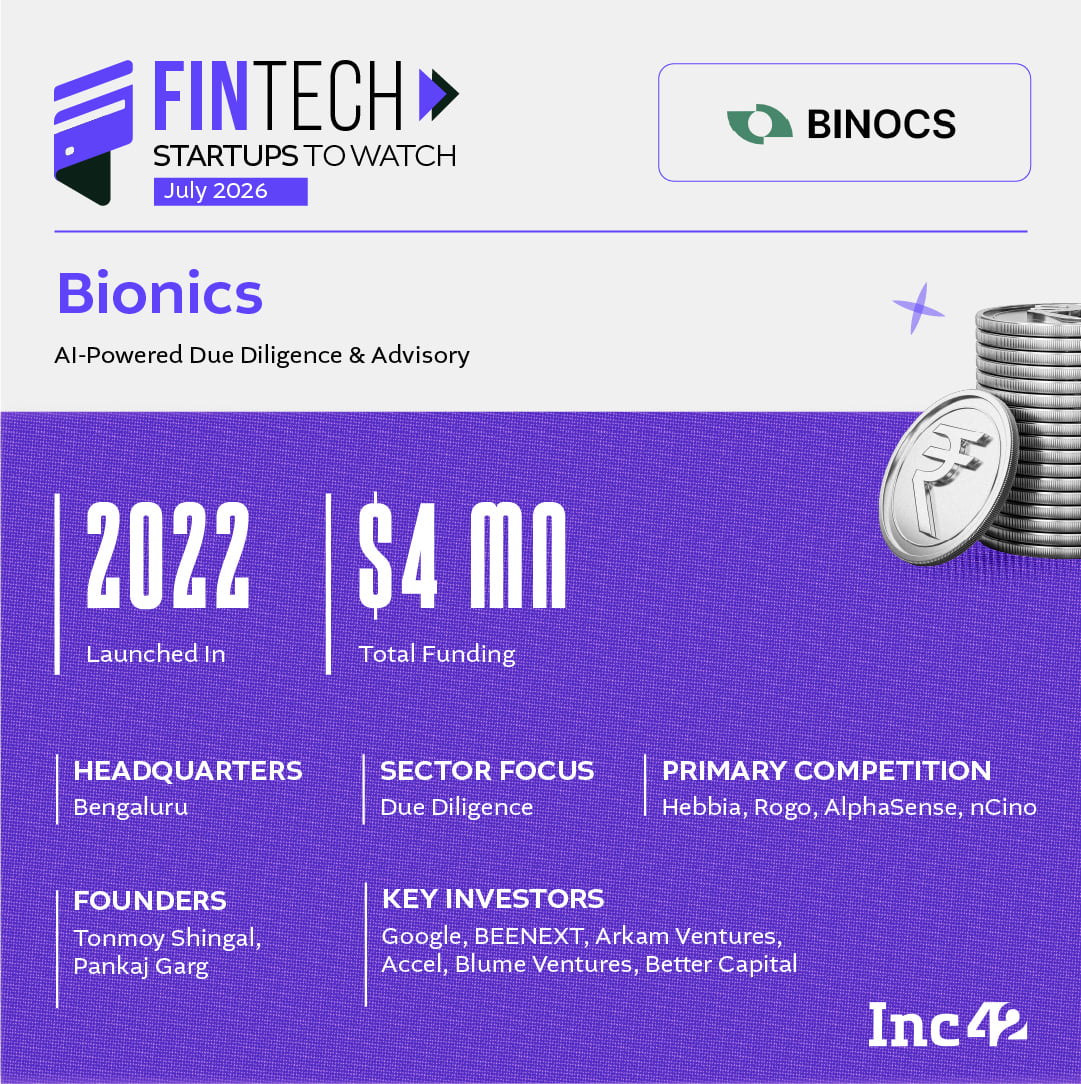
Binocs | AI-Powered Due Diligence & Advisory
A private equity fund screening a hundred deals a year will pass on most of them but not before analysts have spent weeks each on market maps, financial models and diligence memos.
The work is slow, expensive and largely manual, and the pool of capital that depends on it keeps growing. Global alternative assets stood at $16.8 Tn at the end of 2023 and are forecast to cross $30 Tn by 2030, with private credit alone already past $3.5 Tn.
Bengaluru-based Binocs is trying to compress that work from weeks to minutes. Founded in 2022 by Tonmoy Shingal and Pankaj Garg, Binocs is an agentic AI platform for due diligence and strategic advisory, built for private equity firms, consultancies, investment banks and corporate development teams. It began life as a crypto tax and Web3 portfolio tracker before pivoting to serve alternative investors.
Its agentic framework is designed to mirror the structure of a real investment team, running deal sourcing and screening, market assessment, financial statement analysis, investment memos, sell-side CIMs and credit assessment memos, alongside continuous portfolio monitoring for private credit funds. The pitch is decision-ready diligence at up to 90% lower cost than traditional consulting, with fully traceable citations.
The SOC2-compliant platform counts two of the Big Four and lenders such as Vivriti among its users. The pool its clients operate in is global private credit, which stands at around $1.7 Tn in AUM today and is forecast to reach $2.64 Tn by 2029.
____________________________________________________________________________
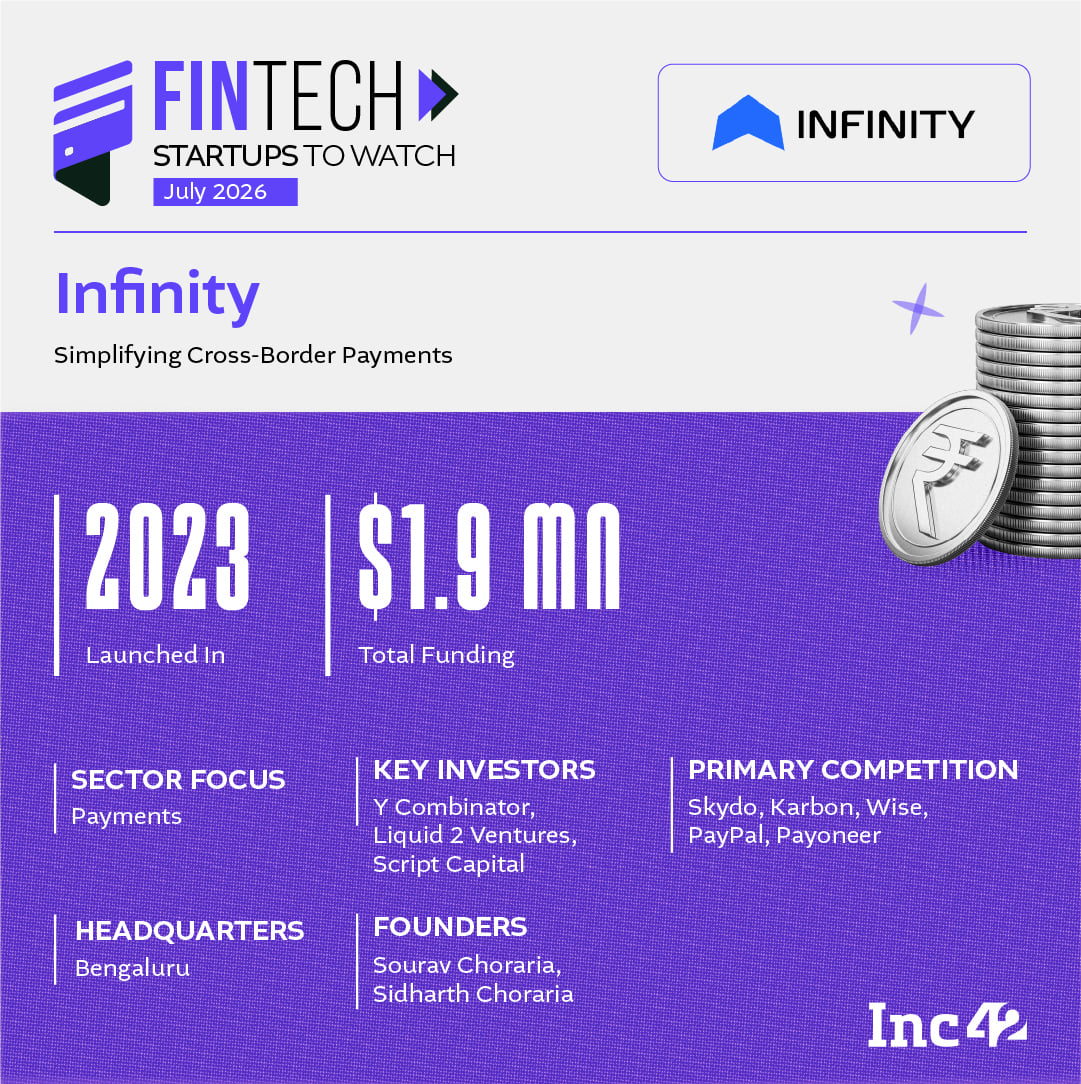
Infinity | Simplifying Cross-Border Payments
For an Indian freelancer or exporter, getting paid by an overseas client is rarely as simple as raising an invoice. On the traditional SWIFT network, a payment can hop through three or four correspondent banks before it lands, and each stop adds a fee or a delay, leaving businesses to lose as much as 3-5% on every dollar moved.
India received about $129.4 Bn in inward remittances in FY25, the most of any country, and its businesses account for hundreds of billions of dollars in cross-border trade each year.
Bengaluru-based Infinity is going after that leakage. Founded in 2023 by brothers Sourav and Sidharth Choraria, Infinity is a cross-border payments platform that lets freelancers, exporters, ecommerce sellers and startups receive international payments through custom rails that bypass the multi-hop SWIFT route.
Built on partnerships with RBI-regulated AD-I banking partners, the platform offers a flat 0.5% all-inclusive fee with no FX mark-up, free FIRA certificates on every withdrawal, and settlement into an INR account within a day. It operates in the global cross-border payments market, which is projected to grow to $336 Bn by 2031.
Users also get multi-currency global accounts to collect money like a local across more than 160 countries. The startup processes over $10 Mn in transactions a month and has onboarded more than 10,000 customers to date.
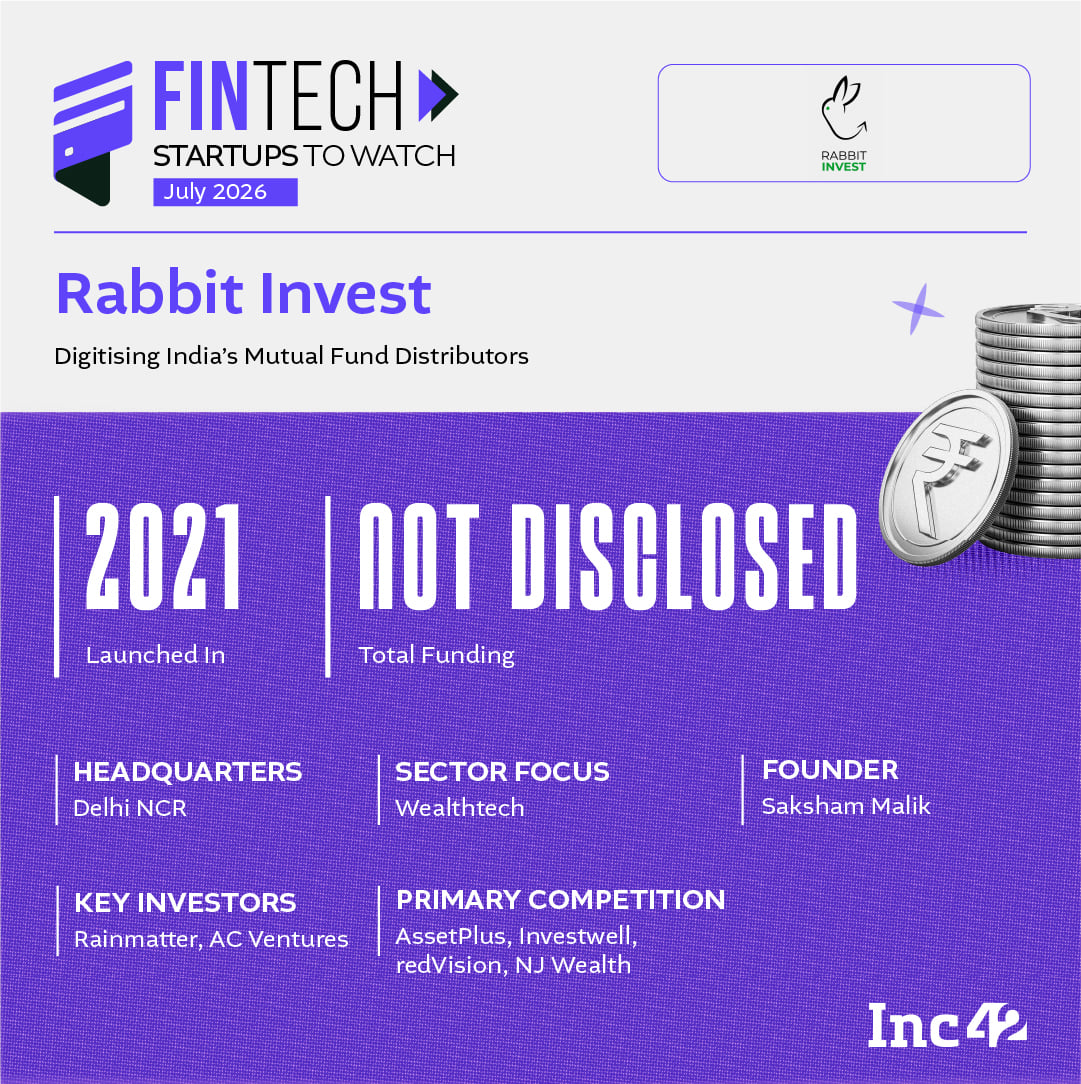
Rabbit Invest | Digitising India’s Mutual Fund Distributors
India’s mutual fund industry manages around ₹81.58 Lakh Cr across 27.66 Cr folios, with roughly ₹40.46 Lakh Cr of that held through regular plans sold by distributors rather than direct channels.
Yet the independent mutual fund distributor who serves those investors often still runs the business on AMC portals, manual entries and spreadsheets, losing his best hours to paperwork rather than clients.
Delhi-based Rabbit Invest is building for that distributor. Founded in 2023 by Saksham Malik and operated by Invedge Assets, it is a distributor-first software platform for India’s independent mutual fund distributors. The platform handles client onboarding and KYC in minutes, buy-sell-SIP execution and fund discovery. It also provides client-wise commission tracking and deep analytics.
Each distributor also gets a branded mobile app for their clients, covering portfolio tracking, goals and fund guidance. It is priced at ₹9,999 per year, with no charges levied on AUM.
Rabbit Invest works with over 110 distributors, tracks more than ₹1,500 Cr in AUM and has served upwards of 22,000 clients, with partnerships including NSE, BSE and Axis Max Life. It has recently added insurance tracking, allowing clients to see all their policies in one place.
With more than 5,000 new distributors registering with AMFI in a single month at the peak of the SIP boom, the pool of independent advisers needing better tooling is expanding. As of June 2026, total industry AUM stood at ₹82.22 Lakh Cr, of which regular plans held ₹45.54 Lakh Cr and direct plans ₹36.69 Lakh Cr.
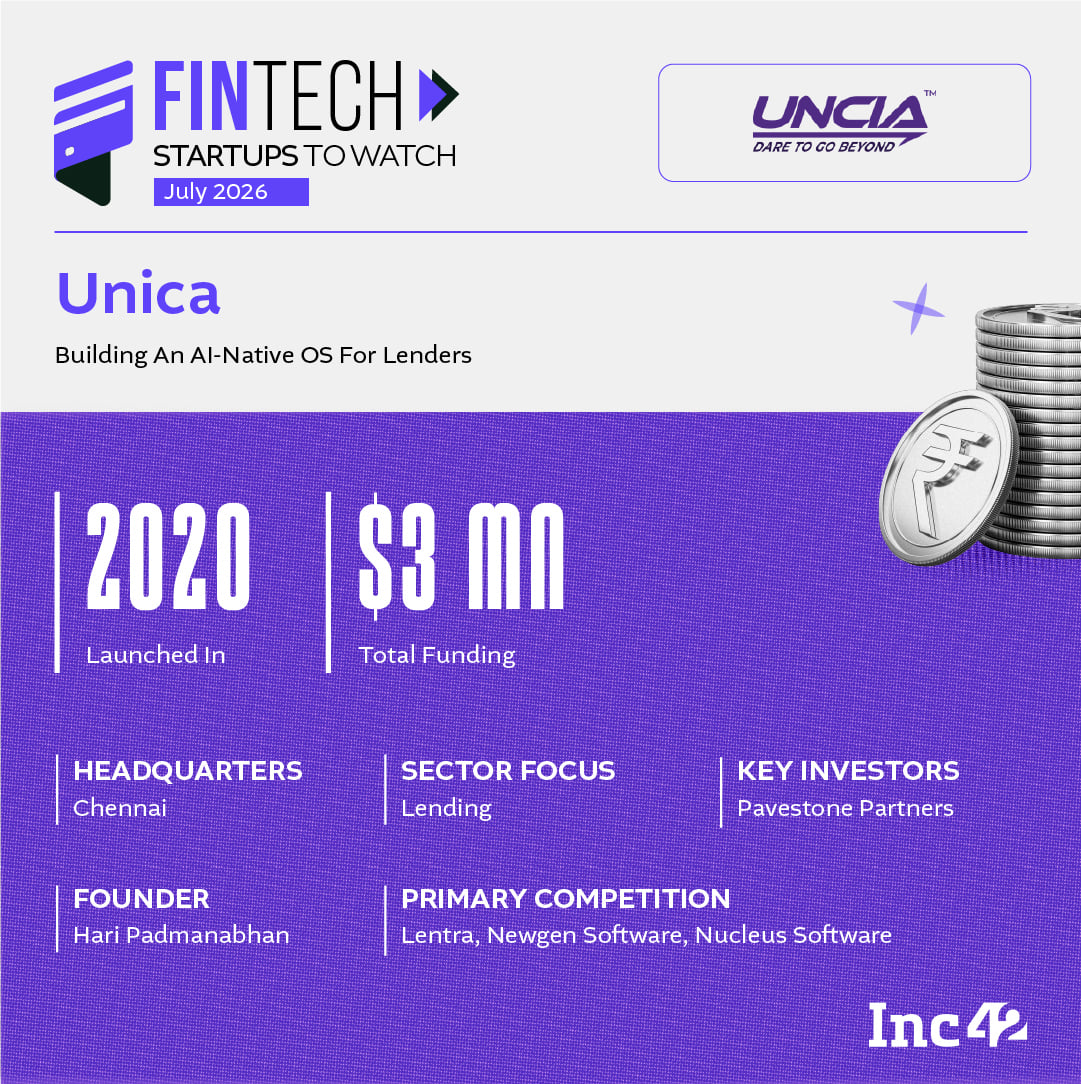
Uncia | Building An AI-Native OS For Lenders
For a bank or NBFC, launching a new lending product is rarely a quick decision to execute. Every new risk parameter or regulatory requirement triggers an IT cycle that can take months, even as the borrower, who has often applied to several lenders at once, goes with whoever responds first. India has over 100 licensed banks and hundreds of NBFCs, and slow origination quietly costs them business.
Chennai-based Uncia is selling speed to that market.
Founded in 2020 and chaired by industry veteran Hari Padmanabhan, Uncia is an AI-native lending platform that gives banks and NBFCs a single, low-code suite to run the full lending lifecycle without waiting on long IT queues.
The suite offers three products — UnciaPrime for loan origination, UnciaLeap for loan management, and UnciaFlow for supply chain finance. The promise is that lenders can design onboarding journeys and launch complex products in days rather than months, on cloud-native, API-first architecture.
Uncia says it has processed over $25 Bn in assets and counts Cholamandalam, ICICI Home Finance, IDFC First Bank, Mahindra Finance, TVS Credit, Religare and Unity Small Finance Bank as its clients in India’s digital lending market projected to cross $133 Bn in revenue by 2030.
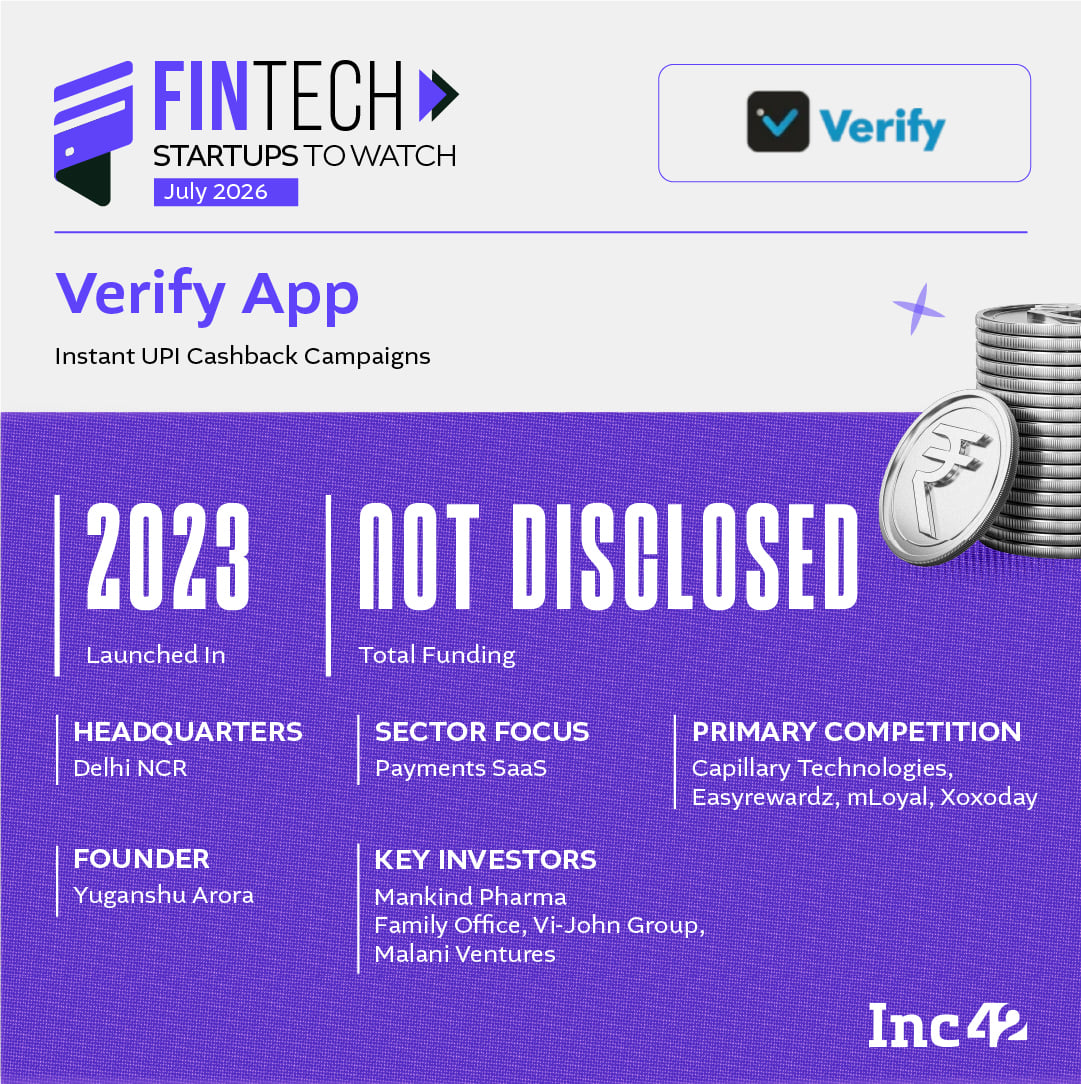
Verify App | Instant UPI Cashback Campaigns
Brands spend heavily on loyalty, but the mechanics rarely work. Scratch cards go untracked, points-based apps go unopened, and one paints-and-adhesives maker found its old app was being scanned by barely 1% of customers. For the painter, plumber or farmer at the end of the chain, the reward is simply too much effort to claim.
Delhi-based Verify App is betting that a UPI payout fixes that.
Founded in 2023 by Yuganshu Arora and operated by Safestack, it is a UPI-powered cashback and channel-loyalty platform for brands, built around a single action: a customer scans a code on a product and the cashback lands in their bank account in under 15 seconds.
Beyond instant cashback, the platform runs point- and target-based milestone schemes, integrates anti-counterfeit stickers, and captures product-, location-, and customer-level data through every scan, with payouts made TDS-compliant under the 194R rule. It is pitched as a plug-and-play stack that a brand can take live in about a week, serving end customers, retailers, distributors, and channel partners from a single dashboard.
Verify App says it works with more than 500 brands across more than 20 industries, with clients reporting scan rates far above those of their old app-based programmes. India’s loyalty market is estimated at $2.11 Bn in 2026 and is forecast to reach $3.91 Bn by 2030. By collapsing the reward into a single scan-to-UPI moment, Verify App is wagering that the brands paying for loyalty will follow the redemption rates.
Edited by Shishir Parasher
Source link