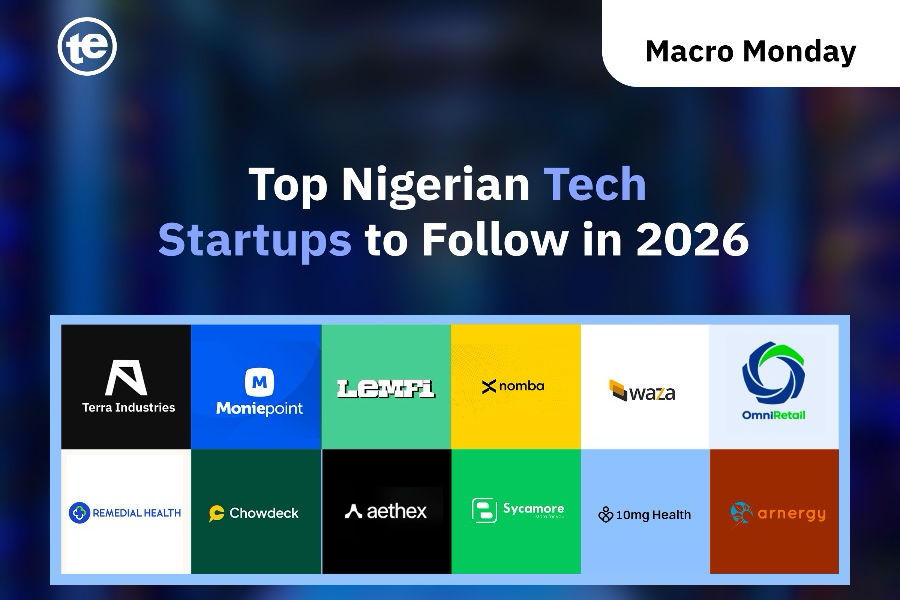
The year 2026 has entered its second phase, and looking from 2025 to the first half of 2026, we see a set of companies worth watching before the year ends, and no, they are not all fintechs, nor are they all focused on the same customers.
Some are building payment infrastructure, while others are working on healthcare supply chains, artificial intelligence, energy, logistics and defence technology.
In 2025, Nigeria was one of Africa’s most capital-constrained startup markets, with local ventures raising $442.8 million across 98 deals.
However, funding was heavily concentrated, as the top 11 startups captured 82.9% of total inflows. Fintech was the leading sector, accounting for half of all funding, though Nigeria slipped to fourth place in Africa behind Kenya, South Africa, and Egypt.
This reveals a tough market for founders, with investors putting more money into fewer companies. That raises the pressure for startups to show real customers, revenue, useful products and a transparent path to growth.
That is why I would not judge the companies to watch in 2026 by funding alone, but by what they are building, who needs it and whether the business can grow beyond its first market.
Here are 12 Nigerian startups and technology companies that deserve attention before the year ends.
1. Terra Industries
Terra Industries is perhaps the biggest pointer to the fact that Nigeria’s startup conversation has moved beyond the familiar fintech categories.
Founded in 2024 by Nathan Nwachuku and Maxwell Maduka, the Abuja-based company develops autonomous defence and security systems for governments and infrastructure operators.
The company made headlines again in August after raising an additional $18 million. That brought its seed round to $52 million, which TechCrunch described as the largest seed round ever raised by an African startup.
Terra says its systems already protect critical assets across Africa, with its products covering aerial surveillance, sentry systems and other autonomous security equipment. The company plans to open a London office and expand manufacturing in Africa. Its Pax-2 facility in Ghana is expected to open in the fourth quarter of 2026.
The company deserves attention for another reason. It shows that Nigerian founders are beginning to attract serious capital for technically demanding sectors that received little attention in the local startup market.
For Terra, the real test now is execution. A large funding round creates room to build, but customers and deployments will determine how far the company can go.
2. Moniepoint
Moniepoint has already grown beyond what many people would call an early-stage startup. Still, it belongs on this list because its expansion changes the role it plays in Nigeria’s business economy.
The company started with payments and financial infrastructure for small businesses, but now offers payments, banking, credit and business management tools.
Moniepoint serves more than 20 million businesses and individuals through its group and processes more than $250 billion in digital payment value each year.
Its lending business is also becoming more important, as the company has disbursed over $700 million to more than 71,000 MSMEs in 2025. For three out of every four borrowers, it says the loan represented their first formal business credit.
Then came another important move. In March 2026, Moniepoint acquired Orda Africa, a business management platform for restaurants and food businesses. The deal added inventory, payments and operational tools to its growing business offering.
This makes Moniepoint worth following for what it does next with its existing reach. The company has gone beyond helping businesses collect money to building more of the financial and operational tools they need to run.
3. LemFi
LemFi is another example of a Nigerian-founded company addressing a market far beyond Nigeria.
Co-founded by Nigerian Ridwan Olalere and Rian Cochran, the financial services company focuses on immigrants and cross-border payments.
In January 2025, LemFi raised $53 million in Series B funding led by Highland Europe, with the round taking its total funding to $85 million. At the time, the company had over one million users and was processing more than $1 billion in monthly transactions.
The company has continued expanding its payment network across Africa, Asia and other markets. Its services include international transfers and multi-currency accounts.
LemFi is an important company to watch because its growth does not depend only on Nigerian consumers. It is building around the movement of money between migrant communities and emerging markets.
That gives the business a much larger market to pursue.
4. Nomba
Nomba is another fintech that has been steadily moving away from the idea of being simply a payment company.
Its platform provides businesses with payment acceptance, transfers, virtual accounts and other financial tools. Its developer platform also supports online checkout and global payouts.
The company steps in as business payments become more integrated with other services. A merchant that starts with payment collection may also need banking, reconciliation, credit and international transfers.
Nomba is building around that need.
Its recent product updates show continued work on transfers, checkout and global payouts, including support for additional international payment routes.
The company is therefore one to watch as Nigerian fintech moves further into business infrastructure.
5. Waza
Waza is building around one of Africa’s incessant business problems, which is moving money across borders.
The Y Combinator-backed company provides payment and liquidity services for businesses operating across emerging markets. In 2025, the Central Bank of Nigeria granted Waza an International Money Transfer Operator licence.
The company said at the time that it had processed more than $700 million in annualised transaction volume across businesses in six continents.
That licence gives Waza a stronger position in Nigeria’s regulated financial system. More importantly, its model fits a growing need among African businesses that trade internationally but still face difficult payment routes.
Cross-border payments are still expensive and complicated across much of Africa. Companies that can make that process easier have a large market to pursue.
6. OmniRetail
OmniRetail is tackling a very different problem.
The company is building technology around the informal retail and FMCG distribution market, where thousands of manufacturers, distributors and retailers still depend on fragmented processes.
Its $20 million Series A in April 2025 gave the company more money to expand across Nigeria, Ghana and Côte d’Ivoire. OmniRetail said its network connected more than 150,000 informal retailers across the three markets.
The company had also reached profitability before the funding round. It reported EBITDA profitability in 2023 and net profitability in 2024. Its embedded finance arm processed more than ₦1.3 trillion in transactions in 2024.
That combination makes OmniRetail particularly interesting.
It is not aiming to replace the traditional retail system overnight. Instead, it is adding technology, payments, logistics and credit to a system that already serves millions of consumers.
7. Remedial Health
Nigeria’s healthcare problems are not limited to hospitals and doctors. The supply chain behind medicines is just as important.
Remedial Health is working in that area.
The company provides software and financial tools that help pharmacies, hospitals and other healthcare providers manage pharmaceutical procurement and inventory. It works with manufacturers and distributors while helping healthcare businesses access financing.
In 2023, Remedial Health raised $12 million in equity and debt funding. Its investors included QED Investors, Ventures Platform, Y Combinator and Tencent.
The company also earned a place on Bloomberg’s 2026 African Startups to Watch list. Bloomberg selected four Nigerian companies for the list, with healthcare, fintech and defence technology among the areas represented.
Remedial Health is worth following because its success would have consequences beyond the technology sector. Better procurement and inventory management can affect whether medicines reach patients when they need them.
8. Chowdeck
Chowdeck has already shown that a Nigerian consumer technology company can build a business in a notoriously difficult market.
The Lagos-based delivery company raised $9 million in Series A funding in August 2025. Novastar Ventures led the round, with participation from Y Combinator and other investors.
The funding is supporting expansion in Nigeria and Ghana and the company’s move into quick commerce.
Chowdeck has also expanded beyond basic food delivery, including groceries and other everyday essentials, supported by dark stores and local logistics hubs.
The company says it delivered 2.63 million orders in the third quarter of 2025 and processed ₦600 million in quick-commerce orders in one month. It also opened 16 dark stores during the year.
That makes 2026 an important year for Chowdeck.
Food delivery can be a difficult business on its own, but the opportunity can be found in the logistics network that the company has built around it.
9. AethexAI
Artificial intelligence is now unavoidable in the global technology industry. Nigeria will not be an exception.
AethexAI is one of the younger companies worth following in this space.
The startup raised $3 million in pre-seed funding in June 2026, with 4DX Ventures among its investors.
AethexAI focuses on voice technology, including voice models and AI agents designed for customer interactions. Its products are aimed at sectors such as banking, telecommunications and government.
That focus is important in markets where accents, dialects and local speech patterns can affect how well voice systems work.
The company is still young, so it is too early to call it a major Nigerian technology success. That is exactly why it is worth following.
2026 could show whether African founders can build AI products that solve local problems and compete beyond the continent.
10. Sycamore
Sycamore is another company to watch as financial technology moves deeper into credit.
The startup was one of the four Nigerian companies included in Bloomberg’s 2026 African Startups to Watch list. The selection reiterates the attention on companies tackling gaps in financial access rather than simply building another payment product.
Credit is still a difficult market in Nigeria. Many individuals and small businesses lack the records, collateral or formal financial history that conventional lenders expect.
Technology can help lenders assess customers differently. But the challenge is balancing access with responsible lending.
That will be an important issue to watch as Sycamore and similar companies grow.
11. 10mg Health
10mg Health sits at the point where healthcare and financial technology meet.
Founded in 2022 by pharmacist Christian Nwachukwu, the company helps hospitals and pharmacies access financing for medical supplies. Bloomberg included it among its 25 African Startups to Watch for 2026.
A pharmacy may need to restock medicines but may not have enough cash to pay immediately. A healthcare facility may also struggle with the same working-capital problem.
10mg Health is building financial infrastructure around that gap.
Its inclusion on Bloomberg’s list also puts it alongside Remedial Health, showing how much attention investors are now paying to the financial problems inside Africa’s healthcare system.
12. Arnergy
Nigeria’s power problem creates opportunities for technology companies.
Arnergy has built its business around distributed solar power for homes and businesses. The company raised $18 million in Series B funding in 2025, including a $15 million extension led by CardinalStone Capital Advisers after an earlier $3 million investment.
The company plans to use the funding to expand its solar systems and its rent-to-own model, with a focus on areas such as healthcare, education and small businesses.
Energy is not usually the first sector people associate with Nigerian startups. However, unreliable electricity is one of the biggest costs facing businesses.
That gives companies such as Arnergy a market that is difficult to ignore.
Looking at these companies together, we see that Nigerian technology is becoming more varied.
Fintech still has the largest share of startup funding, and that will not change overnight. However, companies such as Terra Industries, Remedial Health, OmniRetail, Arnergy and AethexAI show that founders are tackling problems outside payments and banking.
Nigeria’s 2025 funding data also points to a market where later-stage deals are taking a larger share of capital. There is another change worth watching.
Several of these businesses are building infrastructure rather than simple consumer applications.