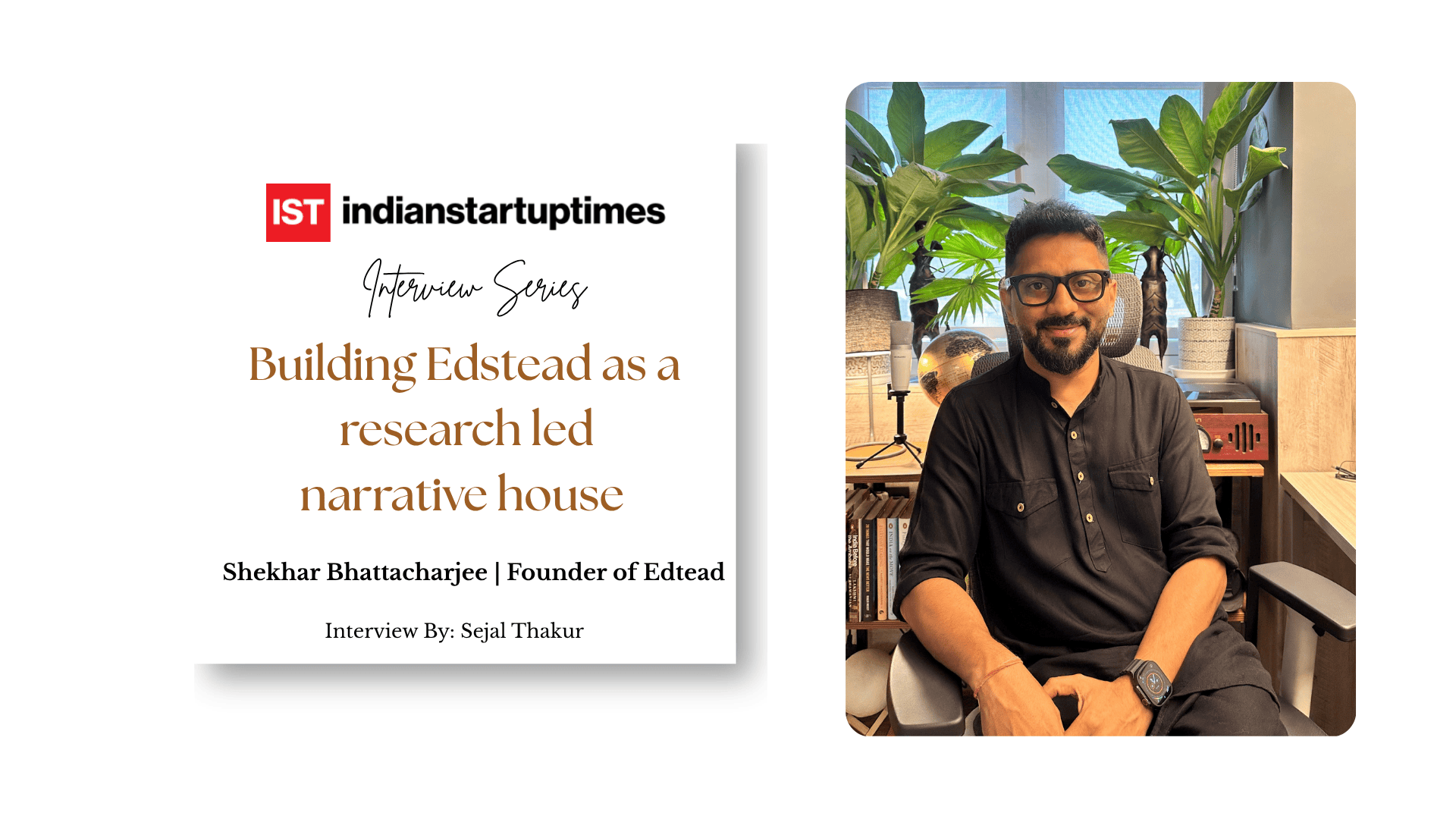
In an exclusive interview with Indian Startup Times, Shekhar Bhattacharjee, founder of Edstead, discusses his journey from education-focused documentaries to building a research-led storytelling platform that spans fintech, jewelry, the space economy and sports. He explains why intent matters more than initial capital, how culture-led narratives can cut through noise, and why he wants Edstead to be remembered as a house that tells deep, sector-specific stories instead of surface-level content.
Indian Startup Times: You began your journey in the education ecosystem in 2012 through Skill Tree and a TV show called Great Place to Study. What inspired that early focus on educational storytelling?
Shekhar: I was inspired by the show Young Turks on CNBC to tell stories about school and university leaders. I launched Great Place to Study on ET Now and Times Now to provide authentic video insights into educational institutions. My primary motivation stemmed from seeing a disconnect between college brochures and actual campus realities during my undergraduate years. I wanted to move beyond brochure-based information and offer authentic visual storytelling about what campuses were really like.
Indian Startup Times: After producing over 350 stories, what were your key observations about India’s education system?
Shekhar: After years of filming across institutions, I observed that education quality in India is heavily dictated by financial systems and fees. There is a significant diversity gap where access to quality resources varies wildly based on socio-economic status. I expressed a desire for the democratization of education to make it more affordable through government support for private ecosystems. The gap between what students are promised and what they actually experience was far too large.
Indian Startup Times: How did those experiences lead to the founding of Edstead, and what does the name stand for?
Shekhar: Edstead was born from my experiences with previous organizations like Great Place to Study and Dalham. The name Edstead is an abbreviation derived from Education Stories (EDST) and Entertainment, Art, and Digital (EAD). I learned that products should be released early to find their shape rather than waiting for perfection. A core business philosophy for me is prioritizing the recruitment of a strong, reliable team over micromanagement. Those lessons shaped how we approached Edstead from day one.
Indian Startup Times: You scaled Great Place to Study into an international entity operating in 11 countries without outside funding. How did that shape your view on capital versus intent?
Shekhar: I emphasize that intent is more critical than capital when building and scaling a business. Edstead started with zero external funding, utilizing an email ID and existing connections to secure initial work. A partnership with Nat Geo helped generate the necessary capital to build the current team after leaving my previous role in September 2022. I successfully scaled Great Place to Study into an international entity operating in 11 countries without outside funding. When your intent is clear and your team is strong, capital tends to follow.
Indian Startup Times: Edstead operates as a service-led industry that uses deep research to build credibility across domains like fintech, jewelry and the space economy. How do you establish trust in such diverse sectors?
Shekhar: Trust in Edstead was established through my established relation within the educational fraternity from my past ventures. The platform builds credibility across diverse sectors like fintech, jewelry, and space economy by conducting deep research before ideating shows. This research-driven approach allows Edstead to expand its reach beyond its original niche of education into broader industries. We do not start with a narrative. We start with research, and the narrative emerges from that.
Indian Startup Times: You talk about culture-led storytelling and projects like Voices of the Land, which adopts a slow-paced, analog style. Why this approach in a fast, digital-first world?
Shekhar: I view art not as a problem solver but as a medium that connects people, society, and culture. Through projects like Voices of the Land, I use culture-led storytelling to tap into the growing interest in roots and slow living among Gen Z and Gen Alpha. I advocate for brands to use storytelling to connect with audience values rather than just pushing products. In a world of constant noise, slow, rooted stories stand out because they feel real.
Indian Startup Times: What are some of the current projects Edstead is working on, and how do they fit into your broader strategy?
Shekhar: Edstead aims to bring storytelling to the forefront of various sectors. We are currently developing concepts across the Sports, Education and Entertainment industries. Our business model is to operate as a service-led industry that utilizes deep research to build credibility across different domains. Each project is an opportunity to go deeper into a sector and tell stories that traditional media often overlooks.
Indian Startup Times: What is your long-term vision for Edstead, and how do you want the brand to be remembered?
Shekhar: The company aims to lead in sector-focused storytelling by constantly discovering new avenues like the sports economy via Game on India. I am currently developing a new product that merges entertainment and education under a different brand identity. My long-term goal is to leave a legacy as a research-led storyteller who avoids surface-level content in favor of deep engagement. I want Edstead to be known as a Studio that celebrates aspects of society and industry that are often ignored, through stories that are researched, respectful and memorable.
Indian Startup Times: If there is one lesson from your entrepreneurial journey that you want aspiring founders to take away, what would it be?
Shekhar: Intent is more critical than initial capital for scaling a business. Hire a strong team and trust them. Release your product early to find its shape instead of waiting for perfection. And always start with research, not with a narrative. If you do that consistently, the stories and the business will follow.
Interview By: Sejal Thakur