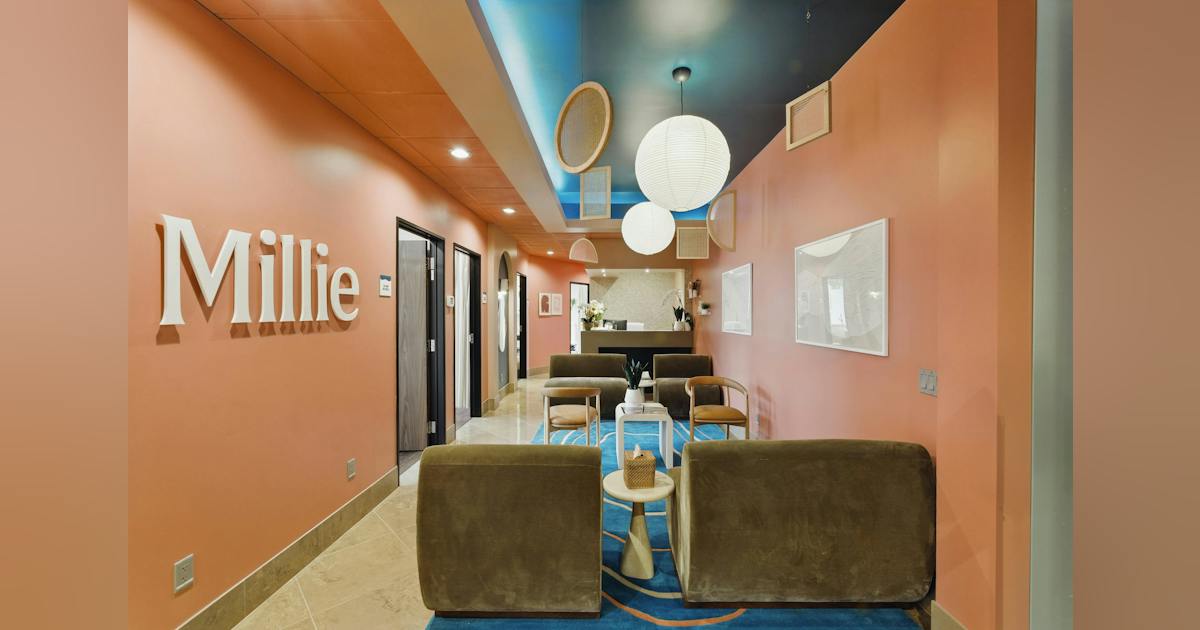
Millie, a tech-enabled women’s health clinic startup, and El Camino Health are launching a joint maternity clinic, which will open in Palo Alto, California, in late November. Millie founder and CEO Anu Sharma recently spoke with Healthcare Innovation about the potential for combining Millie’s midwifery-led care model with El Camino Health’s maternity services.
The Palo Alto clinic is expected to be the first of a larger footprint of clinics that Millie and El Camino Health plan to open in the Silicon Valley and Bay Area.
Healthcare Innovation: Could you talk about why you founded the Millie clinics and how that led to partnerships with health systems, including El Camino?
Sharma: When you really look at the state of maternity care in the U.S., it’s a model of care that has not actually evolved for about 75 years. It’s a handful of visits at pre-specified intervals, broken up into trimesters. Then you have a baby, and it all wraps up with a single visit at the six-week postpartum point. We don’t really have much by way of postpartum care, and it’s strictly speaking clinical only. It’s all about lab scans and visits. But care is more than just clinical care. There’s a lot of need for education, emotional support, lactation, nutrition, and mental health. These are things that people have historically pieced together on their own, so it makes for a somewhat unsatisfying patient journey.
Second, and perhaps more importantly, is that when you look at how risk is distributed over the maternity episode, at a population level, something like 75 to 80% of pregnancies are low risk. 10 to 15% are moderate risk, and maybe 5 to 7% or at most 10% tend to be high risk. When you look at peer nations around the world, frontline care and maternity is led by midwives, not OBs. That is something in the U.S. we have not done. The reason why that matters is because for low- to moderate-risk pregnancies, midwives are actually the right provider for care. You will see better outcomes, less intervention, higher rates of vaginal births, fewer C-sections. So we somewhat over-medicalize pregnancies in the U.S. Also, we just don’t have enough OBs to go around. A third of the country is officially in maternity care deserts because of the lack of OBs. Midwives being underutilized in a world where we don’t have enough OBs magnifies the issue and perpetuates a gap in access to care.
HCI: The other thing we hear a lot about are the disparities in maternal morbidity and mortality.
Sharma: Yes, we do have significant racial disparities, and some of that you could superimpose upon markets that have less access. It is true that people of color, particularly Black people, tend to have considerably worse outcomes in the U.S. And they tend to overlap in markets where OB access issues are more magnified, in large part because these also tend to be Medicaid markets. Maternity reimbursements are a problem, but Medicaid reimbursements are a particular problem.
We felt we needed a model that is more complete and addresses the totality of the care that people need, not just clinical pieces only, is more continuous, including in that postpartum period, and is more proactive in the early detection of risk. That’s what we set out to build with Millie.
We wanted to create a more patient-centered model, but also to have better outcomes measured in terms of C-Sections, pre-term births, NICU stays, maternal mental health, and overall better well-being for mother and baby as they make the transition into parenthood. So that’s really what we built, and I think we proved it out. It’s a midwifery-led model, but with OB support layered into it for patients who might need it. We use technology to knit together all the pieces into one unified, continuous journey and also to manage inter-visit risk.
HCI: It sounds like being more proactive is helpful and would lead to better outcomes and perhaps cost savings as well. But do you have to demonstrate that to payers before they’re willing to pay for some of this and do you partner with them? I saw that you partnered with UCSF and became part of their clinically integrated network, and now you’re partnering with El Camino Health. But is there a need to to get the payers on board with this, too?
Sharma: Yes. We launched our first clinic in Berkeley in 2022. When we did that, in order to even demonstrate this model of care we had to build a clinical model. We had to build the operations, the technology, the patient experience, the patient acquisition side, the clinical integration with health systems, because we only deliver in hospital settings. We had to do all of that, and we had to get in-network with all the major insurance plans, because how else would patients come? No one is going to pay for this out of pocket. It’s not reasonable. Also, there’s a lot of care to coordinate, between labor and delivery and any specialty care that people might need.
We have from day one been in-network with the payers, including Medicaid payers, in this market, and we deliver actuarial savings in the range of 12 to 14% consistently. So what we have done is good for payers.
As we thought about scaling Millie, we had two choices: We could either build a collection of clinics and continue to partner with payers or we could think about how we might work more closely with health systems who were dealing with major instability in the service line, given OB shortages, which create access issues, quality-of-care issues, and opens them up to risk. Plus, they were also dealing with a new kind of patient who just wants to be cared for differently. We thought if we could partner with them more closely, perhaps we could become an extension of the service line in a more clinically integrated way.
The first of those partnerships was with UCSF. We are integrated clinically, but we’re also integrated with all their payers, and that really helps us create a full continuum of care, with access to specialty care, all on a single EHR, with seamless payer contracts. With El Camino, we’re doing something similar, but we’re going further. We’re basically building joint maternity clinics that will be co-branded and bring the best of both models to their patient population So this is how we are going to scale. We’re working with the healthcare infrastructure, and creating deep clinical integration and addressing the OB access issues that health systems are facing.
HCI: Was there complexity to negotiating the financial part of the relationship between Millie and El Camino about creating joint clinics?
Sharma: It’s less complex than people think. There has been a long precedence around health systems partnering with other organizations. You see affiliations and joint ventures. It is more about thinking through what’s the right partnership construct that allows us to achieve the goals that the organizations are trying to achieve.
HCI: Do you think we’re seeing more health systems being open to these kind of partnerships with startups?
Sharma: Yes, I would very much say so. In our case, we are talking to a very broad set of health systems, and we’ll be making more announcements. Some health systems may think we can build this. We’re a large, massively resourced health system. What’s the big deal? We’re just going to go hire a couple of midwives and have them work alongside our OBs. You can certainly take that view. But then there are others who realize that building something like this is actually much more complex. Health systems are really good at doing many things, but building patient-centered models may or may not be what they’re necessarily excellent at. What they often find is that working with a company that has built it, done it, and proven it can often help them get further faster with better results.