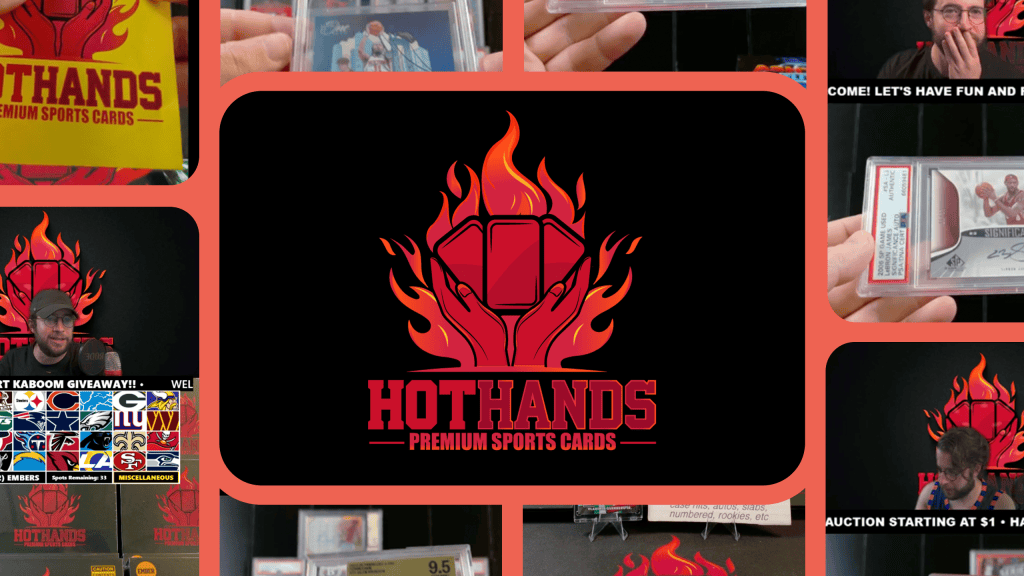
It’s a few minutes after 10 a.m. on a Wednesday in October, and Ben Zucker appears to be frustrated. The founder of collectibles startup Hot Hands Sports is livestreaming on TikTok to an audience of about 60 viewers, and he’s trying to entice the crowd to purchase a spot in an upcoming break, a term for opening sports trading card packs or boxes after selling off the contents sight unseen. But other than one overzealous user, who bought multiple entries, the sales pitch is taking a moment to sink in.
“I guess nobody wants a $2,000 card for $40,” he quipped on the broadcast.
In this particular scenario, he’s auctioning off the rights to 10 “Spark” packs, a product his company created that retails for $129.99 and features a single repackaged card that’s advertised to be worth as little as $20 and as much as $2,000. Fortunately for Zucker, all 33 places on the board, which each correspond to a group of teams mostly from the same city, are successfully sold within minutes. At prices ranging from $26 to $131, Zucker’s total haul for the exercise runs over $1,700.
He opens the packs, and 10 lucky participants receive rewards that included cards autographed by Tom Glavine, Tyler Warren and Tony Parker. Everyone else gets a lower-value consolation prize, otherwise known as a “skunk pack.”
Breaking accounts for roughly 90% of Hot Hands Sports’ business, which is why the company goes live five days a week for about eight hours at a time, with some evening sessions. And it’s been quite lucrative. The company crossed $1 million in revenue just 12 months after launching its stream in May 2025. Now, Hot Hands Sports is generating roughly $400,000 a month and is on pace to reach a topline of $5 million annually. The business has been profitable from day one.
But to be clear, Zucker and his company didn’t invent, or even popularize, breaking. The collectibles industry, once a niche hobby, has boomed since the pandemic with the help of marketing that emphasizes huge potential monetary wins.
The advent of livestreaming e-commerce platforms has only bolstered that proposition. The TikTok Shop, eBay Live, WhatNot and other services have reimagined the concept of direct-to-consumer sales, allowing creators to transform the experience of unwrapping sports cards into an amalgamation of home shopping and playing the lottery. That, in turn, has given rise to a cottage industry of broadcasting breakers, and in less than two years, Hot Hands Sports has carved out its own place.
“There is a ton a competition, and that’s why setting yourself apart with entertaining breakers and a product with a true guarantee, never going below that floor, matters,” Zucker said. “That aspect of trust is very important in this industry.”
Zucker’s original vision wasn’t so heavily invested in putting himself on camera and breaking packs, though. The 30-year-old, who previously worked in sales for a digital marketing company, said he wanted to create quality and affordable repacks—offerings pulled from their original packaging and curated by a third party—to sell to existing breakers. In December 2024, Hot Hands Sports landed two clients, only for that well to dry up five months later.
Looking back, Zucker called the setback the “best thing that happened to us, because it pushed us to open up our own live stream and really be in charge of our own audience.”
Ashtag, Hot Hands Sports’ flagship product—which sells for $39.99, includes one card, guarantees an autograph and claims a value floor of $5 and a ceiling of $1,000—quickly went viral, he said, and helped establish the company.
It has since added four other products at higher prices—the Spark, the Ashtag Elite, the Ember and the Molten Mint—with a sixth on the way.
Zucker has even more ambitious growth plans on the horizon. He wants Hot Hands Sports to expand from nine daily breaks to 15, extend the daily livestream window to midnight and broadcast on weekends. There’s also a software play: Zucker built the business’ back-end system using Claude, Anthropic’s AI tool, and that could become something the company licenses to other breakers down the line.
“You’d be surprised how many hundred-million-dollar breaking companies are using Google Sheets as their backend to manage all of it,” he said. “I think that every single breaker, whether you’re on TikTok or WhatNot, whether you’re doing $10,000 a month or $10 million a month, should have a significantly better operational backend.”
And while the company has mostly operated on TikTok thus far, it’s in the process of getting approved to sell on WhatNot, the industry behemoth that raised $545 million at $20 billion in August and generated $8 billion worth of sales, 20 million new accounts and 332 million viewing hours in 2025. One brick-and-mortar card shop in Boca Raton, Fla., for example, grew monthly revenues from $40,000 to $1.5 million after joining WhatNot, according to the company’s most recent State of Live Selling report.
“I love WhatNot, I got on WhatNot and eBay Live and that kind of thing because I could talk to my customer, get the feedback, hear what they want and give them deals,” Brandon Steiner, an industry veteran and the CEO of The Steiner Agency and CollectibleXchange, said. “I cut out some of the middle part of it. I could sell direct to consumer.”
That’s not to say Steiner isn’t concerned with where the industry is going and its impact on younger consumers, especially since he likens breaking and other aspects of the hobby to gambling, a claim some prominent operators dispute.
“We all thought when we were young and we went to the blackjack table, we were going to win, but the casinos always win. At least you know the odds on a blackjack table,” he said. “You don’t really know your odds when you’re going and buying these packs and these breaks.”
Zucker doesn’t dismiss those gambling concerns, and he’s adamant that the onus is on Hot Hands Sports and other breakers to remain fair and transparent. That’s just one of a plethora of obstacles in the business, which include manufacturers flooding the market with cards, cyclical shifts in the value of these assets, a lack of regulation on repackaged products and a heavy dependence on livestreaming e-commerce platforms.
Still, those challenges don’t give Zucker any pause about just how big Hot Hand Sports can become.
“Without saying the sky’s the limit,” he said, “I think we can go pretty far.”