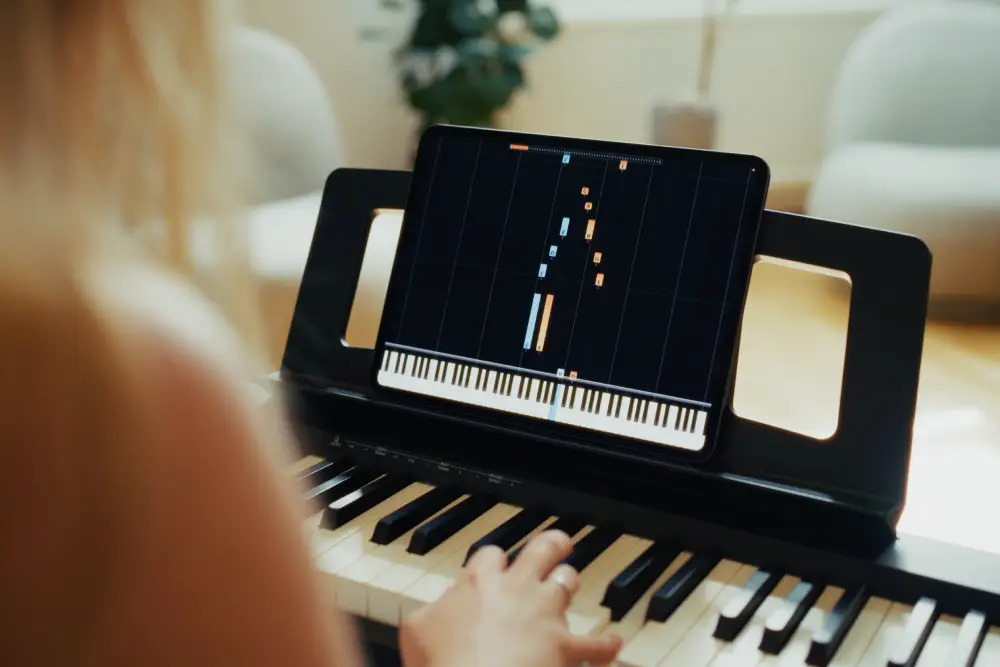
Learning to play the piano could become much easier thanks to artificial intelligence, with music education startup ArtMaster raising $2.4 million to expand its AI-powered piano learning app, Artie.
The Prague-based company has secured fresh investment from several major technology and music industry figures, including music technology company Moises and investors previously involved with Spotify, Google and other leading technology businesses.
ArtMaster has also previously received backing from Warner Music Group CEO Robert Kyncl and Beat Saber co-founder Jaroslav Beck.
The new funding will support the development of AI technology designed to make learning an instrument more personalised, affordable and accessible.
What Is Artie, the AI Piano Learning App?
Artie is an AI-powered piano learning app that listens to people play and provides personalised feedback to help them improve.
Unlike traditional online piano lessons, which generally follow a fixed course or prerecorded videos, Artie adapts its guidance based on how someone actually performs.
The app can identify mistakes, provide feedback on rhythm and accuracy, and guide learners through songs at their own pace.
Users can place their iPhone or iPad next to a piano or keyboard, with the app listening through the device’s microphone. Compatible digital instruments can also connect through MIDI.
Artie then analyses the performance and helps users identify areas that need improvement.
The platform is particularly focused on beginners who want to learn familiar songs rather than spend months working through traditional exercises before playing music they recognise.
ArtMaster Secures $2.4 Million From Major Music and Technology Investors
ArtMaster’s latest $2.4 million seed funding round was led by Factorial Capital, with participation from Reflex Capital and AI music technology company Moises.
Other investors include Nir Zicherman, co-founder of podcast platform Anchor, which Spotify acquired in 2019, and Grant Davis, founder of AI creative platform Wand.
Google DeepMind’s Eliška Vorel also participated in the round.
The investment follows earlier support from Warner Music Group CEO Robert Kyncl and Jaroslav Beck, a co-founder of Beat Games, the company behind the popular virtual reality game Beat Saber.
The involvement of both music industry executives and AI technology investors highlights growing interest in using artificial intelligence to improve how people learn creative skills.
Moises, which has developed tools including AI-powered stem separation and chord recognition, is particularly relevant to ArtMaster’s ambitions.
Both companies are exploring ways to use AI to make music more accessible, although Artie focuses specifically on learning and practising instruments.
Artie Has Already Attracted More Than 500,000 Users
ArtMaster reports that Artie has attracted more than 500,000 users during its first year.
The company also says its content has generated over 100 million views across social media platforms, helping introduce the app to a global audience.
According to ArtMaster, paying subscriber numbers have experienced average month-on-month growth of 38% since October 2025, while monthly recurring revenue has grown by 39% per month over the same period.
The company has not disclosed its total number of paying subscribers or absolute revenue figures.
User engagement is another encouraging sign. ArtMaster reports that its most active 10% of users spend an average of 36 minutes per learning session.
These figures suggest that AI-powered learning could become an increasingly popular alternative or companion to traditional music lessons.
How AI Could Change the Way People Learn Piano
One of ArtMaster’s biggest ambitions is to move beyond simply identifying mistakes.
As the company’s AI technology improves, Artie is expected to generate personalised exercises and adjust lessons based on individual performance.
For example, someone struggling to play a difficult section of a song could receive a simplified version of that passage, followed by exercises targeting the specific skills they need to improve.
The difficulty could then increase gradually as the learner becomes more confident.
This approach would make the learning experience more responsive than traditional video courses, where everyone typically receives the same instructions regardless of their progress.
It could also help solve one of the biggest challenges for beginner musicians: knowing exactly what to practise next.
Rather than repeatedly attempting an entire song, learners could focus on the individual skills holding them back.
These more advanced AI-generated learning capabilities are part of ArtMaster’s development plans, rather than features that are necessarily available in the current version.
From a Traditional Music School to an AI Startup
ArtMaster was founded by Radim Vysoký and Michal Novák, who originally established a music school in Prague in 2018.
The company began expanding its online education offering during the COVID-19 pandemic, producing video lessons for students unable to attend classes in person.
However, the founders recognised a major limitation of online music education.
Although recorded lessons could demonstrate techniques and explain musical concepts, they could not respond to the individual mistakes students made during practice.
Artie was developed to address that problem by combining structured lessons with personalised feedback.
The goal is to give independent learners some of the guidance traditionally available through private tuition, without requiring a teacher to be present for every practice session.
Is the Artie Piano App Free?
Artie is currently available on iPhone and iPad through Apple’s App Store.
The app is free to download and includes a selection of learning content, although additional songs and features require a paid subscription.
It offers beginner-friendly lessons, different difficulty levels, personalised learning paths and tools that allow users to slow down songs or repeat difficult sections.
Learners can also import supported MIDI and MusicXML files, making it possible to practise music beyond the app’s existing song library.
An Android version is planned, alongside support for additional instruments.
Users can find out more through the official ArtMaster website.
AI Music Lessons Could Soon Expand Beyond Piano
Although Artie currently focuses on piano, ArtMaster has plans to bring its AI learning technology to other instruments.
Guitar is among the instruments being considered for future development.
The company’s longer-term vision extends beyond music, with the founders believing that personalised AI feedback could help people develop other creative and practical skills.
Music provides an interesting starting point because learning an instrument requires a combination of physical coordination, listening, memory and technical understanding.
AI systems capable of analysing these abilities and adjusting learning programmes could eventually be adapted to other areas of education.
Will AI Replace Traditional Piano Teachers?
The growth of AI piano learning apps raises an interesting question about the future of traditional music lessons.
Apps such as Artie offer several advantages, particularly for beginners who want to learn independently.
They allow people to practise whenever they want, provide immediate feedback and can potentially make music education more affordable.
However, human teachers still offer important benefits, including personalised advice on physical technique, musical expression and performance.
AI systems may struggle to identify every issue with posture, tension, touch or interpretation, particularly as students develop more advanced skills.
Rather than completely replacing music teachers, AI learning platforms could become valuable tools that support independent practice between lessons.
For people who might never have considered paying for private tuition, they could also provide an accessible introduction to playing an instrument.
The Future of AI-Powered Music Education
ArtMaster’s latest investment reflects a broader shift in how artificial intelligence is being used throughout the music industry.
While much of the conversation around AI has focused on generating songs and replacing human creativity, companies such as ArtMaster are exploring technology that helps people develop their own musical abilities.
The distinction is important.
Instead of creating music on behalf of a user, Artie is designed to help people learn how to play music themselves.
With more than 500,000 reported users, growing investor interest and plans to expand beyond piano, ArtMaster could become an important name in the emerging AI music education market.
For anyone who has always wanted to learn an instrument but struggled to find the time, money or motivation, AI-powered lessons could make getting started easier than ever.