


The question of when India’s Unified Payments Interface (UPI) will finally be monetised has remained at the centre of the fintech industry’s conversations over the past month.
The debate intensified after the National Payments Corporation of India (NPCI) deferred the introduction of merchant discount rate (MDR) charges on select UPI person-to-merchant (P2M) transactions.
Earlier reports suggested that the rollout could be pushed to January 2027. However, the framework now appears likely to be introduced after Diwali, with the industry awaiting a final announcement.
Under the proposed framework, eligible P2M UPI transactions above ₹2,000 would attract an MDR fee of 0.40%, capped at ₹300 per transaction. The proposal has drawn resistance from retail traders, who argue that the charges would add to their operating costs.
The All India Mobile Retailers Association (AIMRA) and the All India Consumer Products Distributors Federation (AICPDF) also called for a ‘No UPI Day’ protest, but eventually withdrew the proposal following a meeting with finance minister Nirmala Sitharaman. Separately, advocate Anjan Datta filed a public interest litigation (PIL) challenging the policy in the Supreme Court. The apex court, however, declined to stay the proposed MDR charges.
Meanwhile, UPI transaction volumes and values declined month-on-month (MoM) in September. The number of transactions fell nearly 1.8% to 24.07 Bn, while their cumulative value dropped 1.5% to ₹29.37 Lakh Cr.
However, the decline that followed August was met with an all-time high in monthly transaction volumes. Average daily UPI transactions increased to 802 Mn in September from 791 Mn in August, while the average daily transaction value rose to ₹97,913 Cr from ₹96,205 Cr.
For banks, payment companies and third-party application providers (TPAPs), the proposed MDR framework could open up a new revenue stream in a market where monetisation has remained a persistent challenge.
Meanwhile, the uncertainty around the rollout has also weighed on listed fintech companies. Reports of a delay in MDR implementation triggered declines in the stocks of Paytm, Pine Labs and MobiKwik, underlining the potential impact of UPI monetisation on the broader payments ecosystem.
As the industry awaits greater clarity on the future of UPI and the economics of digital payments, we are back with the October edition of Five Fintech Startups To Watch. This monthly series spotlights startups operating in some of the most promising and fast-evolving segments of India’s fintech ecosystem.
With that, here are five interesting ventures that caught our attention this month.
Editor’s Note: The list below is not a ranking of any kind. Startups have been listed alphabetically.
Falling behind on loan repayments can quickly turn into a stressful cycle of recovery calls, mounting worries about credit scores and uncertainty over what to do next. For many borrowers, negotiating with lenders, exploring settlement options and dealing with legal notices can be just as daunting as the debt itself.
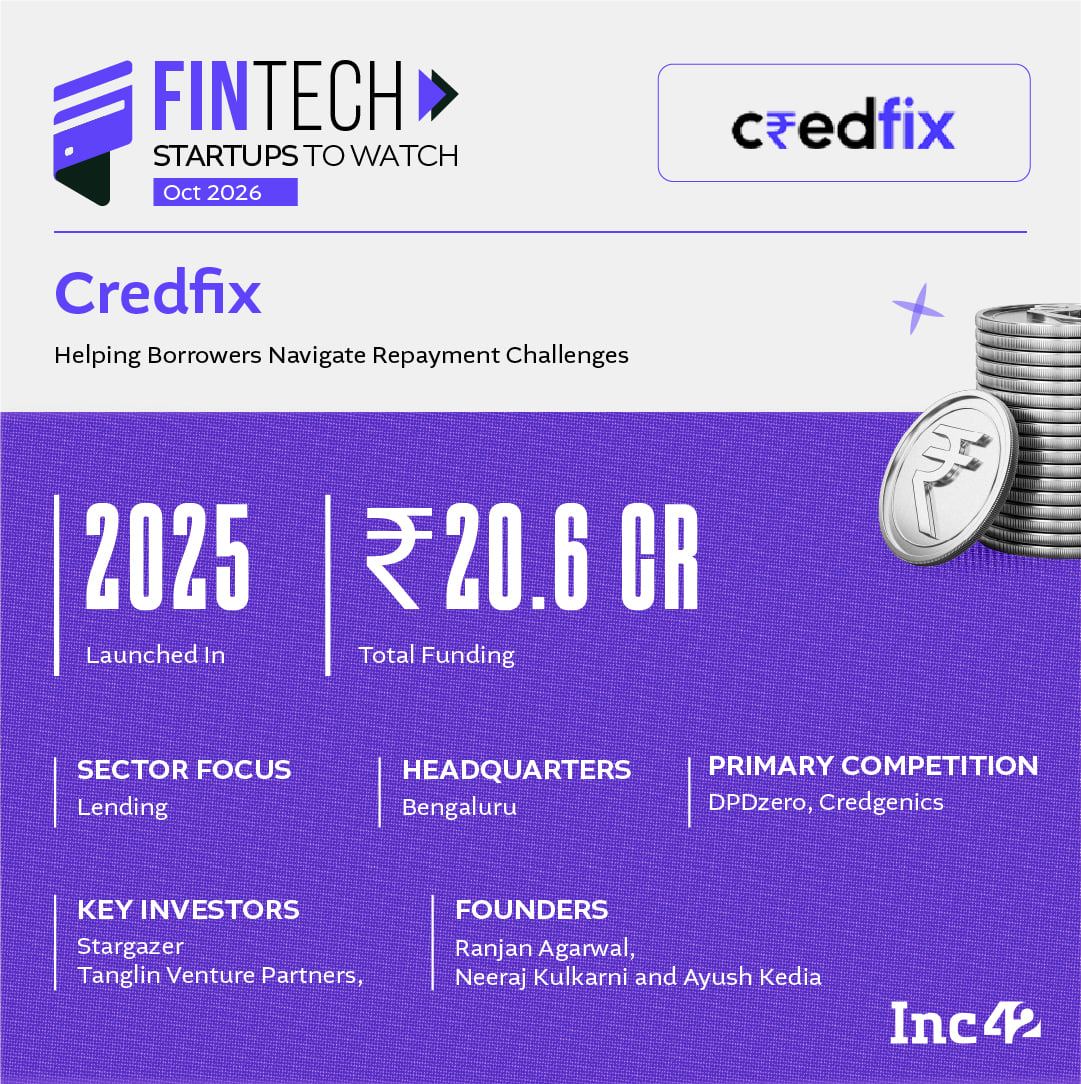
In India’s about $200 Mn debt collection software market, Bengaluru-based Credfix is trying to help borrowers deal with debt through an AI-powered platform. Founded in 2025 by Ranjan Agarwal, Neeraj Kulkarni and Ayush Kedia, Credfix helps borrowers understand their financial situation and explore ways to repay or settle their outstanding loans. It also helps lenders recover money from borrowers who are struggling to pay.
The startup currently serves over 2 Lakh borrowers with total outstanding debt of more than ₹4,000 Cr. Around 40% of its users are from tier II and tier III cities.
Credfix combines AI-powered tools with human support to help borrowers at different stages of the debt repayment process. Its Risi AI assistant offers guidance on available settlement options, responding to legal notices and dealing with recovery agents.
The startup also helps borrowers negotiate one-time settlements, where lenders agree to close a loan for less than the total amount owed. In addition, it explains borrowers’ rights and provides step-by-step guidance on rebuilding their CIBIL scores after settling their loans.
A person’s wealth is often spread across multiple bank accounts, investments, insurance policies and other assets. Keeping track of everything can make it difficult to know how much they own, how much they owe and how their overall financial position is changing.
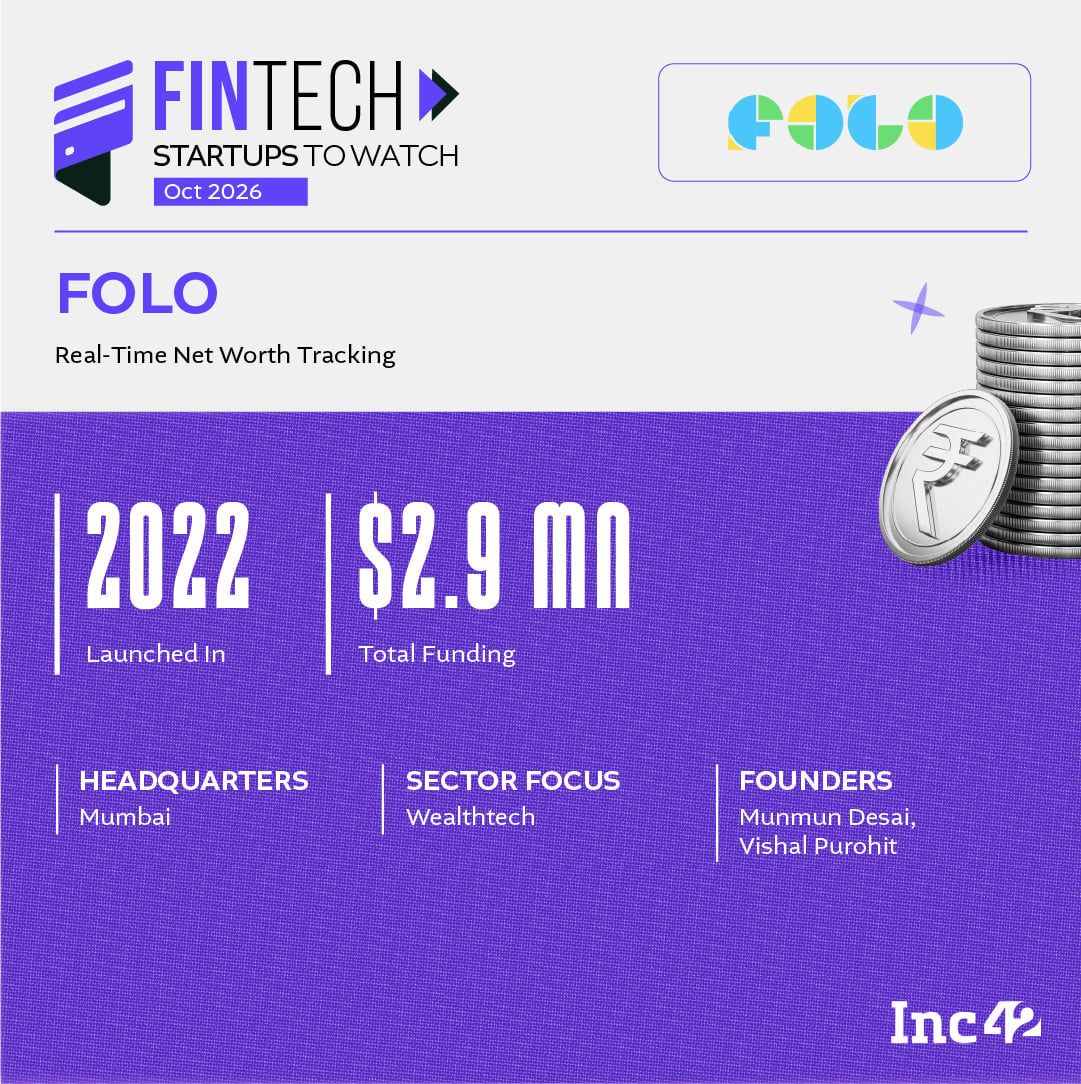
FOLO, short for Family Of Loved Ones, is trying to solve this problem with an app that brings a person’s financial information together in one place. Founded in 2022 by Munmun Desai and Vishal Purohit, the startup operates in India’s $171.2 Bn wealth management market, which is projected to grow at over 10.6% annually over the next eight years. It has raised over $2.9 Mn in funding so far.
FOLO is a SEBI-registered investment adviser that collects financial information from more than 650 sources, including bank accounts, mutual funds, stocks, fixed deposits, property, loans, credit cards and insurance policies. This gives users a consolidated view of their assets and liabilities, without having to manually track everything.
The platform uses the account aggregator framework to access financial information in a read-only mode, with users’ consent. It also allows users to share selected financial details with up to four trusted individuals, such as family members or financial advisers, without revealing their account login details.
Beyond tracking wealth, FOLO offers an offline service, called LYNC, to help users transfer their assets to nominees after their death.
The startup claims to have connected assets worth more than ₹20,000 Cr on its platform and crossed 1 Lakh app downloads.
India’s investors are increasingly looking beyond domestic markets to diversify their bets. However, investing in foreign stocks and other assets can be complicated, with hurdles around research, money transfers, taxes and regulatory compliance.
Founded in 2026 by Nishant Bansal, Spring Street is building a platform that gives Indian residents and non-resident Indians (NRIs) access to international markets through managed investment portfolios. Backed by Nexus Venture Partners, the startup is targeting a growing appetite for overseas investments. Indian residents remitted around $2.6 Bn (₹22,000 Cr) for overseas investments in FY26, up nearly 56% from $1.69 Bn in FY25.
Its flagship product, Prisma, offers professionally managed portfolios investing in international stocks, bonds and commodities. These portfolios provide exposure to markets across North America, Europe, Asia and Latin America, with options tailored to investors’ risk appetites and financial goals.
Spring Street also handles overseas investing, from onboarding and identity verification to remittance paperwork and investment tracking. To facilitate investments under the Reserve Bank of India’s Liberalised Remittance Scheme (LRS), the startup has partnered with GIFT City-based ViewTrade, which is regulated by the International Financial Services Centres Authority (IFSCA). ViewTrade acts as the broker and custodian.
Spring Street charges an annual portfolio management fee of 1.25% to 1.50% of assets managed, depending on the portfolio, with no additional commissions on individual trades. Investors need to start with a minimum investment of $500.
Small and medium enterprises (SMEs) often struggle with cash flow when customers take weeks or months to pay their invoices. This can leave businesses short of money to cover everyday expenses or fund their next order. At the same time, retail investors looking beyond traditional investment products have limited access to opportunities linked to short-term business financing.
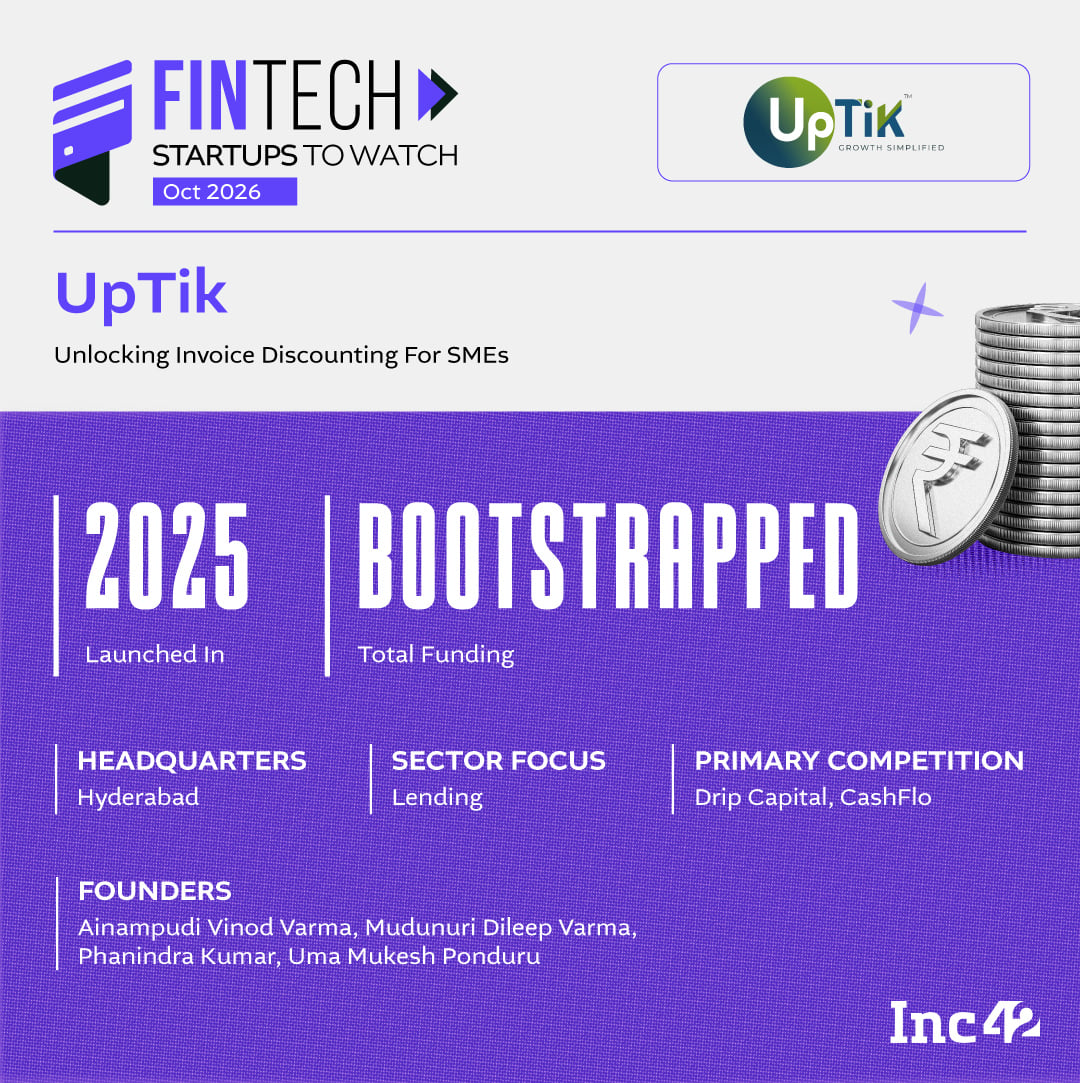
Hyderabad-based UpTik is trying to bridge this gap by connecting investors with businesses seeking working capital. Founded in 2025 by Ainampudi Vinod Varma, Mudunuri Dileep Varma, Phanindra Kumar and Uma Mukesh Ponduru, the startup allows businesses to raise funds against unpaid invoices, while investors can earn returns when those invoices are paid.
UpTik claims to have grown its assets under management (AUM) from ₹6.5 Cr in March 2026 to over ₹25 Cr in September 2026. Monthly disbursements also rose from ₹3.6 Cr to ₹13.3 Cr over the same period.
Through its platform, UpTik offers retail investors, HNIs and institutional investors opportunities to finance verified business invoices. The startup lists investment opportunities with defined tenures and provides details about the underlying transactions, expected returns and associated risks.
Investors must complete KYC checks, while each deal undergoes due diligence and legal screening. Users can also track their investments and request withdrawals of returns to an in-app wallet.
UpTik provides additional protection against defaults on select deals. The startup plans to expand beyond invoice discounting into other alternative investments, including corporate bonds and startup investments.
While wealthy individuals can hire wealth managers to guide their financial decisions, professionals and families with smaller portfolios often have to navigate investment choices on their own.
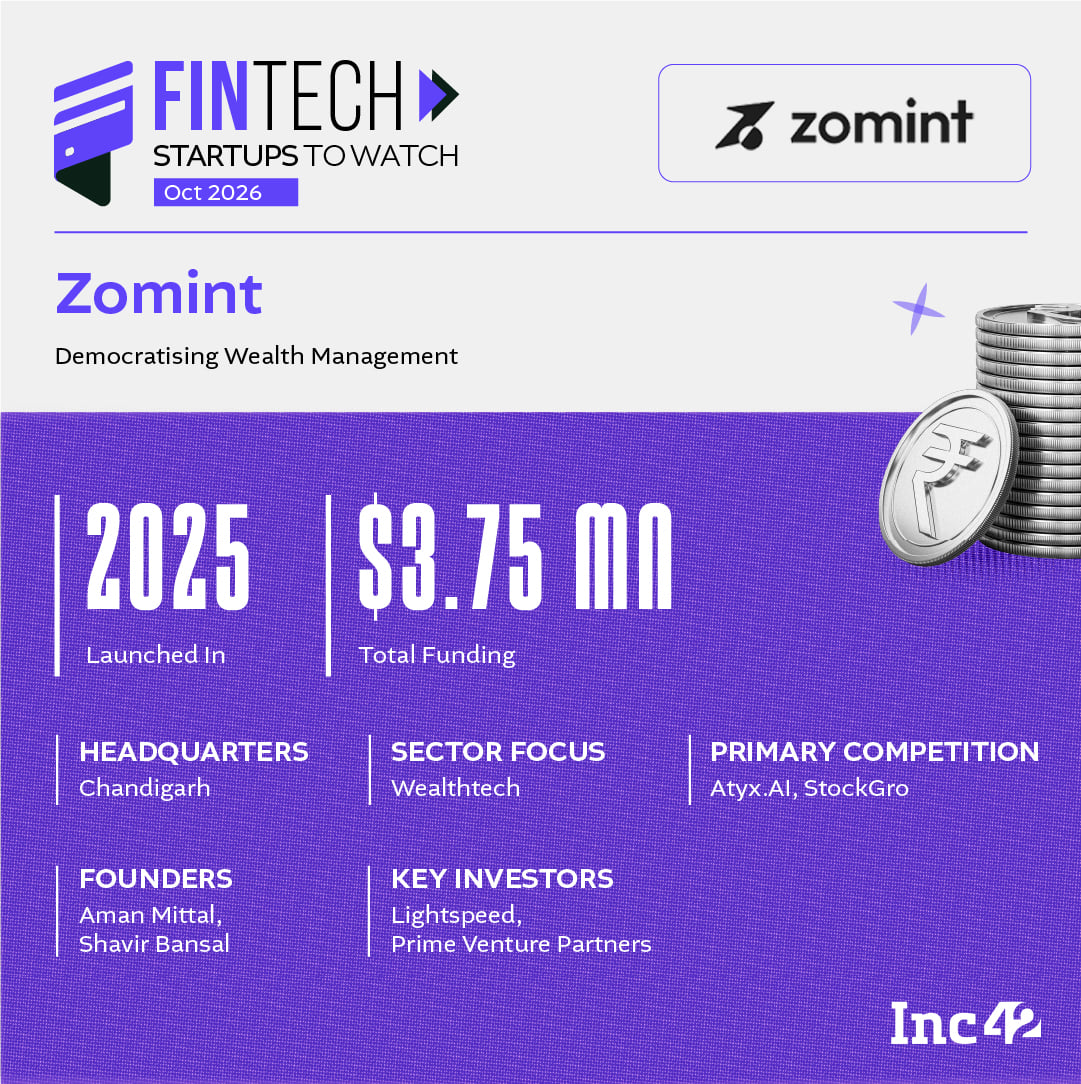
Chandigarh-based Zomint aims to bridge this gap by helping professionals and families manage their wealth through personalised financial advice. Founded in 2025 by Aman Mittal and Shavir Bansal, the wealthtech startup draws on Bansal’s earlier venture, the personal finance content platform Bekifaayati, which claims a community of over 50 Lakh and more than 80 Lakh monthly views. This audience has also helped Zomint build its customer base.
According to a market assessment published in an NSE-hosted document in November 2025, India’s investment and wealth management sector had an estimated annual addressable market of ₹1.1 Lakh Cr in FY25. The assessment projects this to reach ₹2.2 Lakh Cr to ₹2.6 Lakh Cr by FY30.
The startup assigns each customer a dedicated financial expert who uses AI tools and research to track investments, recommend suitable mutual funds and guide financial decisions over time. Its relationship managers currently serve more than 250 families each.
Zomint lets customers start with a monthly systematic investment plan (SIP) of ₹25,000 or a lump-sum investment of ₹5 Lakh. Its investment options include equity, debt and hybrid mutual funds, gold and silver funds, and global investment products available through GIFT City.
Beyond helping customers choose investments, Zomint actively monitors their portfolios and can recommend changes based on market conditions, developments affecting individual funds or shifts in customers’ financial circumstances. This allows the startup to offer ongoing guidance rather than one-time investment recommendations.
Edited by Shishir Parasher
Source link